
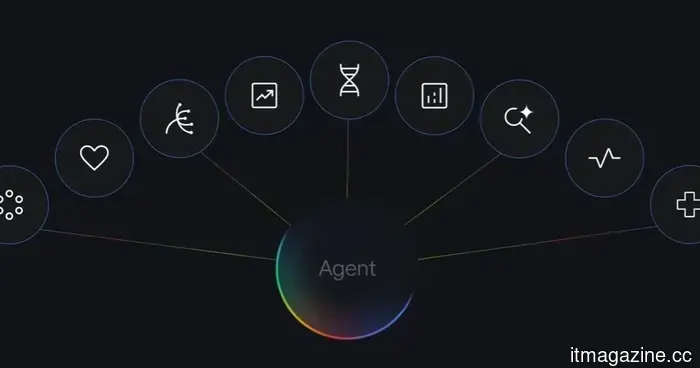
Google aims for Gemini to assist in creating the next major scientific advancement.
Google is integrating Gemini more thoroughly into the research process, beginning with concepts, experiments, and scientific publications.
During Google I/O 2026, the company unveiled Gemini for Science, an experimental toolset centered around agentic AI in science. It aims at addressing the manual tasks involved in discovery, such as hypothesis creation, computational testing, and literature review.
Access will be rolled out gradually via Google Labs, with an alternative option for enterprise organizations through Google Cloud. This rollout provides a pathway for the announcement beyond Google’s conference, although the tools remain in their early stages.
How far can Gemini advance discovery
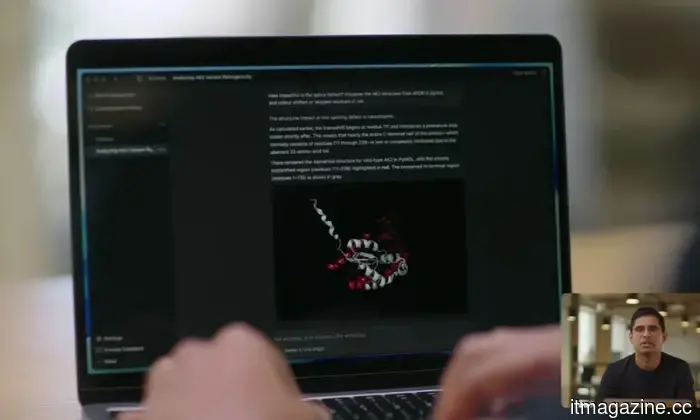
The suite comprises three features that align more closely with the research process than a conventional chatbot. Hypothesis Generation explores extensive collections of papers to assist scientists in generating new ideas, with Google noting that its outputs come with clickable citations.
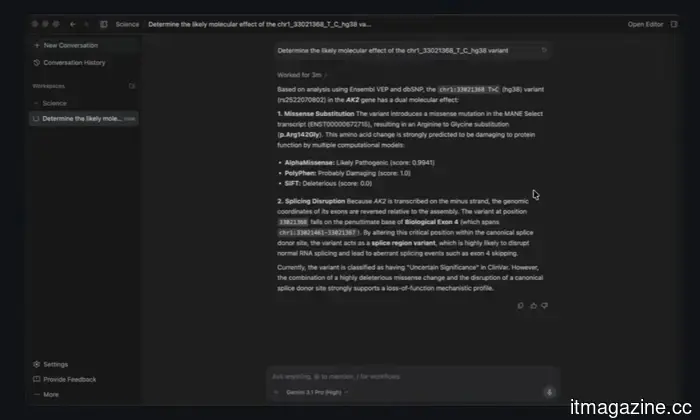
Computational Discovery takes a further step by functioning as an agentic search engine for conducting tests. Rather than requiring teams to design every possible experiment manually, Google asserts that this feature can create thousands of tests significantly more quickly than traditional hands-on approaches.
The third component, Literature Insights, addresses the challenge of reading volume. It enables researchers to query published studies and convert findings into reports, infographics, audio summaries, or video presentations. For laboratories overwhelmed by papers, efficiency begins with reducing the time spent identifying relevant materials.
What distinguishes this from simple search
Google is also introducing Science Skills, a feature intended to extract insights from over 30 key life science databases and research tools. This could enhance the experimental collection’s utility for intricate workflows that typically necessitate scientists navigating between specialized systems.
The launch further illustrates Google’s connection of this release to a broader AI research framework. The company places it alongside initiatives such as Co-Scientist, AlphaEvolve, ERA, and NotebookLM, each targeting different aspects of discovery, reasoning, and research analysis.
The associated risk is significant. If agentic AI in science can expedite routine tasks without compromising rigor, it may allow laboratories to concentrate more on judgment, design, and interpretation.
Who gets early access
Currently, Gemini for Science is not available universally. Google indicates that it is gradually granting access via a form in Google Labs, while enterprise organizations can utilize the toolkit through Google Cloud.
This limited rollout aligns with the risk considerations. AI systems that propose hypotheses, design experiments, and summarize papers require more than just speed. They necessitate clear sourcing, reproducible results, and sufficient transparency for researchers to have confidence in what they observe.
The upcoming challenge is whether Google can effectively integrate agentic AI into genuine scientific workflows once the conference attention dissipates.
Other articles
 Spotify introduces verified podcast badges to ensure you are listening to the authentic host, rather than an AI imitation.
Spotify is introducing verified badges for podcasts and is reinforcing its policies regarding AI voice cloning to ensure that the podcasts you enjoy are truly created by the individuals you believe are behind them.
Spotify introduces verified podcast badges to ensure you are listening to the authentic host, rather than an AI imitation.
Spotify is introducing verified badges for podcasts and is reinforcing its policies regarding AI voice cloning to ensure that the podcasts you enjoy are truly created by the individuals you believe are behind them.
 YouTube has access to Gemini Omni at no cost, but its top AI search features remain locked behind a paywall.
At I/O 2026, Google revealed two major features for YouTube: Omni for Shorts and Ask YouTube for Premium subscribers in the United States.
QIZ Security collaborates with Google Cloud to develop quantum-safe encryption solutions.
QIZ Security partners with Google Cloud to assist businesses in identifying cryptographic vulnerabilities and transitioning to post-quantum encryption before the deadlines become more stringent.
YouTube has access to Gemini Omni at no cost, but its top AI search features remain locked behind a paywall.
At I/O 2026, Google revealed two major features for YouTube: Omni for Shorts and Ask YouTube for Premium subscribers in the United States.
QIZ Security collaborates with Google Cloud to develop quantum-safe encryption solutions.
QIZ Security partners with Google Cloud to assist businesses in identifying cryptographic vulnerabilities and transitioning to post-quantum encryption before the deadlines become more stringent.
 ChatGPT, Claude, Gemini, and Grok are not prepared to inform American voters.
Chatbots cannot be counted on for news accuracy. With the midterm elections 167 days away, we examine what the existing research reveals regarding ChatGPT, Claude, Gemini, and Grok, as well as the actions being taken by the developers.
ChatGPT, Claude, Gemini, and Grok are not prepared to inform American voters.
Chatbots cannot be counted on for news accuracy. With the midterm elections 167 days away, we examine what the existing research reveals regarding ChatGPT, Claude, Gemini, and Grok, as well as the actions being taken by the developers.
 Google aims for Gemini to assist in achieving the next major scientific advancement.
Google's Gemini for Science takes AI further than just summarizing research, introducing experimental tools for generating hypotheses, conducting computational testing, and reviewing literature. The more significant question is whether it can gain credibility within actual laboratories.
Google aims for Gemini to assist in achieving the next major scientific advancement.
Google's Gemini for Science takes AI further than just summarizing research, introducing experimental tools for generating hypotheses, conducting computational testing, and reviewing literature. The more significant question is whether it can gain credibility within actual laboratories.
 Discord calls have finally introduced end-to-end encryption, but your direct messages have not been included.
Discord has completed its multi-year encryption project. Now, all calls are end-to-end encrypted by default across consoles, mobile devices, and browsers. However, there is a caveat that you should be aware of.
Discord calls have finally introduced end-to-end encryption, but your direct messages have not been included.
Discord has completed its multi-year encryption project. Now, all calls are end-to-end encrypted by default across consoles, mobile devices, and browsers. However, there is a caveat that you should be aware of.
Google aims for Gemini to assist in creating the next major scientific advancement.
Google's Gemini for Science extends AI capabilities beyond mere research summaries, offering experimental tools for formulating hypotheses, performing computational tests, and conducting literature reviews. The key question remains whether it can gain confidence within actual laboratories.