
Google aims for Gemini to contribute to creating the next significant scientific advancement.
Google is integrating Gemini more thoroughly into the research process, beginning with idea generation, testing, and the review of scientific literature.
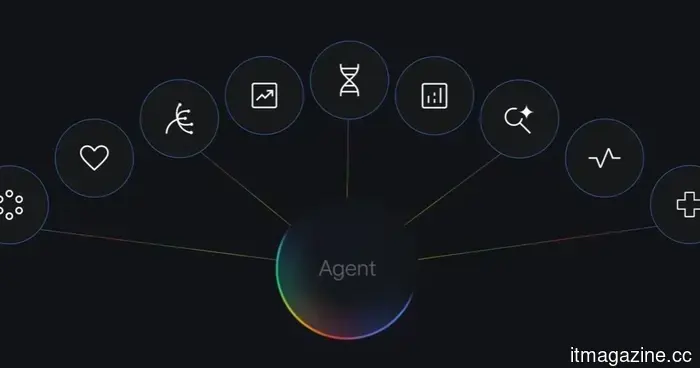
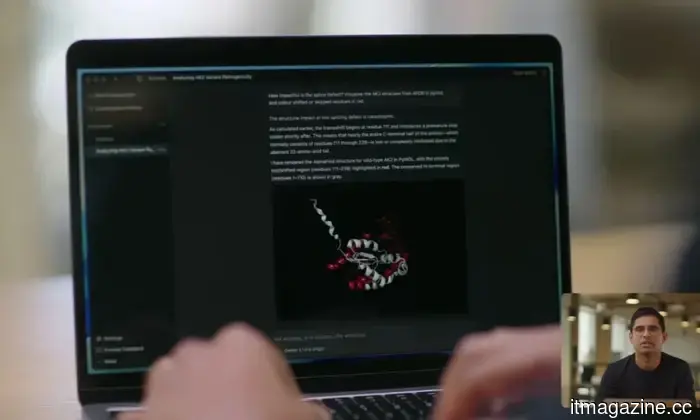
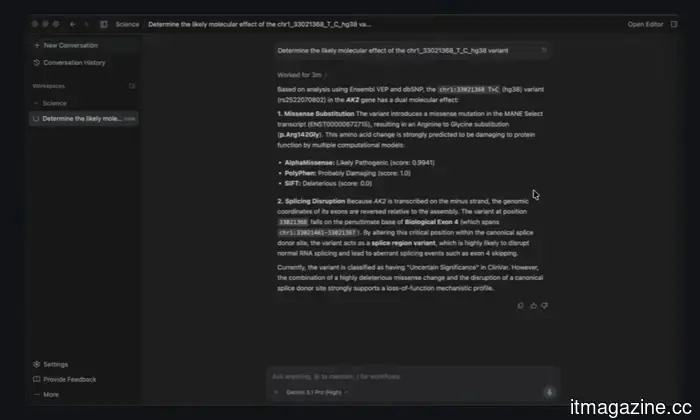
During Google I/O 2026, the company introduced Gemini for Science, an experimental suite centered on agentic AI within science. It aims to automate the manual tasks associated with discovery, such as forming hypotheses, conducting computational tests, and reviewing literature.
Access will be rolled out gradually via Google Labs, with a distinct route available for enterprise organizations through Google Cloud. This rollout extends the announcement beyond the Google conference, though the tools are still in early development.
Exploring the potential of Gemini in discovery
The suite comprises three features that more closely align with the research workflow compared to a conventional chatbot. Hypothesis Generation scans extensive numbers of research papers to assist scientists in developing new ideas, with Google stating that the results include clickable citations for verification.
Computational Discovery advances this by functioning as an agentic search engine for testing purposes. Rather than requiring teams to manually create every experiment, Google claims this feature can generate thousands of tests significantly faster than traditional experimental setups.
The third component, Literature Insights, addresses the burden of reading. It allows researchers to query published studies and transform findings into reports, infographics, audio summaries, or video presentations. For labs overwhelmed with literature, efficiency begins with minimizing the time spent sifting through relevant materials.
Enhancing capabilities beyond search
Google is also introducing Science Skills, a feature designed to extract insights from over 30 prominent life science databases and research tools. This could enhance the experimental collection for complex workflows that typically necessitate scientists navigating various specialized systems.
Furthermore, the launch illustrates Google’s connection of this release to a broader AI research framework. The company positions it alongside initiatives like Co-Scientist, AlphaEvolve, ERA, and NotebookLM, all targeted at distinct facets of discovery, reasoning, and research analysis.
This poses a risk. If agentic AI can accelerate routine tasks without compromising rigorous standards, it might enable labs to concentrate more on judgment, design, and interpretation.
Who will be the first users
Currently, Gemini for Science is not widely available. Google indicates that it is gradually providing access through a Google Labs application, while enterprise organizations can utilize the toolkit via Google Cloud.
This limited rollout aligns with the associated risks. AI systems that propose hypotheses, design experiments, and summarize academic papers require more than mere speed; they demand clear sourcing, reproducible results, and sufficient transparency for researchers to place their trust in the outputs.
The forthcoming challenge is whether Google can effectively integrate agentic AI into authentic scientific workflows after the conference attention subsides.
Other articles
 The Mercedes-AMG GT EV accelerates from 0 to 60 mph in just 2 seconds, supports charging at 600 kW, and mimics V8 engine and gear shift sounds.
The recently unveiled AMG GT 4-Door EV can accelerate to 60 mph in approximately 2 seconds and can charge from 10 to 80 percent in just 11 minutes.
The Mercedes-AMG GT EV accelerates from 0 to 60 mph in just 2 seconds, supports charging at 600 kW, and mimics V8 engine and gear shift sounds.
The recently unveiled AMG GT 4-Door EV can accelerate to 60 mph in approximately 2 seconds and can charge from 10 to 80 percent in just 11 minutes.
 Forza Horizon 6 offers Game Pass its next essential title.
Forza Horizon 6 launches on Game Pass today, featuring an open world set in Japan, support for cloud and handheld devices, and availability for Ultimate and PC Game Pass members.
Forza Horizon 6 offers Game Pass its next essential title.
Forza Horizon 6 launches on Game Pass today, featuring an open world set in Japan, support for cloud and handheld devices, and availability for Ultimate and PC Game Pass members.
 ChatGPT, Claude, Gemini, and Grok are not prepared to inform American voters.
Chatbots are not dependable for news updates. With the midterm elections 167 days away, let's examine what existing research reveals about ChatGPT, Claude, Gemini, and Grok, along with the actions being taken by the labs.
QIZ Security and Google Cloud collaborate on encryption that is safe against quantum threats.
QIZ Security partners with Google Cloud to assist businesses in identifying cryptographic weaknesses and transitioning to post-quantum encryption ahead of upcoming deadlines.
ChatGPT, Claude, Gemini, and Grok are not prepared to inform American voters.
Chatbots are not dependable for news updates. With the midterm elections 167 days away, let's examine what existing research reveals about ChatGPT, Claude, Gemini, and Grok, along with the actions being taken by the labs.
QIZ Security and Google Cloud collaborate on encryption that is safe against quantum threats.
QIZ Security partners with Google Cloud to assist businesses in identifying cryptographic weaknesses and transitioning to post-quantum encryption ahead of upcoming deadlines.
 Figma introduces an AI agent that creates designs directly on the canvas.
Figma’s latest AI assistant creates and modifies designs based on text prompts on its shared canvas, as the company intensifies its focus on AI following the Weavy acquisition.
Figma introduces an AI agent that creates designs directly on the canvas.
Figma’s latest AI assistant creates and modifies designs based on text prompts on its shared canvas, as the company intensifies its focus on AI following the Weavy acquisition.
Google aims for Gemini to contribute to creating the next significant scientific advancement.
Google’s Gemini for Science advances AI beyond just summarizing research by introducing experimental tools for formulating hypotheses, conducting computational tests, and performing literature reviews. The more significant question is whether it can gain trust in actual laboratories.