

Google aims for Gemini to assist in achieving the next major scientific advancement.
Google is integrating Gemini more thoroughly into the research workflow, beginning with concepts, experiments, and academic literature.
During Google I/O 2026, the company introduced Gemini for Science, an experimental suite designed around agentic AI for scientific inquiry. This initiative aims to reduce the manual labor associated with discovery, which includes formulating hypotheses, computational testing, and literature assessment.
Access will be rolled out gradually via Google Labs, with a separate pathway for enterprise users through Google Cloud. This rollout provides a means for the announcement to extend beyond Google's conference stage, although the tools remain in their early stages.
How far can Gemini extend discovery?
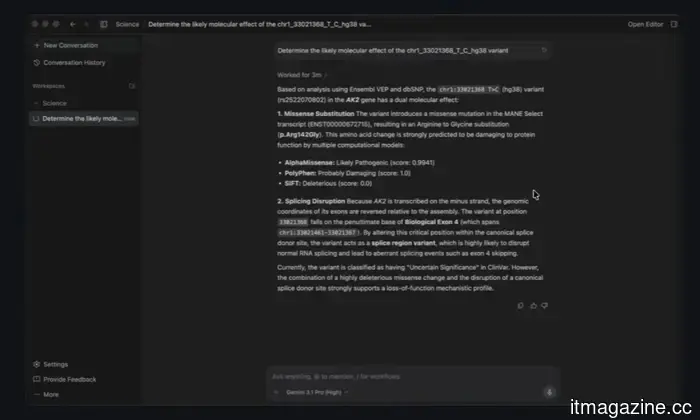
The suite comprises three features that align more closely with the research process than a typical chatbot. Hypothesis Generation scans extensive collections of papers to assist scientists in developing new concepts, with Google asserting that its outputs include clickable citations for support.
Computational Discovery advances this further by functioning as an agentic search engine for experimentation. Rather than having teams manually create every possible experiment, Google claims this feature can rapidly produce thousands of tests, significantly faster than conventional hands-on methods.
The third component, Literature Insights, addresses the challenge of extensive reading. It allows researchers to query published studies and convert findings into reports, infographics, audio summaries, or video presentations. For labs overwhelmed by literature, efficiency begins with minimizing the time required to identify relevant information.
What distinguishes this from mere search?
Google is also introducing Science Skills, a feature aimed at extracting insights from over 30 major life science databases and research tools. This enhancement could make the experimental collection more beneficial for intricate workflows that typically necessitate researchers to navigate between specialized systems.
The launch illustrates Google's connection of this release to a broader AI research framework. The company positions it alongside initiatives such as Co-Scientist, AlphaEvolve, ERA, and NotebookLM, all targeting various aspects of discovery, reasoning, and research evaluation.
This is where the risk lies. If agentic AI for science can accelerate routine tasks without compromising rigor, it may afford laboratories greater opportunity to concentrate on judgment, design, and interpretation.
Who gets to be the first to try it?
At present, Gemini for Science is not universally available. Google states that it is gradually providing access through a Google Labs application, while enterprise organizations will have the opportunity to utilize the toolkit via Google Cloud.
This limited rollout aligns with the risk considerations. AI systems that propose hypotheses, create tests, and summarize literature require more than just speed. They must ensure clear sourcing, reproducible results, and sufficient transparency for researchers to have confidence in what they observe.
The next challenge is whether Google can effectively integrate agentic AI into genuine scientific workflows following the conclusion of the conference spotlight.

Other articles
 GitHub was compromised through a malicious VS Code extension, resulting in the theft of 3,800 repositories.
TeamPCP extracted 3,800 internal GitHub repositories by compromising a VS Code extension. According to the company, no customer data was impacted.
GitHub was compromised through a malicious VS Code extension, resulting in the theft of 3,800 repositories.
TeamPCP extracted 3,800 internal GitHub repositories by compromising a VS Code extension. According to the company, no customer data was impacted.
 YouTube receives Gemini Omni at no cost, but the most advanced AI search functionalities remain accessible only through a subscription.
At I/O 2026, Google unveiled two major features for YouTube: Omni for Shorts and Ask YouTube for Premium subscribers in the United States.
YouTube receives Gemini Omni at no cost, but the most advanced AI search functionalities remain accessible only through a subscription.
At I/O 2026, Google unveiled two major features for YouTube: Omni for Shorts and Ask YouTube for Premium subscribers in the United States.
 French firms have submitted a $10 billion proposal for one of the five AI gigafactory locations planned by the EU.
A French consortium led by Scaleway has submitted a bid of approximately $10 billion to construct one of the AI gigafactories proposed by the European Union.
French firms have submitted a $10 billion proposal for one of the five AI gigafactory locations planned by the EU.
A French consortium led by Scaleway has submitted a bid of approximately $10 billion to construct one of the AI gigafactories proposed by the European Union.
 Spotify introduces verified podcast badges to ensure you're listening to the authentic host rather than an AI replica.
Spotify is introducing verified badges for podcasts and strengthening its regulations on AI voice cloning to ensure that your favorite podcasts are genuinely produced by the individuals you believe are behind them.
Spotify introduces verified podcast badges to ensure you're listening to the authentic host rather than an AI replica.
Spotify is introducing verified badges for podcasts and strengthening its regulations on AI voice cloning to ensure that your favorite podcasts are genuinely produced by the individuals you believe are behind them.
 Wove app examines garments for PFAS and microplastics | TNW
Wove is the inaugural app designed to scan common clothing items for PFAS, microplastics, and concealed toxins, providing safety ratings and cleaner options for consumers.
Wove app examines garments for PFAS and microplastics | TNW
Wove is the inaugural app designed to scan common clothing items for PFAS, microplastics, and concealed toxins, providing safety ratings and cleaner options for consumers.
 Fairplay and NCSE have requested that the FTC look into Roblox regarding child safety concerns and allegations of ‘unfair and deceptive’ marketing practices.
Fairplay and the National Center on Sexual Exploitation have requested that the US Federal Trade Commission look into Roblox for allegedly engaging in 'unfair and deceptive' design and marketing practices.
Fairplay and NCSE have requested that the FTC look into Roblox regarding child safety concerns and allegations of ‘unfair and deceptive’ marketing practices.
Fairplay and the National Center on Sexual Exploitation have requested that the US Federal Trade Commission look into Roblox for allegedly engaging in 'unfair and deceptive' design and marketing practices.
Google aims for Gemini to assist in achieving the next major scientific advancement.
Google's Gemini for Science takes AI further than just summarizing research, introducing experimental tools for generating hypotheses, conducting computational testing, and reviewing literature. The more significant question is whether it can gain credibility within actual laboratories.