
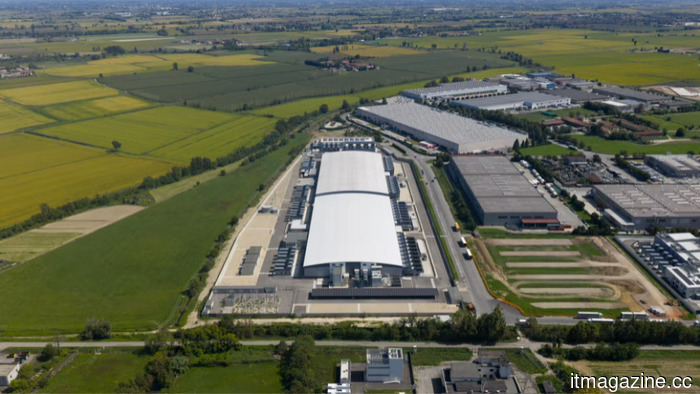
Meta's Hyperion data center will involve a $200 billion investment, encompass 10 gas plants, and occupy 4,000 acres in rural Louisiana for artificial intelligence development.
**TL;DR** Meta’s Hyperion AI data center campus in Richland Parish, Louisiana, now has a projected cost exceeding $200 billion. The facility covers nearly 4,000 acres, will need 10 gas-fired power plants generating over 7 gigawatts, and is funded through a $27 billion off-balance-sheet deal from Wall Street.
Meta is constructing the most costly private infrastructure project in U.S. history. The Hyperion AI data center campus in Richland Parish, Louisiana, now has a projected cost exceeding $200 billion, increasing from the initial $10 billion announced in December 2024. Covering almost 4,000 acres, it will require 10 gas-fired power plants to generate over 7 gigawatts of electricity, financed through a $27 billion Wall Street deal that allows Meta to keep the majority of the debt off its balance sheet. This project represents a significant gamble that the returns from AI infrastructure will justify such unprecedented expenditure.
**Project Scale**
Hyperion will consist of up to nine buildings on a site that has expanded multiple times since Meta first acquired land in Richland Parish. Earlier this year, the company acquired an additional 1,400 acres, making the campus roughly four times the size of Central Park in Manhattan. The facility aims to deliver 5 gigawatts of computational power, with an extra 2.5 gigawatts dedicated to campus support systems, cooling, and other infrastructure. It is anticipated to be operational by 2030.
To supply power to the campus, Entergy Louisiana is constructing 10 gas-fired power plants, increasing from the original three planned. In March 2026, Meta negotiated a new agreement with Entergy for seven additional plants generating 5.2 gigawatts, alongside the initial three. Meta will finance the construction of all 10 plants and has pledged to support 2.5 gigawatts of new renewable energy resources, along with 240 miles of new transmission lines and battery energy storage systems. Both companies are also investigating the potential incorporation of nuclear power for future capacity.
**Political Context**
Hyperion has garnered political interest across all levels. Mark Zuckerberg has prioritized the project, presenting it to President Trump, House Speaker Mike Johnson (whose district includes Richland Parish), and Louisiana Governor Jeff Landry. Trump mentioned the project during a Cabinet meeting in August 2025, citing a $50 billion figure now surpassed by the $200 billion estimate.
Governor Landry referred to the initial announcement as “a new chapter” for Louisiana, prompting the state to expedite regulatory approvals for the energy infrastructure. The political dynamics are clear: Meta secures the energy, land, and tax benefits needed for the project, Louisiana obtains the largest single private investment in its history, and elected officials at all levels can credit their involvement for the jobs and economic activity generated.
**Cost Structure**
Meta reported a record quarterly revenue of $56.3 billion for Q1 2026, but also raised its total capital expenditure guidance for the year to between $125 billion and $145 billion, nearly double the $72.2 billion from 2025. This increase in capex resulted in a more than 6 percent drop in stock during after-hours trading. On the same day, Meta finalized a $25 billion bond sale to support its infrastructure program.
The company is laying off 8,000 employees and canceling 6,000 open positions to help offset infrastructure expenses, a restructuring framed by Zuckerberg as a shift from payroll to compute. Evercore estimates these layoffs could save around $3 billion annually, while Bank of America projects savings between $7 billion and $8 billion. Regardless, these savings cover only a small portion of the capex plan, underscoring the importance of the Wall Street financing structure and off-balance-sheet strategy to Meta.
**Energy Considerations**
The choice to power Hyperion with 10 natural gas plants has attracted criticism from environmental advocates. The Sierra Club has raised concerns about whether the project's economic benefits outweigh the environmental costs, especially considering Meta's prior commitments to renewable energy. In response, the company has paired gas plants with commitments to renewable energy and battery storage and is exploring nuclear power as a long-term solution.
The energy requirements of AI infrastructure are transforming the American power grid. U.S. utilities plan to invest $1.4 trillion by 2030 to meet demand from data centers, with residential customers expected to bear nearly half the costs. Hyperion alone will require more electricity than many mid-sized American cities, and the 10 gas-fired plants Meta is funding will significantly contribute to Louisiana's total generating capacity.
**Competitive Landscape**
Hyperion is Meta’s largest project in its infrastructure expansion but not the only one. The company is also developing Prometheus, a one-gigawatt AI supercluster in Ohio set to launch this year, and is raising $13 billion for another data center in El Paso, Texas.
Other articles
 Motif, backed by Temasek, introduces the Clarity AI financial intelligence system | TNW
Swiss startup Motif has introduced Clarity, an AI system designed to monitor the evolution of financial relationships over time and to enable advisory agents that institutions can implement within a matter of days.
Motif, backed by Temasek, introduces the Clarity AI financial intelligence system | TNW
Swiss startup Motif has introduced Clarity, an AI system designed to monitor the evolution of financial relationships over time and to enable advisory agents that institutions can implement within a matter of days.
 Motif, supported by Temasek, has introduced the Clarity AI financial intelligence system | TNW
Swiss startup motif has introduced Clarity, an AI system designed to monitor the evolution of financial relationships over time and enables advisory agents that institutions can implement within days.
Motif, supported by Temasek, has introduced the Clarity AI financial intelligence system | TNW
Swiss startup motif has introduced Clarity, an AI system designed to monitor the evolution of financial relationships over time and enables advisory agents that institutions can implement within days.
 The CEO of Take-Two, Strauss Zelnick, has confirmed that GTA 6 does not utilize any generative AI.
Strauss Zelnick mentioned that the worlds in Rockstar games are constructed "building by building, street by street" without the use of generative AI, as GTA 6 aims for a release in November 2026.
The CEO of Take-Two, Strauss Zelnick, has confirmed that GTA 6 does not utilize any generative AI.
Strauss Zelnick mentioned that the worlds in Rockstar games are constructed "building by building, street by street" without the use of generative AI, as GTA 6 aims for a release in November 2026.
 Panasonic purchases HIVE Media Control to enhance immersive experiences.
Panasonic has acquired the UK media server firm HIVE Media Control, securing the BeeBlade platform to broaden its offerings beyond hardware into integrated visual solutions under the MEVIX brand.
Panasonic purchases HIVE Media Control to enhance immersive experiences.
Panasonic has acquired the UK media server firm HIVE Media Control, securing the BeeBlade platform to broaden its offerings beyond hardware into integrated visual solutions under the MEVIX brand.
 Panasonic has acquired HIVE Media Control to enhance its immersive initiatives.
Panasonic has acquired the UK media server firm HIVE Media Control, which includes the BeeBlade platform, allowing the company to enhance its offerings beyond hardware into comprehensive visual solutions under the MEVIX brand.
Panasonic has acquired HIVE Media Control to enhance its immersive initiatives.
Panasonic has acquired the UK media server firm HIVE Media Control, which includes the BeeBlade platform, allowing the company to enhance its offerings beyond hardware into comprehensive visual solutions under the MEVIX brand.
 Amprius collaborates with Matternet for batteries used in drone delivery.
Amprius Technologies will provide its high-energy silicon anode SiCore batteries to Matternet's FAA-approved drone delivery fleet, aiming for extended range and increased payload capacity.
Amprius collaborates with Matternet for batteries used in drone delivery.
Amprius Technologies will provide its high-energy silicon anode SiCore batteries to Matternet's FAA-approved drone delivery fleet, aiming for extended range and increased payload capacity.
Meta's Hyperion data center will involve a $200 billion investment, encompass 10 gas plants, and occupy 4,000 acres in rural Louisiana for artificial intelligence development.
Hyperion is set to provide 5 GW of AI computing, supported by 10 gas-fired plants constructed by Entergy. The $27 billion financing is arranged off-balance-sheet via Blue Owl Capital, coinciding with Meta's capital expenditures reaching $145 billion in 2026.