
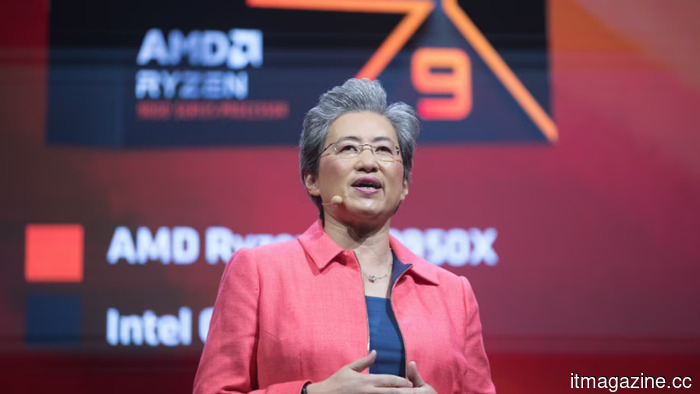
AMD's CEO Lisa Su meets with China's He Lifeng to talk about collaboration in the semiconductor industry | TNW
AMD CEO Lisa Su met with Chinese Vice Premier He Lifeng at the Great Hall of the People in Beijing on May 18, 2026, where she committed to expanding AMD's presence and investment in China. This meeting followed closely on the heels of Trump’s state visit and highlights the precarious situation that US chipmakers find themselves in as export controls alter the semiconductor trade landscape.
Su's discussion with He, who is a senior official in charge of economic and trade affairs, emphasized the need for multinationals like AMD to leverage China's growth opportunities and enhance cooperative efforts. He referred to the recent summit between President Xi Jinping and President Donald Trump, mentioning that both leaders reached significant agreements and that trade delegations achieved favorable outcomes.
Su expressed AMD's readiness to continue its expansion and investment in China, striking a balance that reassures Beijing while remaining ambiguous enough to not irritate Washington.
The context of export controls
This meeting occurred just two days after Trump concluded his state visit to China, which yielded some trade concessions but left semiconductor export controls largely unchanged. US Trade Representative Jamieson Greer noted that chip export controls were not a significant subject of discussion, indicating that easing these restrictions is not a priority for Washington at this moment.
For AMD, these restrictions have altered its strategy in China. The company is now developing modified, less powerful chips for the Chinese market—a costly yet necessary adjustment. The MI308 accelerator can be sold to China without special approval, whereas the MI325X transitioned to a case-by-case review process in January 2026, offering AMD a limited route to supply more advanced hardware to Chinese clients.
The larger US strategy is a mix of incentives and restrictions. Washington has authorized about ten Chinese firms to purchase Nvidia’s H200 processors, but no shipments have gone out yet. Congress is also advancing the MATCH Act, which aims to enhance controls on semiconductor manufacturing equipment by requiring Japan and the Netherlands to align their export restrictions with US regulations within a set timeframe. Beijing criticized this US legislation as counterproductive prior to the summit.
Huawei's looming presence
Despite the diplomatic optics of the Great Hall meeting, earlier events painted a different picture. Two days before Trump’s arrival, state broadcaster CCTV showcased footage of Huawei’s secret chip laboratory during prime time, emphasizing China’s determination to develop its own semiconductor capabilities regardless of US policies. This broadcast was widely viewed as a strategic move to remind the US of its limited leverage.
In this context, Su’s visit gains further importance. Like Nvidia and Intel, AMD confronts a strategic choice: withdraw from China and let domestic companies like Huawei take the market share or stay engaged and navigate a volatile regulatory landscape. Su's decision to meet with He in person indicates that AMD is opting for the latter approach, at least for the time being.
What AMD stands to gain and lose
China is a vital source of revenue for AMD. The company’s data center segment, its fastest-growing area, relies partly on sales to Chinese cloud providers and research organizations. Exiting this market would mean sacrificing billions of dollars and providing an advantage to Huawei, which is rapidly bridging the gap with its own Ascend accelerators.
However, AMD must also be cautious not to alienate Washington. The company is in the process of constructing a gigawatt-scale data center for OpenAI, set to launch in the latter half of 2026, reinforcing its role in the US AI sector. Any perception that AMD is enabling China to surpass US technology could threaten that relationship and risk regulatory backlash.
Su's delicate maneuvering in Beijing highlights the challenging position for American chipmakers. They rely on China's market to fund R&D that keeps them ahead of local competitors, but the regulations controlling their sales are constantly changing due to new executive orders and legislation. The meeting at the Great Hall of the People, therefore, signifies a temporary measure, indicating AMD's intention to remain active while the rules are still evolving.
The success of this strategy hinges on factors outside Su's control: the development of US-China relations, the speed of Huawei's advancements, and the willingness of regulators in Washington, Tokyo, and The Hague to continue granting exceptions. For the moment, the handshake in Beijing buys AMD some time, though the duration of that time remains uncertain.
Other articles
 Strauss Zelnick, the CEO of Take-Two, has confirmed that GTA 6 does not utilize any generative AI.
Strauss Zelnick states that Rockstar's environments are constructed "building by building, street by street" without the use of generative AI, as GTA 6 aims for a launch in November 2026.
Strauss Zelnick, the CEO of Take-Two, has confirmed that GTA 6 does not utilize any generative AI.
Strauss Zelnick states that Rockstar's environments are constructed "building by building, street by street" without the use of generative AI, as GTA 6 aims for a launch in November 2026.
 ECARX and May Mobility have finalized a $750 million agreement for robotaxis, with the vehicles being manufactured outside of China to meet US regulations.
ECARX, supported by Li Shufu, will supply thousands of autonomy-capable vehicles featuring custom L4 computing to May Mobility, aiming for a 50% reduction in hardware costs by 2028. The manufacturing process is organized outside of China to comply with US ICTS regulations.
ECARX and May Mobility have finalized a $750 million agreement for robotaxis, with the vehicles being manufactured outside of China to meet US regulations.
ECARX, supported by Li Shufu, will supply thousands of autonomy-capable vehicles featuring custom L4 computing to May Mobility, aiming for a 50% reduction in hardware costs by 2028. The manufacturing process is organized outside of China to comply with US ICTS regulations.
 Motif, supported by Temasek, has introduced the Clarity AI financial intelligence system | TNW
Swiss startup motif has introduced Clarity, an AI system designed to monitor the evolution of financial relationships over time and enables advisory agents that institutions can implement within days.
Motif, supported by Temasek, has introduced the Clarity AI financial intelligence system | TNW
Swiss startup motif has introduced Clarity, an AI system designed to monitor the evolution of financial relationships over time and enables advisory agents that institutions can implement within days.
 Temasek-supported motif introduces Clarity AI financial intelligence platform | TNW
Swiss startup Motif has introduced Clarity, an AI system designed to monitor the evolution of financial relationships over time and enable advisory agents that institutions can implement within days.
Temasek-supported motif introduces Clarity AI financial intelligence platform | TNW
Swiss startup Motif has introduced Clarity, an AI system designed to monitor the evolution of financial relationships over time and enable advisory agents that institutions can implement within days.
 Amprius collaborates with Matternet for batteries used in drone delivery.
Amprius Technologies will provide its high-energy silicon anode SiCore batteries to Matternet's FAA-approved drone delivery fleet, aiming for extended range and increased payload capacity.
Amprius collaborates with Matternet for batteries used in drone delivery.
Amprius Technologies will provide its high-energy silicon anode SiCore batteries to Matternet's FAA-approved drone delivery fleet, aiming for extended range and increased payload capacity.
 Take-Two CEO Strauss Zelnick confirms that GTA 6 does not utilize any generative AI.
Strauss Zelnick states that the worlds in Rockstar games are constructed "building by building, street by street" without the use of generative AI, as GTA 6 aims for a launch in November 2026.
Take-Two CEO Strauss Zelnick confirms that GTA 6 does not utilize any generative AI.
Strauss Zelnick states that the worlds in Rockstar games are constructed "building by building, street by street" without the use of generative AI, as GTA 6 aims for a launch in November 2026.
AMD's CEO Lisa Su meets with China's He Lifeng to talk about collaboration in the semiconductor industry | TNW
AMD's Lisa Su met with Vice Premier He Lifeng in Beijing, committing to increased investment in China as U.S. export regulations continue to alter the semiconductor landscape.