
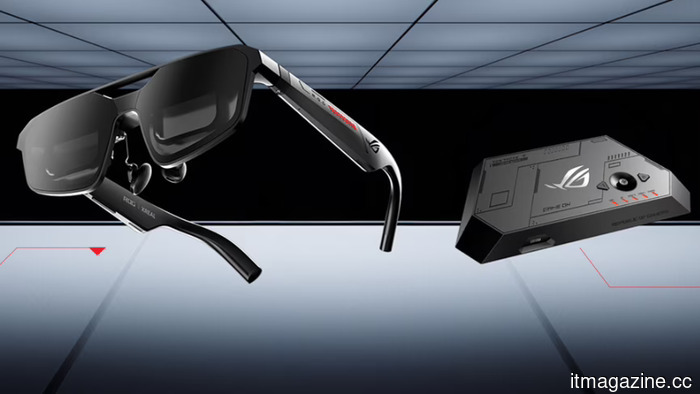
Asus ROG and Xreal have created the inaugural 240Hz AR gaming glasses. Priced at $849, they will be available for shipping in June.
TL;DR: The ROG Xreal R1 offers 240Hz micro-OLED gaming on a 171-inch virtual screen for $849, with pre-orders now available and shipping starting on June 1.
Asus Republic of Gamers and Xreal have launched pre-orders for the ROG Xreal R1, the first AR glasses featuring 240Hz micro-OLED gaming technology. The price is set at $849 through Best Buy, while Xreal's own website will start taking orders on May 17. Global shipping is set to commence on June 1.
The standout feature is its refresh rate, which at 240Hz, surpasses all other AR glasses currently available, including Xreal's own One Pro, which is limited to 120Hz and priced at $650. The R1 utilizes dual 0.55-inch Sony micro-OLED displays, achieving a peak brightness of 700 nits, a 0.01ms response time, and a Full HD resolution of 1,920 x 1,080 per eye. It offers a 57-degree field of view, which Xreal claims covers 95% of the wearer’s focused vision, creating a virtual screen equivalent to 171 inches wide. The entire device weighs in at 91 grams.
Inside, Xreal’s X1 spatial coprocessor manages the menu, 3DoF tracking (with support for 6DoF), and latency management. The motion-to-photon lag is rated at 3ms. The glasses have electrochromic dimming with three levels, automatically adjusting the lens transparency based on head movement—clear when looking away from the virtual screen and tinted when refocusing. Audio is provided through built-in speakers tuned by Bose.
The R1 comes packaged with the ROG Control Dock, a docking station equipped with DisplayPort 1.4 and two HDMI 2.0 ports that facilitates switching between three connected devices (PC, PlayStation 5, Xbox Series X, or Nintendo Switch 2) with a single button. Without the dock, the glasses can connect directly to any smartphone, tablet, laptop, or portable device with USB-C DisplayPort output. The ROG Ally integration is most advanced, allowing the handheld to function as a live control panel for adjusting brightness, screen size, aspect ratio, tint level, and spatial settings while the glasses display gameplay.
First revealed at CES 2026 in January, the product has seen several months of optimization. Asus states that it doesn’t require additional software to operate, just a USB-C cable or the Control Dock. The glasses also support the Asus DisplayWidget Center app for adjusting settings from a laptop or computer.
The competitive landscape is complex. Meta sold over seven million Ray-Ban smart glasses in 2025, controlling roughly 82% of the smart glasses market, but these are AI-powered audio and camera frames rather than display devices. The Meta Quest 3, offering a complete VR headset experience with 6DoF tracking and passthrough AR, is priced lower than the R1. Meanwhile, the Xreal 1S features a larger cinematic 500-inch screen and higher resolution at 120Hz and launched for $449 at CES 2026.
The R1 is not a VR headset and does not compete on those grounds. It acts as a wearable external monitor, projecting a flat virtual screen in front of the wearer, which can either be anchored in space or head-tracked based on the selected mode. There is no hand tracking, passthrough camera feed, or app ecosystem. Its unique selling point is a 240Hz gaming display that fits into a glasses case, weighs less than most smartphones, and connects to any device with video output. For competitive gamers prioritizing refresh rate and response time, the specifications are appealing. However, for others, $849 is a considerable price for a product that serves a singular function.
Apple is reportedly testing at least four frame designs for AI smart glasses aimed at a 2027 launch, with the first version lacking a display. Google is preparing Android XR glasses for 2026 in collaboration with Samsung, Warby Parker, and Gentle Monster. The wearable display market is set to grow significantly, although none of these products are aimed at 240Hz gaming. The ROG Xreal R1 fills a specific niche: the highest-refresh-rate wearable display for gamers seeking a large screen without the bulk and isolation of a VR headset.
The real-world performance will determine if the R1 turns out to be a breakthrough or merely a curiosity. The X1 coprocessor was initially intended for 120Hz glasses, and its capability to effectively manage 240Hz has yet to be proven in consumer use. The 57-degree field of view, while adequately covering focused vision, appears narrow compared to VR standards, and the 1080p resolution implies that pixel density diminishes as the virtual screen size enlarges. Road to VR’s community
Other articles
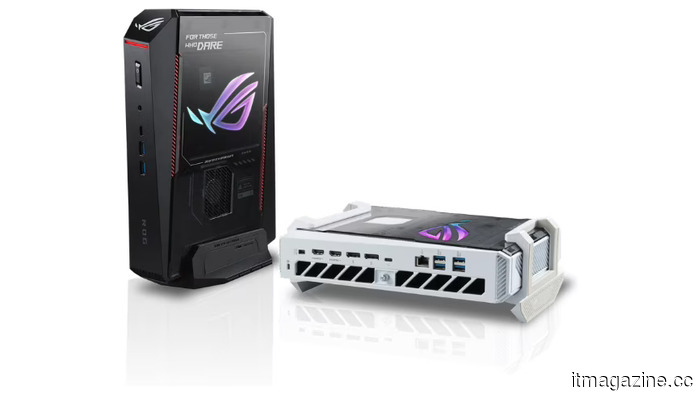 Asus packed an RTX 5080 into a 3-litre chassis. It is priced at $4,400, and the improvement in performance is 2.3%.
The ROG NUC 16 combines Intel's Core Ultra 9 290HX with an RTX 5080 laptop GPU in a case that is smaller than a PS5. The anticipated global price is around $4,000.
Asus packed an RTX 5080 into a 3-litre chassis. It is priced at $4,400, and the improvement in performance is 2.3%.
The ROG NUC 16 combines Intel's Core Ultra 9 290HX with an RTX 5080 laptop GPU in a case that is smaller than a PS5. The anticipated global price is around $4,000.
 A student equipped with a laptop and a radio interrupted four high-speed trains. The crypto keys had remained unchanged for 19 years.
A 23-year-old in Taiwan took advantage of TETRA radio vulnerabilities that have remained unchanged since 2007 to activate emergency brakes on four trains. He could face a prison sentence of up to 10 years.
A student equipped with a laptop and a radio interrupted four high-speed trains. The crypto keys had remained unchanged for 19 years.
A 23-year-old in Taiwan took advantage of TETRA radio vulnerabilities that have remained unchanged since 2007 to activate emergency brakes on four trains. He could face a prison sentence of up to 10 years.
 The individual who introduced a Roomba into every household aims to substitute your dog with a soft robotic companion.
Colin Angle's new venture, Familiar Machines, has come out of stealth mode with an AI pet that tracks your movements, adapts to your routines, and doesn't require feeding.
The individual who introduced a Roomba into every household aims to substitute your dog with a soft robotic companion.
Colin Angle's new venture, Familiar Machines, has come out of stealth mode with an AI pet that tracks your movements, adapts to your routines, and doesn't require feeding.
 Malta has recently become the first nation to provide all its citizens with complimentary access to ChatGPT Plus. However, there is one stipulation.
OpenAI has reached an agreement with Malta to offer ChatGPT Plus for one year to all residents who finish a complimentary AI literacy course created by a university.
Malta has recently become the first nation to provide all its citizens with complimentary access to ChatGPT Plus. However, there is one stipulation.
OpenAI has reached an agreement with Malta to offer ChatGPT Plus for one year to all residents who finish a complimentary AI literacy course created by a university.
 Destinus is seeking to raise €200 million prior to its initial public offering (IPO). The manufacturer of cruise missiles aims for a valuation of €5 billion.
The Dutch defense startup produces drones and cruise missiles for Ukraine and its European allies. It has already formed a joint venture with Rheinmetall.
Destinus is seeking to raise €200 million prior to its initial public offering (IPO). The manufacturer of cruise missiles aims for a valuation of €5 billion.
The Dutch defense startup produces drones and cruise missiles for Ukraine and its European allies. It has already formed a joint venture with Rheinmetall.
 Malta has just become the first nation to provide all its citizens with free access to ChatGPT Plus, but there is one stipulation.
OpenAI has reached an agreement with Malta to offer ChatGPT Plus for one year to all residents who successfully finish a complimentary AI literacy course created by a university.
Malta has just become the first nation to provide all its citizens with free access to ChatGPT Plus, but there is one stipulation.
OpenAI has reached an agreement with Malta to offer ChatGPT Plus for one year to all residents who successfully finish a complimentary AI literacy course created by a university.
Asus ROG and Xreal have created the inaugural 240Hz AR gaming glasses. Priced at $849, they will be available for shipping in June.
The ROG Xreal R1 features dual Sony micro-OLED screens, offers a 171-inch virtual display, and includes Bose audio, all weighing just 91 grams. Pre-orders are now available on Best Buy.