

AI shouldn't decide for you, but this one will alert you when you're about to make a poor choice.
Cornell researchers have developed an AI tool designed to evaluate your decisions based on your personal values.
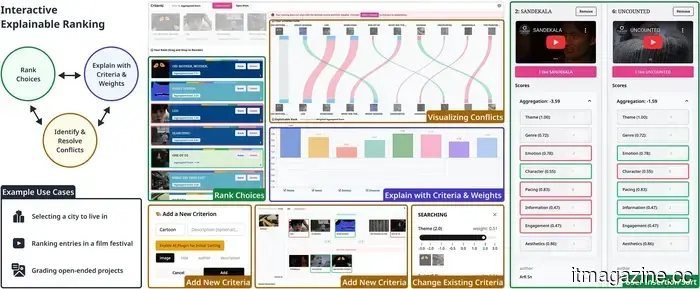
If you've ever faced a lengthy list of choices and felt overwhelmed, you're not alone. The team at Cornell University understands this dilemma and created a tool called Interactive Explainable Ranking (IER). This tool doesn't make decisions for you; instead, it gently highlights when your selections diverge from the values that matter to you.
How does this tool function?
IER does not relinquish decision-making to AI but utilizes it to ensure your choices are logical. Consider it a reality check for your own reasoning. Studies indicate that AI can diminish your problem-solving abilities in just ten minutes, but this tool aims to keep you in charge.
For example, if you're selecting a car, you can specify which criteria are most important to you, such as price, reliability, and fuel efficiency. The tool then guides you through a series of direct comparisons, leveraging AI to determine the most pertinent questions to ask.
If your selections don't align with the values you've indicated, the tool points out the inconsistency. For instance, if you find yourself consistently choosing red cars without realizing it, the tool brings that trend to your attention and prompts you to modify your preferences or justify why color should be a significant factor.
The outcome is a choice that you can logically articulate and defend. Additionally, you can completely disable the AI feature for situations where its use feels unsuitable.
Has it been practically applied?
Chao Zhang and Abe Davis from Cornell University confirm that it has. Researchers conducted two experiments—one involving participants ranking short films and another where four teaching assistants rated ten projects from a Cornell computer graphics course. Both studies yielded reliable and explainable results consistent with existing evaluations.
The tool received a Best Paper Award at the ACM CHI conference, one of the foremost events in human-computer interaction. IER is available for public use, should you want to test it for your next significant decision.
This tool isn't intended for everyday, low-risk choices but rather for instances where making the correct decision is crucial, such as hiring, grading, or competitive selections. With AI already assisting with routine tasks, it seems worthwhile to devote more consideration to the remaining decisions.
Manisha Priyadarshini is a tech and entertainment writer with more than nine years of editorial experience.
Google I/O is approaching, and after the conclusion of The Android Show, attention is shifting to the company's AI endeavors—particularly Gemini. Although no official announcements have been made, a recent leak hints at what Google might be preparing behind the scenes. Your inbox could soon have more to fear from Gemini than spam.
A new type of nearly invisible solar cell has the potential to enable everyday glass surfaces, including car windows and smart glasses, to generate electricity. Researchers at Nanyang Technological University in Singapore have created ultrathin transparent perovskite solar cells that are approximately 10,000 times thinner than a human hair and about 50 times thinner than traditional perovskite solar cells. The research findings, led by Associate Professor Annalisa Bruno, were published in ACS Energy Letters (via TechXplore).
Microsoft’s latest Edge update for mobile devices provides a compelling reason to consider it over Chrome. While Chrome remains the default browser for many smartphone users, Microsoft has introduced a significant Copilot update for Edge across both desktop and mobile platforms. This update comes just before Google’s Gemini-enhanced Chrome upgrade for Android, anticipated in June, giving Edge an opportunity to distinguish itself before Chrome's major AI launch.




Other articles
 Gemini is set to take flight on your phone with its proactive capabilities.
A recent leak indicates that Google might be developing a more advanced version of Gemini capable of handling inbox clutter, producing meeting summaries, and even creating personalized AI skills.
Gemini is set to take flight on your phone with its proactive capabilities.
A recent leak indicates that Google might be developing a more advanced version of Gemini capable of handling inbox clutter, producing meeting summaries, and even creating personalized AI skills.
 Samsung PenUp introduces new stylus features for your Galaxy phone, provided it is compatible with an S Pen.
Samsung's PenUp update introduces 53 new brushes, a Dual brush feature, enhanced draft syncing, and improved controls, enhancing the drawing app's utility on Galaxy devices that support the S Pen.
Samsung PenUp introduces new stylus features for your Galaxy phone, provided it is compatible with an S Pen.
Samsung's PenUp update introduces 53 new brushes, a Dual brush feature, enhanced draft syncing, and improved controls, enhancing the drawing app's utility on Galaxy devices that support the S Pen.
 In 2026, the HomePod mini remains a sensible choice if you are already integrated into Apple's ecosystem.
The HomePod mini has seen little change over the years, but it continues to deliver respectable sound quality, effortless integration with Apple devices, and an unexpectedly good experience with the Apple TV 4K. However, the downside is that many of its top features are best utilized within Apple’s ecosystem.
Anthropic has partnered with the Gates Foundation, investing $200 million to implement AI in the areas of global health, education, and agriculture.
The four-year collaboration will support vaccine research for overlooked diseases, AI education in sub-Saharan Africa, and public benchmarks. This partnership significantly surpasses OpenAI's $50 million agreement with the Gates Foundation.
In 2026, the HomePod mini remains a sensible choice if you are already integrated into Apple's ecosystem.
The HomePod mini has seen little change over the years, but it continues to deliver respectable sound quality, effortless integration with Apple devices, and an unexpectedly good experience with the Apple TV 4K. However, the downside is that many of its top features are best utilized within Apple’s ecosystem.
Anthropic has partnered with the Gates Foundation, investing $200 million to implement AI in the areas of global health, education, and agriculture.
The four-year collaboration will support vaccine research for overlooked diseases, AI education in sub-Saharan Africa, and public benchmarks. This partnership significantly surpasses OpenAI's $50 million agreement with the Gates Foundation.
 Samsung PenUp introduces additional stylus features for your Galaxy phone, provided it is compatible with an S Pen.
Samsung’s PenUp update introduces 53 new brushes, a Dual brush feature, improved draft syncing, and enhanced control smoothness, enhancing the functionality of the drawing app on Galaxy devices that support the S Pen.
Samsung PenUp introduces additional stylus features for your Galaxy phone, provided it is compatible with an S Pen.
Samsung’s PenUp update introduces 53 new brushes, a Dual brush feature, improved draft syncing, and enhanced control smoothness, enhancing the functionality of the drawing app on Galaxy devices that support the S Pen.
 AI shouldn't decide for you, but this one will indicate when you're making a poor choice.
A novel AI tool developed by researchers at Cornell assists you in making improved decisions by identifying inconsistencies between your declared values and your real choices.
AI shouldn't decide for you, but this one will indicate when you're making a poor choice.
A novel AI tool developed by researchers at Cornell assists you in making improved decisions by identifying inconsistencies between your declared values and your real choices.
AI shouldn't decide for you, but this one will alert you when you're about to make a poor choice.
A new AI tool developed by researchers at Cornell assists you in making improved decisions by identifying inconsistencies between your expressed values and your real choices.