
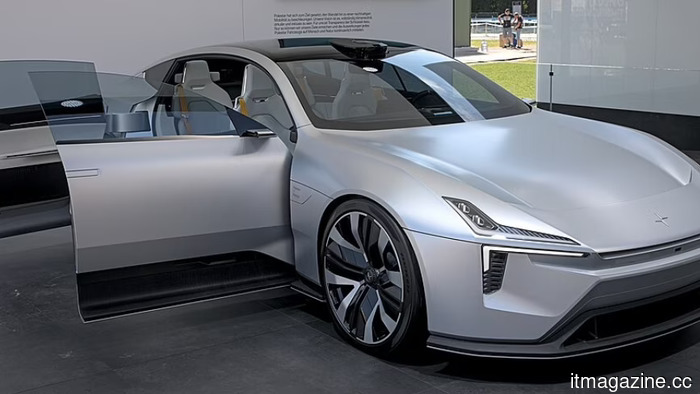
The CEO of Polestar attributes the increase in electric vehicle demand to "pump anxiety" resulting from rising fuel prices due to the war in Iran.
TL;DR: Polestar CEO Michael Lohscheller informed CNBC that "pump anxiety" has overtaken range anxiety as the primary concern for consumers, with rising fuel costs due to the Iran war and the closure of the Strait of Hormuz contributing to a noticeable increase in EV demand. EU EV registrations rose by 51% in March. Polestar reported a Q1 net loss of $383 million on stagnant revenue of $633 million despite setting a record with 13,126 vehicle deliveries; gross margins turned negative due to pricing pressures, tariffs, and currency fluctuations.
For years, range anxiety was the primary challenge facing the electric vehicle sector. However, according to Polestar's CEO, this anxiety has shifted elsewhere. “Consumers are now worried about gas prices,” Lohscheller told CNBC’s Squawk Box Europe on Wednesday, coining the term “pump anxiety” to reflect a broader industry shift.
The context is clear. Following strikes by the U.S. and Israel against Iran on February 28, the Strait of Hormuz has largely been shut off to commercial shipping, impacting about a fifth of the world’s oil supply. As a result, Brent crude has surpassed $100 per barrel. In the UK, average petrol prices have increased by over 25 pence per litre since early March, with diesel prices nearly 45 pence higher, according to RAC Fuel Watch. In various EU markets, petrol prices have exceeded €2 per litre, leading to a continent-wide reassessment of driving costs.
The economic landscape has undergone a transformation. Lohscheller argues that consumer considerations have shifted. “People once viewed EVs for idealistic reasons, but now it's purely about financial factors,” he stated. This view is corroborated by data showing a 51% increase in EU electric vehicle registrations in March compared to the same month last year; Italy saw a 65.7% rise in battery-electric registrations during Q1, France had a 50.4% increase, and Germany experienced a 41.3% growth, according to figures from the European Automobile Manufacturers’ Association. In the UK, Polestar’s operational base, both Chinese EV makers and established European brands report spikes in online inquiries and test-drive requests.
However, this change is not uniform across the globe. In the U.S., where petrol exceeded $4 per gallon for the first time in four years, the impact has been less pronounced. Used EV sales saw a year-over-year increase of 12% in Q1 and a 17% rise from the previous quarter, while new EV sales have yet to exhibit the same surge. Lohscheller pointed to vanishing federal tax incentives and general consumer uncertainty as barriers to American demand.
Polestar finds itself under pressure at this time. The Sweden-based, Geely-owned firm reported a widened net loss of $383 million in Q1, more than double the $166 million loss reported during the same period last year. Revenue remained steady at $633 million, despite a 7% rise in deliveries, totaling a record 13,126 vehicles. Gross margins dropped to negative 3.2%, down from positive 10.3% a year earlier, a decline attributed to pricing pressure, tariffs in the EU and U.S., reduced carbon-credit sales, and adverse foreign-exchange impacts due to a weakening yuan.
The financial situation illustrates the complexity faced by the EV industry in 2026. While demand is growing, so too are competitive costs. Polestar primarily manufactures in China, making its vehicles subject to U.S. and European tariffs imposed to address the competitive advantages of Chinese production. The company has characterized the domestic Chinese market as "hyper competitive" and suggested that Europe needs to enhance its response.
Range anxiety appears to be a thing of the past. What follows, however, presents greater challenges. Lohscheller, who previously led Opel and Vauxhall, was straightforward regarding range issues. “Range anxiety, I think this has gone,” he stated at the Financial Times Future of the Car conference held on the same day. The most affordable Polestar 2 provides an official range of 344 miles on the WLTP cycle. The dual-motor Polestar 3 SUV can achieve 402 miles. A fully charged 82-kilowatt-hour Polestar 2 in the UK costs around £15 on a home EV tariff, significantly less than the current refueling cost of a similar petrol vehicle.
Yet, reduced operating costs have not eliminated purchase anxiety. Lohscheller acknowledged that EV residual values lag behind those of traditional combustion vehicles. Pressure on new-car prices, driven by manufacturers attempting to meet the UK's zero-emission vehicle mandates to avoid penalties, has led to significant discounting that further lowers used-EV values. “I’m asking for stability,” he remarked regarding the regulatory landscape. “Frequent debates about changing rules every three months do not benefit anyone.”
The fuel-price crisis is changing automotive markets beyond just Polestar. BYD
Other articles
 Flo Health introduces perimenopause tools following a survey that reveals 66% of women felt better equipped for puberty.
Flo Health's latest perimenopause suite aims at an 80 million user base, offering symptom scoring, timeline monitoring, and options for relief. A survey by Wakefield revealed that many women feel less equipped to handle perimenopause compared to puberty.
Flo Health introduces perimenopause tools following a survey that reveals 66% of women felt better equipped for puberty.
Flo Health's latest perimenopause suite aims at an 80 million user base, offering symptom scoring, timeline monitoring, and options for relief. A survey by Wakefield revealed that many women feel less equipped to handle perimenopause compared to puberty.
 OpenAI is gearing up for legal action against Apple as the collaboration between ChatGPT and Siri falls apart.
OpenAI claims that Apple has hidden ChatGPT within Siri and did not actively promote it. Currently, its legal team is exploring breach-of-contract possibilities as Apple introduces Claude and Gemini in iOS 27.
OpenAI is gearing up for legal action against Apple as the collaboration between ChatGPT and Siri falls apart.
OpenAI claims that Apple has hidden ChatGPT within Siri and did not actively promote it. Currently, its legal team is exploring breach-of-contract possibilities as Apple introduces Claude and Gemini in iOS 27.
 Carta unveils Carta Law following its acquisition of Avantia, marking its fourth transaction in eight months.
Carta has taken over the UK law firm Avantia to establish Carta Law, integrating AI-driven legal and compliance features into its private capital ERP. This marks the fourth acquisition since October 2025.
Figma's revenue in Q1 increases by 46% as early signs of monetization from AI credits gain momentum.
Figma exceeded expectations with $333.4 million in revenue for Q1. Over 75% of its power users chose to purchase AI credits once free limits were put in place. The stock rose 8% in after-hours trading.
Carta unveils Carta Law following its acquisition of Avantia, marking its fourth transaction in eight months.
Carta has taken over the UK law firm Avantia to establish Carta Law, integrating AI-driven legal and compliance features into its private capital ERP. This marks the fourth acquisition since October 2025.
Figma's revenue in Q1 increases by 46% as early signs of monetization from AI credits gain momentum.
Figma exceeded expectations with $333.4 million in revenue for Q1. Over 75% of its power users chose to purchase AI credits once free limits were put in place. The stock rose 8% in after-hours trading.
 Dell is introducing Alienware laptops aimed at budget-conscious gamers, even if that requires using older chips.
Dell has introduced the Alienware 15 together with the Dell 14S and 16S, emphasizing more affordable pricing, AI capabilities, and a balanced performance suitable for various user groups.
Dell is introducing Alienware laptops aimed at budget-conscious gamers, even if that requires using older chips.
Dell has introduced the Alienware 15 together with the Dell 14S and 16S, emphasizing more affordable pricing, AI capabilities, and a balanced performance suitable for various user groups.
The CEO of Polestar attributes the increase in electric vehicle demand to "pump anxiety" resulting from rising fuel prices due to the war in Iran.
According to Polestar's CEO, elevated fuel prices have turned EVs into a financial matter. While EU registrations surged by 51% in March, the company's losses in Q1 increased to $383 million.