
Google is reimagining the computer cursor, and its AI-driven future appears absurd.
The unassuming mouse pointer has seen little change over the years. It navigates, clicks, selects, drags, and occasionally becomes a source of frustration with its spinning wheel. Now, Google aims to transform that small arrow into one of the most powerful AI tools on your laptop, which may seem absurd until you consider how frequently you utilize it.
The company has introduced Magic Pointer for Googlebook, a new category of Gemini-powered laptops. This feature endows the cursor with AI capabilities, enabling it to comprehend what you are pointing at and assist you in taking action without requiring lengthy prompts or a separate chatbot interface.
Could the cursor become the new AI interface?
In a recent DeepMind post, the company outlined its plans to redefine the pointer for the AI era. The goal is for Gemini to understand the specific part of a webpage, image, table, document, or video frame that the user is indicating. This transformation shifts the cursor from a simple navigation tool to a sort of AI remote for the entire screen.
Google
This is where things begin to sound delightfully absurd. A pointer could convert a table into a graph, compare selected products on a webpage, summarize a PDF into bullet points for an email, or identify a building in a photograph and provide directions. The cursor, previously used mainly for clicking small buttons, is now expected to grasp context, intent, and action.
Why is this significant for Googlebooks?
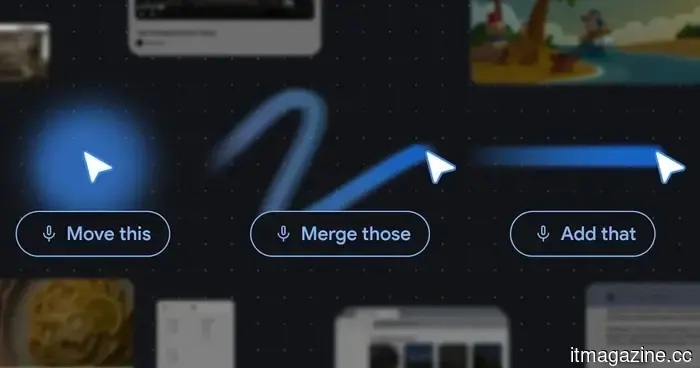
Google has drawn inspiration from how people naturally communicate offline. Typically, you don’t describe every object in a room before requesting someone to move it. You simply point and say, “move this” or “fix that.” Magic Pointer applies this concept to the screen. The cursor informs Gemini what you are referencing, while brief commands like “add this,” “merge those,” or “what does this mean?” indicate the desired action.
This new feature will be thoroughly integrated into Googlebook laptops, with Magic Pointer being announced as part of that platform. This means users will have the ability to utilize it more broadly throughout their laptop experience, rather than being confined to a specific app or browser window.
For everyone else, this AI pointer will currently be limited to Gemini in Chrome. Google states that users can point to precise areas of a webpage and pose questions, such as comparing multiple selected products, summarizing technical specifications from a product listing, or quickly converting prices into a different currency.
If Magic Pointer functions effectively, routine AI tasks might not require a prompt box at all.
Other articles
 Prime Video has just announced some disappointing news regarding Henry Cavill's live-action Voltron film.
Amazon has announced that Henry Cavill's live-action Voltron movie will bypass theaters and debut on Prime Video, leaving fans who anticipated a theatrical release feeling disappointed.
TikTok requests that Europe's highest court eliminate its gatekeeper designation.
On Tuesday, TikTok requested the Court of Justice to annul its designation as a DMA gatekeeper, marking the first challenge of this kind to be presented to the EU's highest court.
Prime Video has just announced some disappointing news regarding Henry Cavill's live-action Voltron film.
Amazon has announced that Henry Cavill's live-action Voltron movie will bypass theaters and debut on Prime Video, leaving fans who anticipated a theatrical release feeling disappointed.
TikTok requests that Europe's highest court eliminate its gatekeeper designation.
On Tuesday, TikTok requested the Court of Justice to annul its designation as a DMA gatekeeper, marking the first challenge of this kind to be presented to the EU's highest court.
 The Comeback of Spatial Computing in Gaming
For several years, spatial computing in gaming has primarily relied on head-mounted devices. Although virtual reality (VR) headsets, augmented reality (AR) glasses, and mixed-reality wearables have taken center stage in virtual gaming, many still face issues similar to those of their early versions, such as complicated setup processes and device comfort, […]
The Comeback of Spatial Computing in Gaming
For several years, spatial computing in gaming has primarily relied on head-mounted devices. Although virtual reality (VR) headsets, augmented reality (AR) glasses, and mixed-reality wearables have taken center stage in virtual gaming, many still face issues similar to those of their early versions, such as complicated setup processes and device comfort, […]
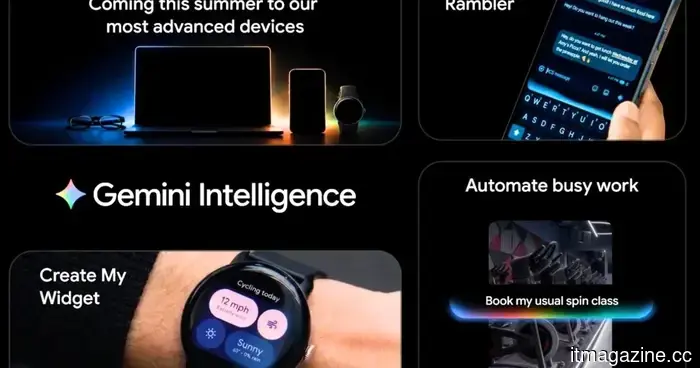 The Android Show 2026: Updates on Gemini Intelligence, Googlebook, Android 17, and more.
Google entered The Android Show with an unexpected laptop, an AI enhancement that manages your tasks, and a much-needed security update.
The Android Show 2026: Updates on Gemini Intelligence, Googlebook, Android 17, and more.
Google entered The Android Show with an unexpected laptop, an AI enhancement that manages your tasks, and a much-needed security update.
 Europe's reliance on cloud services poses a political risk, in addition to being a technical issue.
Europe's reliance on external cloud services impacts not only its AI sovereignty but also its data sovereignty, leading to increased political vulnerability.
Europe's reliance on cloud services poses a political risk, in addition to being a technical issue.
Europe's reliance on external cloud services impacts not only its AI sovereignty but also its data sovereignty, leading to increased political vulnerability.
 Meta loses case regarding payment to Italian publishers at the EU's highest court.
The CJEU has decided that Italy’s AGCOM can mandate Meta to reimburse publishers for news excerpts, representing a significant procedural victory for European publishers.
Meta loses case regarding payment to Italian publishers at the EU's highest court.
The CJEU has decided that Italy’s AGCOM can mandate Meta to reimburse publishers for news excerpts, representing a significant procedural victory for European publishers.
Google is reimagining the computer cursor, and its AI-driven future appears absurd.
Google is enhancing the mouse pointer on Googlebook with a Gemini-powered upgrade, enabling users to point, speak, and receive assistance on their desktop without the need for extensive prompts.