

AI tools are ubiquitous, yet why do the majority of people continue to utilize them as if it were 2015?
AI tools are everywhere, so why do most people still utilize them as if it's 2015? Artificial intelligence is integrated into nearly every tool we use, whether it's search engines, office applications, browsers, phones, or creative software. Regular updates continually introduce assistants, copilots, and generators, each claiming to transform the way we work.
On the surface, adoption rates seem high. Millions of users have access to these features, often enabled by default, hidden within menus that most rarely navigate. However, actual user behavior tends to lag. Many individuals still create documents line by line, browse the internet as they did years ago, and manually complete tasks, even when software suggests alternative methods.
The heart of EU tech The latest happenings in the EU tech sector, insights from our wise founder Boris, and some questionable AI-generated art. It's free, delivered weekly to your inbox. Sign up now! The aim of AI was never to supplant creativity or skill but to enhance them, which only succeeds when users grasp how the new capabilities integrate into their existing tasks.
This article examines why AI tools are ubiquitous yet daily software usage appears outdated. The real issue isn't access to AI; it's the adoption of these tools. Software providers are not lagging; new AI features roll out almost weekly, added to the tools people already use for writing, coding, design, searching, and communicating. Access is no longer the issue. What’s missing is the moment users comprehend how to incorporate the new feature into their current workflow.
Most software still expects users to figure that out independently, which is why platforms like WalkMe Learning Arc concentrate on teaching features within the application rather than directing users to external documentation or training resources. This shift reflects a broader realization in the industry that simply releasing new features doesn't guarantee usage, a challenge also examined in discussions about AI oversight and usability in clarity as a strategy.
Most learning still occurs outside the tools themselves. Users are anticipated to read manuals, watch tutorials, or engage in traditional training sessions, despite the actual challenges arising once they’re back in the software, trying to accomplish tasks under time constraints. Consequently, individuals revert to familiar habits, neglecting features they haven't had time to thoroughly explore. While innovation continues to progress, user capabilities evolve at a different speed.
Feature overload complicates modern software usage
Modern applications are not struggling due to a lack of capabilities; rather, they are overwhelmed because each update adds another layer to what already exists. AI hasn't replaced old interfaces; it has added to them, resulting in users facing a greater number of options, panels, and assistants than ever before. Discussions about AI analytics agents requiring guardrails, not merely larger models, echo the concern that introducing intelligence doesn’t inherently simplify software use.
Open nearly any tool today, and you'll see the familiar trend: office software featuring built-in copilots and sidebars, design tools filled with generators, templates, and prompts, productivity apps offering chatbots in every menu, and platforms anticipating users will learn through guides akin to employee training. When interfaces become cluttered, people cease to experiment and revert to what they know. While added capabilities sound appealing in release notes, they often translate to more decisions required on each screen. This is why user engagement often lags significantly behind the technology available.
Users don't resist AI; they resist altering their working methods
Most users are not opposed to artificial intelligence; their resistance stems from changing how they already work. Once a routine feels dependable, people continue to follow it without hesitation, even when the software provides a quicker alternative. Habits become the default, illustrating the growing gap between AI availability and actual proficiency.
While most employees are expected to use AI at work, only a small fraction feel adequately trained to do so. Research from Microsoft reveals that 66% of leaders would not hire someone lacking AI competencies. Many are learning independently as job requirements increasingly align with the skills associated with emerging developer roles rather than traditional positions.
Learning a new workflow seems straightforward until it disrupts real work. Muscle memory kicks in, deadlines loom, and there's often insufficient guidance within the tool itself to make the new approach feel secure to attempt. The discrepancy between innovation and adoption is primarily human, not technical; therefore, the next advancement in AI will not stem solely from enhanced models.
The next wave of AI will emphasize teaching rather than just automating
The forthcoming phase of AI development is beginning to transition from merely adding features to assisting users in comprehending the existing ones. Instead of relying on users to read guides or watch tutorials as if it were 2015, newer tools are starting to provide direct guidance within the interface, offering step-by-step suggestions as users progress through tasks.
Copilots that suggest the next command, walkthroughs appearing during workflows, and adaptable interfaces are becoming increasingly common across productivity, design, and development software. This transformation also explains why more teams are posing questions about selecting digital adoption platforms, as learning is no longer something that occurs prior to using software but rather
Other articles
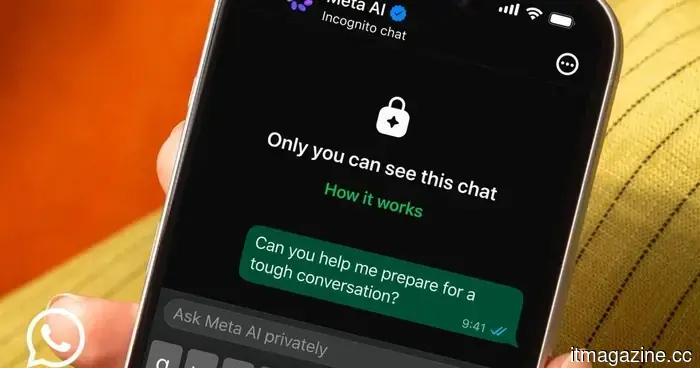 Meta claims that WhatsApp is now the most secure app for chatting… with AI.
WhatsApp has introduced a private incognito mode for Meta AI chats, allowing messages to vanish, and even Meta is unable to access your discussions with the assistant.
Meta claims that WhatsApp is now the most secure app for chatting… with AI.
WhatsApp has introduced a private incognito mode for Meta AI chats, allowing messages to vanish, and even Meta is unable to access your discussions with the assistant.
 Disney+ has officially announced the release date for VisionQuest, bringing the WandaVision trilogy closer to its conclusion.
Disney+ has officially announced the premiere date for VisionQuest, with Paul Bettany, Robert Downey Jr., and Tom Hiddleston revealing the initial teaser during Disney's Upfront presentation.
Disney+ has officially announced the release date for VisionQuest, bringing the WandaVision trilogy closer to its conclusion.
Disney+ has officially announced the premiere date for VisionQuest, with Paul Bettany, Robert Downey Jr., and Tom Hiddleston revealing the initial teaser during Disney's Upfront presentation.
 AI tools are ubiquitous, so why do many individuals continue to utilize them as if it were 2015?
AI is integrated into nearly every tool we use, but many individuals continue to work as they did back in 2015. The issue isn't availability; it's the lack of adoption.
AI tools are ubiquitous, so why do many individuals continue to utilize them as if it were 2015?
AI is integrated into nearly every tool we use, but many individuals continue to work as they did back in 2015. The issue isn't availability; it's the lack of adoption.
 Alexa for Shopping is a talkative new AI assistant equipped with some impressive features to encourage you to shop on Amazon.
Following years of relying on Alexa to respond to inquiries, manage smart homes, play music, and assist with daily tasks, Amazon has identified a clearer role for the assistant. Alexa is now evolving into your personal shopper, designed to help you locate what you need more quickly and add it to your cart with less hesitation. Amazon is introducing […]
Alexa for Shopping is a talkative new AI assistant equipped with some impressive features to encourage you to shop on Amazon.
Following years of relying on Alexa to respond to inquiries, manage smart homes, play music, and assist with daily tasks, Amazon has identified a clearer role for the assistant. Alexa is now evolving into your personal shopper, designed to help you locate what you need more quickly and add it to your cart with less hesitation. Amazon is introducing […]
 Amazon has stated that it will not produce another smartphone after its experience with the Fire Phone.
Amazon's head of devices asserts that the company is not pursuing a traditional smartphone, despite reports indicating the development of a mobile AI device influenced by Alexa.
Amazon has stated that it will not produce another smartphone after its experience with the Fire Phone.
Amazon's head of devices asserts that the company is not pursuing a traditional smartphone, despite reports indicating the development of a mobile AI device influenced by Alexa.
 This transparent smart ring interprets sign language and functions almost like magic.
Scientists in South Korea have created a ring-shaped sign language translator that functions wirelessly and can identify ASL and ISL words with an accuracy of approximately 88%.
This transparent smart ring interprets sign language and functions almost like magic.
Scientists in South Korea have created a ring-shaped sign language translator that functions wirelessly and can identify ASL and ISL words with an accuracy of approximately 88%.
AI tools are ubiquitous, yet why do the majority of people continue to utilize them as if it were 2015?
AI is integrated into nearly every tool we use, but many individuals continue to operate as they did back in 2015. The issue isn't with access; it's with adoption.