

UFORCE, the first defence technology unicorn in Ukraine, has successfully carried out 150,000 combat missions as unmanned warfare becomes a commercial venture.
TL;DRUFORCE, a defence technology startup with Ukrainian-British roots formed from nine merged companies, has carried out over 150,000 combat missions, reached a valuation of over a billion dollars, and is involved in what Ukraine claims is the first military operation in history where territory was taken using only robots and drones. The company is increasing production as unmanned warfare transitions from theory to tangible assets.
In April, Ukrainian President Volodymyr Zelensky announced that for the first time in military history, his forces had captured an enemy position solely with unmanned systems—without the involvement of infantry or human soldiers. Drones and ground robots identified the target, neutralized defensive fire, and took the position without incurring any Ukrainian casualties. This claim has not been independently verified in detail, and the military has not provided specifics. However, UFORCE, the key company in the operation, has conducted over 150,000 combat missions since Russia's full-scale invasion in 2022, achieved unicorn status with a valuation exceeding one billion dollars, and is currently scaling production from a discreet London headquarters designed to protect it from Russian sabotage. The era of unmanned warfare is no longer just a topic at conferences; it is now a real aspect of a defence contractor's balance sheet.
The company
UFORCE was established by merging nine Ukrainian defence firms that collaborated during the war. It is headed by Oleg Rogynskyy, formerly of People.ai, and Oleksii Honcharuk, a former Ukrainian prime minister. The company develops drones for air, sea, and land applications, employs over 1,000 engineers, developers, and operators across six European nations, and reported a 450 percent growth in bookings for 2025. In March, it secured 50 million dollars at a valuation over a billion dollars, becoming Ukraine's first defence technology unicorn. Ukraine has turned into a global testing ground for military robots, with UFORCE effectively transforming this testing into a commercial venture.
The product range covers various aspects of the conflict. UFORCE’s MAGURA maritime drones have targeted over 12 Russian warships in the Black Sea, marking the first instance recorded of an uncrewed vessel shooting down a manned helicopter and fighter jet. Its Nemesis strike drones perform precision attacks, while its ground systems use software-assisted targeting to engage enemy positions. The company also develops counter-drone technology and battlefield management software to coordinate operations across multiple unmanned platforms simultaneously. The figure of 150,000 combat missions includes air, sea, and land operations conducted since 2022, a deployment scale unmatched by any Western defence technology company, including the significantly larger and better-funded Anduril Industries, in actual combat.
The operation
Zelensky’s April video highlighted various Ukrainian-developed robotic weapon systems, including Ratel, TerMIT, Ardal, Rys, Zmiy, Protector, and Volia ground robots, which collectively completed over 22,000 missions in just three months. The president emphasized that unmanned systems had captured territory without risking human lives. Rhiannon Padley, UFORCE’s UK director of strategic partnerships, did not comment on the specific operation shown in Zelensky’s video but confirmed that the company’s air, land, and sea drones are actively being used in combat. She noted that battles between robots are becoming increasingly common and predicted that unmanned systems would eventually outnumber human soldiers on the battlefield.
Russia is deploying its own unmanned ground systems, using robots designed to deliver explosives into Ukrainian positions. Both sides are in an arms race where the development cycle has compressed from years to weeks, with modifications, software updates, and entirely new platform designs evolving at a pace that traditional defence procurement has not accommodated. The rise in European defence stocks reflects a broader recognition that military technology is shifting from hardware platforms developed over decades to software-defined systems evolving in months, making companies that produce these systems resemble tech startups more than traditional contractors like BAE Systems or Lockheed Martin.
The industry
UFORCE represents a wave of so-called neo-prime defence companies challenging established contractors. Anduril Industries, founded by Oculus VR co-creator Palmer Luckey, conducted its first test flight of an autonomous fighter jet in February, has secured billions in US military contracts, and is building Arsenal-1, a billion-dollar manufacturing facility in Ohio with a goal of 5 million square feet of production capacity. Ukrainian drone startups are increasingly looking to transform wartime technology into dual-use commercial products, and the wider European defence technology sector raised 2.3 billion euros in 2025, more than double the figure for 2024, with German startups accounting for 90 percent of the continent’s defence technology investment in the first half of the year.
Europe’s military AI capabilities are being influenced by partnerships between AI labs and defence specialists, such as the collaboration between Munich-based military AI firm Helsing, valued at 12 billion euros, and M
Other articles
 Google is developing a "24/7 personal assistant" that closely resembles its response to OpenClaw.
Google is developing an AI agent named Remy within its Gemini app, aiming to compete in a rapidly evolving market that is already dominated by OpenClaw, Meta, and Anthropic.
Google is developing a "24/7 personal assistant" that closely resembles its response to OpenClaw.
Google is developing an AI agent named Remy within its Gemini app, aiming to compete in a rapidly evolving market that is already dominated by OpenClaw, Meta, and Anthropic.
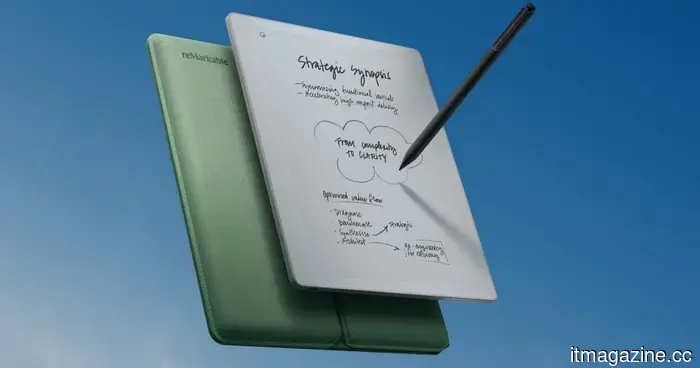 ReMarkable Paper Pure aims to be the sole notebook you'll ever require.
ReMarkable's latest offering, the Paper Pure, is a straightforward black-and-white paper tablet priced from $399. It boasts a three-week battery life, enhanced navigation speed, and a writing experience that closely resembles that of the top-tier Paper Pro.
Google is in discussions with Blackstone, KKR, and EQT regarding an omnibus licensing agreement for Gemini AI, while OpenAI and Anthropic are establishing consulting businesses.
Alphabet is in discussions for an omnibus Gemini licensing agreement with Blackstone, KKR, and EQT. This approach differs from OpenAI's $10 billion and Anthropic's $1.5 billion embedded-engineer initiatives.
ReMarkable Paper Pure aims to be the sole notebook you'll ever require.
ReMarkable's latest offering, the Paper Pure, is a straightforward black-and-white paper tablet priced from $399. It boasts a three-week battery life, enhanced navigation speed, and a writing experience that closely resembles that of the top-tier Paper Pro.
Google is in discussions with Blackstone, KKR, and EQT regarding an omnibus licensing agreement for Gemini AI, while OpenAI and Anthropic are establishing consulting businesses.
Alphabet is in discussions for an omnibus Gemini licensing agreement with Blackstone, KKR, and EQT. This approach differs from OpenAI's $10 billion and Anthropic's $1.5 billion embedded-engineer initiatives.
 Google Search updates aim to transform AI responses into a launching pad for you, rather than a cul-de-sac.
Google is introducing five updates to AI Mode and AI Overviews in Search aimed at bringing more links to the forefront and providing users with additional incentives to click on the websites associated with them.
Snap Q1 2026: The war in Iran results in a monthly loss of $20-25 million in advertising revenue, the $400 million deal with Perplexity concludes, and a 16% reduction in the workforce occurs as the company doubles down on its investment in AR glasses.
Snap's revenue for Q1 increased by 12%, yet its stock dropped by 4%. The ongoing conflict in Iran resulted in a loss of $20-25 million in advertising revenue for March. The partnership with Perplexity AI has concluded. Additionally, the company has eliminated 1,000 jobs. The launch of Specs AR glasses represents its final wager.
Google Search updates aim to transform AI responses into a launching pad for you, rather than a cul-de-sac.
Google is introducing five updates to AI Mode and AI Overviews in Search aimed at bringing more links to the forefront and providing users with additional incentives to click on the websites associated with them.
Snap Q1 2026: The war in Iran results in a monthly loss of $20-25 million in advertising revenue, the $400 million deal with Perplexity concludes, and a 16% reduction in the workforce occurs as the company doubles down on its investment in AR glasses.
Snap's revenue for Q1 increased by 12%, yet its stock dropped by 4%. The ongoing conflict in Iran resulted in a loss of $20-25 million in advertising revenue for March. The partnership with Perplexity AI has concluded. Additionally, the company has eliminated 1,000 jobs. The launch of Specs AR glasses represents its final wager.
 Apple TV receives a dozen Tony nominations and is set to achieve an unexpected rare recognition that caught me off guard.
Apple is close to achieving an EGOT after receiving 12 Tony nominations for Schmigadoon!, a theatrical version of its original Apple TV Plus series.
Apple TV receives a dozen Tony nominations and is set to achieve an unexpected rare recognition that caught me off guard.
Apple is close to achieving an EGOT after receiving 12 Tony nominations for Schmigadoon!, a theatrical version of its original Apple TV Plus series.
UFORCE, the first defence technology unicorn in Ukraine, has successfully carried out 150,000 combat missions as unmanned warfare becomes a commercial venture.
UFORCE reached a valuation of $1 billion following 150,000 combat missions. Ukraine asserts that robots have taken territory without the need for infantry for the first time. The unmanned warfare sector is expanding.