
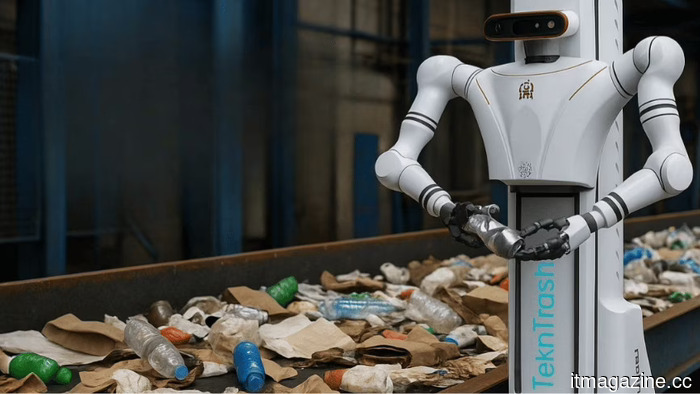
A UK recycling company has introduced a Chinese-manufactured humanoid robot in response to a 40% yearly employee turnover and an eightfold higher fatality rate in the waste sorting industry.
A family-run recycling firm in east London is training a humanoid robot, built in China, to sort waste on its conveyor belts. The company faces a significant labor crisis, with staff turnover at 40 percent and a fatality rate that is eight times higher than the national average. While the robot is not yet operational, the industry's labor challenges make automation an unavoidable necessity.
The recycling sector grapples with a persistent labor issue that cannot be resolved by simply increasing recruitment efforts. Waste sorting facilities experience an annual staff turnover of 40 percent. The fatality rate in this field is significantly higher than in other industries, with work-related health issues also noted to be 45 percent more severe. Workers are tasked with standing next to rapidly moving conveyor belts, pulling out various items—including shoes, concrete blocks, VHS tapes, and even firearms—from mixed waste. The conditions are so dusty and loud that many workers do not stay long enough to develop their skills. Attempts to improve the situation through higher pay, shift rotations, and staffing agencies have not altered the fundamental reality: the work is inherently dangerous, unpleasant, and physically taxing, leading to high turnover as soon as better opportunities arise. In response, a family-owned waste company in east London has decided that the solution does not lie in recruitment strategies but in deploying a humanoid robot trained by the very workers it is meant to replace.
The robot, named Alpha, processes 280,000 tonnes of mixed recycling annually at Sharp Group's facility in Rainham, east London, utilizing 24 agency workers on fast-moving conveyor belts. Founded by Tom Sharp and now run by the third generation of the family, Sharp Group has partnered with RealMan Robotics in China and TeknTrash Robotics, a British startup, to adapt Alpha for recycling tasks.
Alpha operates alongside human workers, designed to integrate seamlessly into existing plant layouts without necessitating a redesign of the facility. This humanoid robot presents a more cost-effective and quicker path to automation for numerous smaller recycling plants that cannot afford extensive renovations. Currently, Alpha is undergoing a training program. During a visit from the BBC, it was being instructed on arm movements while a worker wearing a Meta Quest 3 VR headset demonstrated appropriate sorting actions. TeknTrash’s HoloLab system collects data from various cameras to train Alpha in two main functions: identifying items on the belt and physically lifting them. The system processes thousands of items daily, providing millions of data points for training. Costa, the founder of TeknTrash, remarks on the timeline required for effective training, acknowledging the misunderstanding that robots can be readily deployed and function flawlessly without substantial training data. The training phase will span several months, with plans to implement this system across 1,000 European plants connected to the cloud, contingent on Alpha mastering sorting reliably at one facility first.
The humanoid robot approach is quite rare. The recycling automation market is primarily occupied by companies that have selected alternative methods. For instance, Sereact raised $110 million in April to develop AI that adapts any industrial robot for logistics and manufacturing, aligning with a broader investment trend that favors software capabilities over physical designs. The Colorado-based AMP has raised $91 million in its Series D financing and now operates three of its own plants while supplying AI-powered sorting equipment to over 100 facilities globally. Their system employs air jets to expedite sorting at eight to ten times the speed of human labor. Tim Stuart, AMP’s CEO, emphasizes a fundamentally different strategy focused on engineering sorting intelligence into the system rather than mimicking human movements.
Glacier, a California startup backed by Amazon and co-founded by Rebecca Hu-Thrams, has opted for a middle ground, utilizing mounted robotic arms controlled by AI vision systems that can be integrated into existing facilities without extensive reconstruction. They raised $16 million in 2025, serve nearly one in ten Americans in recycling, and have been recognized in TIME’s Best Inventions list. Hu-Thrams highlights that Glacier's system targets semi-rural facilities with tighter budgets, going beyond just large urban operations. The AI continuously learns from over a billion sorted items to enhance performance. She points out that the challenges posed by variable waste can be quite significant, noting that sorted items can often include hazardous materials like live hand grenades and firearms.
In a real industrial setting in January, Siemens tested a humanoid robot powered by Nvidia technology that successfully picked and moved totes, proving the feasibility of humanoid robots for industrial applications. However, the challenges in recycling environments are significant, as these systems must contend with the unpredictable nature of waste streams, where items can be wet, broken, or tangled. A humanoid capable of sorting waste effectively would likely perform well in various factory settings; hence, automating the recycling process is a complex engineering challenge.
Tesla plans to mass-produce its Optimus humanoid robot from its Shanghai Gigafactory, having already deployed over 1,000 Gen 3 units in its facilities, with plans for large-scale production between 2026 and
Другие статьи
 Schools are utilizing VR headsets to alleviate student stress and address attention problems.
Schools in London are utilizing VR headsets to assist students in coping with exam stress and ADHD, with 90% of students reporting a quick decrease in stress levels.
Schools are utilizing VR headsets to alleviate student stress and address attention problems.
Schools in London are utilizing VR headsets to assist students in coping with exam stress and ADHD, with 90% of students reporting a quick decrease in stress levels.
 Google Pixel 11 series: Tensor G6, Pixel Glow, updated cameras, and all other information that has been leaked thus far.
The Google Pixel 11 series is several months from launch, but leaks have already disclosed information regarding the new Tensor G6 chip, design modifications, camera enhancements, and more. Here's all the information we have at this point.
Intel reaches an all-time high amid discussions with Apple about foundry services, as the US government's $8.9 billion investment sees a 300% return in just nine months.
Intel’s shares surged 14% due to discussions regarding chip manufacturing with Apple, building on a 330% increase since the government acquired a 10% stake. The 18A node is attracting interest from Apple, Musk, and Amazon.
Google Pixel 11 series: Tensor G6, Pixel Glow, updated cameras, and all other information that has been leaked thus far.
The Google Pixel 11 series is several months from launch, but leaks have already disclosed information regarding the new Tensor G6 chip, design modifications, camera enhancements, and more. Here's all the information we have at this point.
Intel reaches an all-time high amid discussions with Apple about foundry services, as the US government's $8.9 billion investment sees a 300% return in just nine months.
Intel’s shares surged 14% due to discussions regarding chip manufacturing with Apple, building on a 330% increase since the government acquired a 10% stake. The 18A node is attracting interest from Apple, Musk, and Amazon.
 Google Pixel 11 series: Tensor G6, Pixel Glow, updated cameras, and all other details that have been leaked so far.
The Google Pixel 11 series is several months from release, but leaks have already disclosed information regarding the new Tensor G6 chip, design modifications, camera enhancements, and additional features. Here’s all the information we currently have.
Intel reaches an all-time high amid discussions with Apple regarding foundry services, as the US government's $8.9 billion investment sees a 300% return in just nine months.
Intel's shares rose 14% following discussions about chip manufacturing with Apple, adding to a 330% increase since the government acquired a 10% stake. The 18A node is attracting interest from Apple, Musk, and Amazon.
Google Pixel 11 series: Tensor G6, Pixel Glow, updated cameras, and all other details that have been leaked so far.
The Google Pixel 11 series is several months from release, but leaks have already disclosed information regarding the new Tensor G6 chip, design modifications, camera enhancements, and additional features. Here’s all the information we currently have.
Intel reaches an all-time high amid discussions with Apple regarding foundry services, as the US government's $8.9 billion investment sees a 300% return in just nine months.
Intel's shares rose 14% following discussions about chip manufacturing with Apple, adding to a 330% increase since the government acquired a 10% stake. The 18A node is attracting interest from Apple, Musk, and Amazon.
 Schools are utilizing VR headsets to alleviate student stress and address attention problems.
Schools in London are utilizing VR headsets to assist students in coping with exam stress and ADHD, with 90% of students indicating a prompt reduction in their stress levels.
Schools are utilizing VR headsets to alleviate student stress and address attention problems.
Schools in London are utilizing VR headsets to assist students in coping with exam stress and ADHD, with 90% of students indicating a prompt reduction in their stress levels.
A UK recycling company has introduced a Chinese-manufactured humanoid robot in response to a 40% yearly employee turnover and an eightfold higher fatality rate in the waste sorting industry.
A UK recycling company has introduced a Chinese-made humanoid robot to address the challenges in the waste sorting industry, which experiences a 40% annual employee turnover and an eightfold increase in fatality rates.