
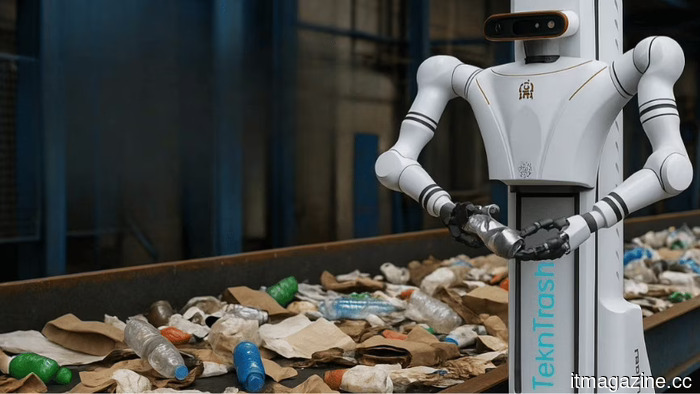
A UK recycling company has introduced a Chinese-made humanoid robot to address the challenges in the waste sorting industry, which is experiencing a 40% annual employee turnover and an eightfold higher fatality rate.
A family-operated recycling company in East London is training a humanoid robot, built in China, to sort waste on conveyor belts, amid staff turnover of 40% and a fatality rate eight times higher than the national norm. Although the robot isn't yet functioning, the ongoing labor crisis in the industry makes automation unavoidable.
The recycling sector is facing a labor issue that recruitment efforts cannot resolve. Employee turnover in waste sorting facilities stands at 40% annually, with fatalities eight times the average across other industries. Injuries and health issues related to work are 45% more prevalent compared to other sectors. Workers must endure exhausting conditions, standing next to a rapidly moving conveyor belt to remove various items from a mixed waste stream, including shoes, concrete blocks, VHS tapes, and occasionally firearms. The hazardous and uncomfortable nature of the work has led to numerous attempts at improving conditions through higher pay, shift rotations, and temporary staffing, yet fundamentally, the work remains perilous and labor-intensive. Consequently, workers leave as soon as they find alternative employment options. In an East London skip yard, the family-run waste firm has determined that a humanoid robot trained by existing staff is a better solution than merely enhancing recruitment strategies.
The robot
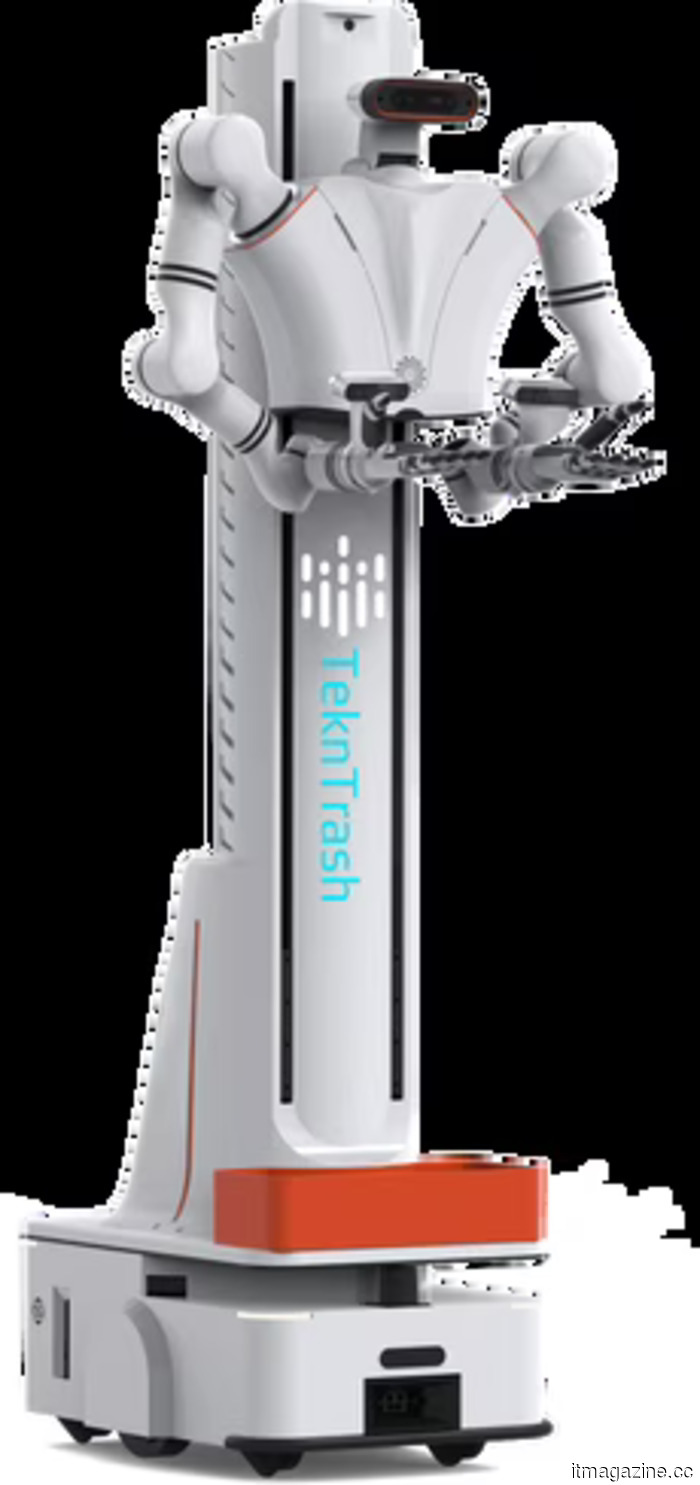
Sharp Group processes around 280,000 tonnes of mixed recycling annually at its facility in Rainham, East London, employing 24 agency workers on fast-moving conveyor belts. Established by Tom Sharp and currently operated by his family's third generation, the company has introduced a humanoid robot named Alpha. Alpha was developed by RealMan Robotics in China and modified for recycling use by the British startup TeknTrash Robotics.
Alpha, the Automated Litter Processing Humanoid Assistant, takes its place at the sorting line like a human employee. This design choice allows it to fit into existing facility layouts without necessitating costly redesign. Other companies, such as Colorado's AMP and California's Glacier, have opted for specially designed sorting systems integrating robotic arms, air jets, and AI vision, which require either new facilities or expensive retrofitting. A humanoid robot that can operate in the same way as a human could provide a more affordable and quicker approach to automation for numerous smaller recycling plants that cannot finance extensive renovations.
Currently, Alpha is in training, as noted during a BBC visit. It is learning arm movements, while a worker nearby uses a Meta Quest 3 VR headset to record their own sorting actions to illustrate proper picking techniques. TeknTrash's HoloLab system compiles data from various cameras to teach the robot two parallel tasks: recognizing items on the conveyor belt and physically lifting them. The system processes thousands of items daily, generating millions of data points, but Costa is realistic about the timeline. He states that there's a misconception that these robots are ready for immediate deployment, but they require substantial data for effective operation. The training is projected to take several months, and TeknTrash aspires to implement the same system across 1,000 plants in Europe, all linked to the cloud, depending on Alpha's ability to sort consistently in one facility first.
The competition
The humanoid approach is uncommon, with the recycling automation market largely dominated by companies following different strategies. Sereact raised $110 million in April to develop AI that makes any industrial robot versatile in logistics and manufacturing, demonstrating a broader trend that prioritizes software over hardware. Colorado's AMP has raised $91 million in its Series D funding round, currently running three of its own plants while providing AI-driven sorting equipment to over 100 facilities globally. Its system utilizes air jets to direct items into chutes at speeds eight to ten times greater than a human worker's pace. CEO Tim Stuart describes their method as fundamentally distinct from simply emulating human movement, advocating instead for embedding sorting intelligence within the system and building the physical framework around it.
Glacier, a California-based startup backed by Amazon and co-founded by Rebecca Hu-Thrams, has adopted a hybrid approach using mounted robotic arms operated by AI vision systems that can integrate into existing facilities without requiring complete reconstruction. The company secured $16 million in 2025 and now recycles for nearly 10% of Americans. Hu-Thrams highlights that Glacier's system is tailored for semi-rural facilities with limited budgets, not just larger urban centers. The AI learns from over a billion sorted items, continuously improving. The variability of waste presents a significant technical challenge—Hu-Thrams notes that her clients have confronted hazards as severe as hand grenades and firearms on the sorting lines.
The industrial logic
In January, Siemens introduced an Nvidia-powered humanoid robot in a live factory setting, tasked with picking totes from storage stacks and relocating them to conveyor belts during a two-week trial. This test illustrated that humanoid robots can operate effectively in real industrial environments, but it also showcased the disparity between controlled demonstrations and ongoing production use. The recycling environment presents greater challenges—factory floors are organized and predictable, whereas recycling conveyor belts transport an unpredictable mix of items at varying speeds, many of
Other articles
 Xteink's newest e-reader offers Android functionality on a compact screen that attaches to your phone.
Xteink's latest S4 replaces its proprietary operating system with Android 11, allowing the use of third-party reading applications such as Kindle, Kobo, and Libby.
Intel reaches record peak amid discussions with Apple on foundry services, while the US government's $8.9 billion investment sees a 300% gain in just nine months.
Intel's stock surged 14% due to discussions about chip manufacturing with Apple, continuing a 330% increase since the government acquired a 10% stake. The 18A node is attracting interest from Apple, Musk, and Amazon.
Xteink's newest e-reader offers Android functionality on a compact screen that attaches to your phone.
Xteink's latest S4 replaces its proprietary operating system with Android 11, allowing the use of third-party reading applications such as Kindle, Kobo, and Libby.
Intel reaches record peak amid discussions with Apple on foundry services, while the US government's $8.9 billion investment sees a 300% gain in just nine months.
Intel's stock surged 14% due to discussions about chip manufacturing with Apple, continuing a 330% increase since the government acquired a 10% stake. The 18A node is attracting interest from Apple, Musk, and Amazon.
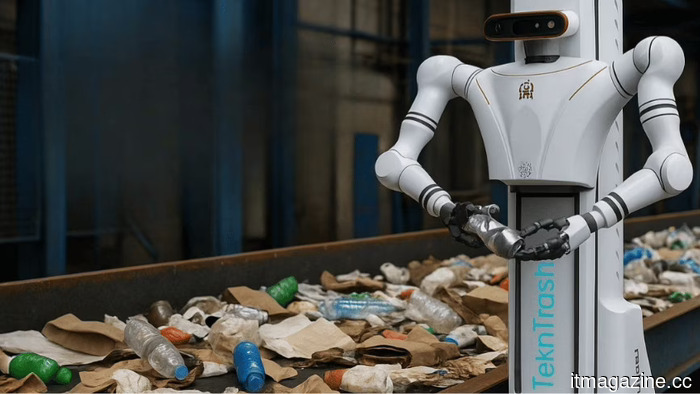 A UK recycling company has introduced a Chinese-manufactured humanoid robot in response to a 40% yearly employee turnover and an eightfold higher fatality rate in the waste sorting industry.
A UK recycling company has introduced a Chinese-made humanoid robot to address the challenges in the waste sorting industry, which experiences a 40% annual employee turnover and an eightfold increase in fatality rates.
A UK recycling company has introduced a Chinese-manufactured humanoid robot in response to a 40% yearly employee turnover and an eightfold higher fatality rate in the waste sorting industry.
A UK recycling company has introduced a Chinese-made humanoid robot to address the challenges in the waste sorting industry, which experiences a 40% annual employee turnover and an eightfold increase in fatality rates.
 Schools are utilizing VR headsets to alleviate student stress and address attention problems.
Schools in London are utilizing VR headsets to assist students in coping with exam stress and ADHD, with 90% of students indicating a prompt reduction in their stress levels.
Schools are utilizing VR headsets to alleviate student stress and address attention problems.
Schools in London are utilizing VR headsets to assist students in coping with exam stress and ADHD, with 90% of students indicating a prompt reduction in their stress levels.
 Schools are utilizing VR headsets to alleviate student stress and address attention problems.
Schools in London are utilizing VR headsets to assist students in coping with exam stress and ADHD, with 90% of students reporting a quick decrease in stress levels.
Schools are utilizing VR headsets to alleviate student stress and address attention problems.
Schools in London are utilizing VR headsets to assist students in coping with exam stress and ADHD, with 90% of students reporting a quick decrease in stress levels.
 Google Pixel 11 series: Tensor G6, Pixel Glow, updated cameras, and all other information that has been leaked thus far.
The Google Pixel 11 series is several months from launch, but leaks have already disclosed information regarding the new Tensor G6 chip, design modifications, camera enhancements, and more. Here's all the information we have at this point.
Google Pixel 11 series: Tensor G6, Pixel Glow, updated cameras, and all other information that has been leaked thus far.
The Google Pixel 11 series is several months from launch, but leaks have already disclosed information regarding the new Tensor G6 chip, design modifications, camera enhancements, and more. Here's all the information we have at this point.
A UK recycling company has introduced a Chinese-made humanoid robot to address the challenges in the waste sorting industry, which is experiencing a 40% annual employee turnover and an eightfold higher fatality rate.
A UK recycling company has introduced a humanoid robot made in China to address the challenges in the waste sorting industry, which is experiencing a 40% annual turnover of staff and an eightfold higher fatality rate.