
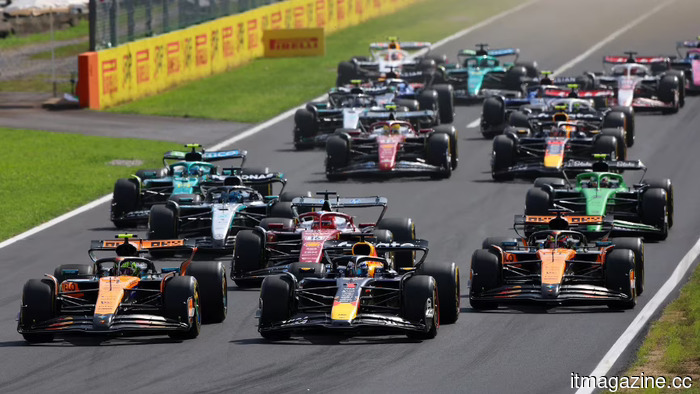
AI has now become a sponsor, strategist, and technical director in F1.
In six months, eight AI partnerships have been established, with Williams utilizing Claude, McLaren employing Gemini, and Red Bull enhancing its relationship with Oracle. The overhaul of regulations for 2026 has transformed the paddock into one of the largest real-time commercial AI applications in sports.
Formula One teams have always relied on data behind the scenes but have become more vocal about it recently. A Reuters report indicates that, in the past six months, eight new AI partnerships have been signed across the F1 paddock, with the technology category now dominating team budgets. AI and machine-learning companies account for four of the top 15 new sponsorship investors in the sport. Highlights include Williams using Anthropic’s Claude, Red Bull deepening its Oracle collaboration, and McLaren's long-standing partnership with Google transitioning to Gemini.
This development can be seen as either an expected convergence or as a significant moment when a sport primarily focused on engineering has openly embraced software as well.
Revenue from technology has become the leading spending category for F1 teams, reaching around $769 million last season, a 41 percent increase from the previous year, according to Ampere Analysis. The Reuters report elaborates on sponsorship details, highlighting a concentration of AI and cloud partnerships. CoreWeave, a GPU-cloud provider, has joined Aston Martin, while Oracle has expanded its role with Red Bull. Anthropic, a newcomer to motorsport sponsorship, is integrating Claude into Williams’ operational and race strategy. Google has incorporated Gemini into McLaren's data-analysis platform. Each of these partnerships serves as both a marketing initiative and a significant operational investment.
The defining characteristic of this shift is the blend of sponsor logos and operational technologies. Traditionally, F1 sponsors showcased logos on cars and operated hospitality suites, whereas the 2026 framework aligns more with deployed enterprise contracts. Engineers from Anthropic reportedly collaborate with Williams’ strategy team, CoreWeave supports Aston Martin’s computational fluid dynamics (CFD) processes, and Oracle's systems inform Red Bull’s pit wall strategies, effectively making sponsorship an integral part of operational deployment.
The catalyst for this transformation is the 2026 technical regulation overhaul, the largest rule change in over ten years. The new specifications for chassis and power units have altered the dynamics of car development, favoring teams adept at swiftly assessing numerous design variations while placing those reliant on physical wind-tunnel testing at a disadvantage. For example, Racing Bulls joined forces with Neural Concept to leverage digital twins and machine learning for aerodynamic assessments that can't be physically tested within FIA's limited testing period. Most teams have adopted similar strategies.
Since the introduction of a budget cap in 2022, F1 has evolved into a sport where competitive advantage is increasingly dictated by financial resources, computational ability, and talent access. IMD's analysis suggests that in this cost-constrained environment, success comes from maximizing decision quality for every dollar spent on computation rather than from sheer expenditure. Generative AI, utilized in strategy rooms and engineering departments, perfectly fits this model.
During race weekends, the AI's visible contributions manifest in real time. For instance, McLaren, leveraging Google Cloud’s technology, conducts nearly 300 million race simulations ahead of a Grand Prix, with generative models revealing pit strategies and tire combinations that would be beyond human analysis in the limited time available. McLaren's chief AI officer has noted that the accuracy of these predictions approaches an "almost eerie level" of alignment with actual race outcomes.
Beyond the visible efforts, Formula 1 itself has built generative AI processes on AWS to expedite race-day problem-solving, such as handling telemetry anomalies and streamlining communication of pit-lane incidents to broadcasters. Lenovo trialed its ThinkPad X9 Aura Edition during the Chinese Grand Prix, using a MATLAB model to provide insights over 30% faster than non-AI laptops, demonstrating how incremental improvements can compound across 24 race weekends.
The FIA is also reportedly deploying AI to address one of the sport's most controversial technical issues in 2026, with an algorithmic approach to rule enforcement and design. Formula1.com's profile of the FIA's new "tech director" points to this shift, aiming to equip the regulator with the analytical tools already at the teams' disposal.
The Anthropic-Williams partnership exemplifies a broader strategy at the model company. Recently, Anthropic announced plans to launch a $1.5 billion enterprise AI services firm with major investment firms, aimed at embedding Claude into the operations of significant buyout companies. The Williams implementation serves as a high-profile testing ground for Claude's capabilities in a real-time decision-making environment. Insights from Williams’ experiences will likely benefit Anthropic’s enterprise clients soon after.
A key feature of F1 sponsorship that AI vendors are quickly realizing is that the sport acts as a public testing ground for technology. With cars racing every other weekend, successful strategies and technologies are often documented widely by media outlets.
The data generated by the cars themselves has also reached a scale that justifies AI investments. Reports suggest that Mc
Other articles
 GameStop offers $55.5 billion for eBay, backed by a $9 billion cash reserve, a $20 billion letter from TD Bank, and a dwindling retail sector.
GameStop, led by Ryan Cohen, has proposed a bid of $125 per share for eBay in cash and stock. However, the market seems to doubt this offer, as eBay's shares are currently trading at $110 while GameStop's stock has declined. Michael Burry is offloading his shares.
GameStop offers $55.5 billion for eBay, backed by a $9 billion cash reserve, a $20 billion letter from TD Bank, and a dwindling retail sector.
GameStop, led by Ryan Cohen, has proposed a bid of $125 per share for eBay in cash and stock. However, the market seems to doubt this offer, as eBay's shares are currently trading at $110 while GameStop's stock has declined. Michael Burry is offloading his shares.
 STMicroelectronics aims to generate over $3 billion from the space sector.
STMicroelectronics aims for over $3 billion in total revenue from space chips from 2026 to 2028, driven by the growth of Starlink.
STMicroelectronics aims to generate over $3 billion from the space sector.
STMicroelectronics aims for over $3 billion in total revenue from space chips from 2026 to 2028, driven by the growth of Starlink.
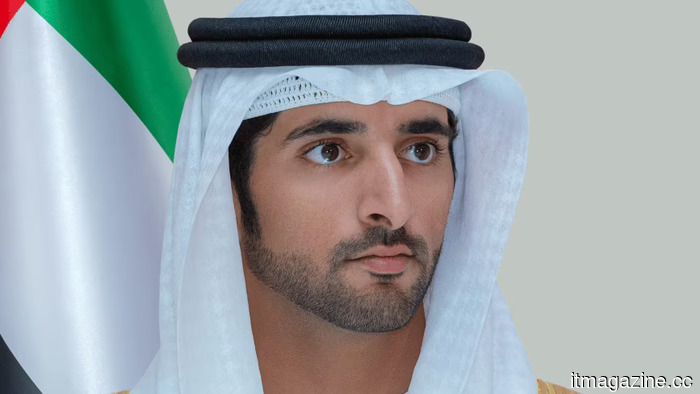 Dubai requires private sector companies to adopt agentic AI within two years, supported by incubators, training programs, and specialized funding.
Sheikh Hamdan initiates a two-year initiative aimed at encouraging Dubai's private sector to embrace agentic AI. Training will be provided to all business councils, incubators, and funds via the Chamber.
Dubai requires private sector companies to adopt agentic AI within two years, supported by incubators, training programs, and specialized funding.
Sheikh Hamdan initiates a two-year initiative aimed at encouraging Dubai's private sector to embrace agentic AI. Training will be provided to all business councils, incubators, and funds via the Chamber.
 Do you believe music has been most negatively affected by slop? Podcasts have also been significantly impacted by AI.
A surge of AI-generated podcasts is rapidly spreading across audio platforms, with a Bloomberg report indicating that approximately 39% of new podcast feeds established in about nine days might have been created by machines.
Do you believe music has been most negatively affected by slop? Podcasts have also been significantly impacted by AI.
A surge of AI-generated podcasts is rapidly spreading across audio platforms, with a Bloomberg report indicating that approximately 39% of new podcast feeds established in about nine days might have been created by machines.
 Do you think music has been the most affected by slop? AI has also significantly impacted podcasts.
A surge of AI-generated podcasts is rapidly spreading across audio platforms, with a Bloomberg report indicating that approximately 39% of new podcast feeds established in a span of about nine days might have been created by machines.
Do you think music has been the most affected by slop? AI has also significantly impacted podcasts.
A surge of AI-generated podcasts is rapidly spreading across audio platforms, with a Bloomberg report indicating that approximately 39% of new podcast feeds established in a span of about nine days might have been created by machines.
 Do you believe music is the most affected by sloppiness? AI has also greatly tainted podcasts.
A surge of AI-produced podcasts is rapidly spreading across audio platforms, with a Bloomberg report indicating that around 39% of new podcast feeds established in approximately nine days might have been created by machines.
Do you believe music is the most affected by sloppiness? AI has also greatly tainted podcasts.
A surge of AI-produced podcasts is rapidly spreading across audio platforms, with a Bloomberg report indicating that around 39% of new podcast feeds established in approximately nine days might have been created by machines.
AI has now become a sponsor, strategist, and technical director in F1.
In the past six months, Formula One has welcomed eight new AI partnerships, with Williams utilizing Claude, McLaren employing Gemini, and Red Bull partnering with Oracle.