

China prohibits foreign investment in the Manus AI project as examination of AI exports increases.
Credit: Manus
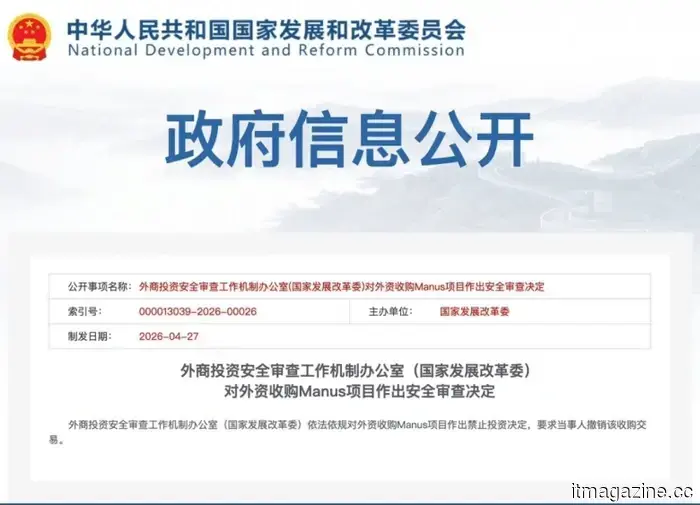
Today, China’s National Development and Reform Commission (NDRC) announced that, in alignment with its laws and regulations, it has decided to prohibit foreign investment aimed at acquiring the general-purpose AI project Manus. Additionally, it has mandated that the involved parties promptly withdraw and cancel all related acquisition activities.
This decision represents a significant move in China’s regulation of foreign mergers and acquisitions within the tech sector, underscoring its commitment to uphold national technological sovereignty and data security.
The Manus project was initiated in March 2025 by the Chinese team Monica.im (Beijing Butterfly Effect Technology) and is referred to by its developers as a general-purpose AI agent. Its main ability is to autonomously handle complex computer-based tasks within a virtual environment, encompassing activities such as market research, code review, and event planning, while also supporting comprehensive output delivery.
However, the cross-border transfer of this technological development has attracted considerable regulatory scrutiny. Investigations indicate that Manus’ core technologies were created in China and involve processing a large volume of user data. Although its parent company has relocated its registered headquarters to Singapore, its affiliated entities in China—Beijing Red Butterfly Technology and Beijing Butterfly Effect Technology—are still operational. The technical foundation and domestic entities have not been legally dissociated.
Credit: Manus
As per China’s Measures for the Security Review of Foreign Investment, the Catalogue of Technologies Prohibited and Restricted from Export in China, and the Measures for Security Assessment of Data Export, core AI algorithms are classified as restricted export technologies. Thus, cross-border transfers necessitate adherence to technology export licensing protocols and data security evaluation standards.
In a related case concerning Meta's acquisition, the involved parties reportedly neglected to comply with the mandatory procedures for declaring technology export and data outbound transfers, and may have attempted to bypass regulatory oversight through structural modifications, leading to the activation of the national security review mechanism.
The Ministry of Commerce has reiterated that companies involved in cross-border activities must adhere to Chinese laws and regulations and complete all necessary statutory procedures. The recent prohibition reflects a stringent commitment to these compliance requirements.
This incident serves as a warning to the AI sector and highlights China’s strategic approach to balancing technological innovation with national security in a global context. As major economies worldwide enhance regulatory scrutiny over cross-border investments in high-tech industries, China is establishing a framework to safeguard its technological sovereignty via stricter regulations and improved oversight.
Looking ahead, technology firms expanding internationally will need to prioritize compliance, balancing business interests with national obligations to ensure stable and sustainable development in global competition.
Jessie Wu is a tech reporter based in Shanghai. She reports on consumer electronics, semiconductors, and the gaming industry for TechNode. Connect with her via e-mail: jessie.wu@technode.com.



Other articles
 China restricts foreign investment in the Manus AI project as increasing scrutiny on AI exports intensifies.
China's National Development and Reform Commission (NDRC) announced today that it has made a decision in accordance with existing laws and regulations.
China restricts foreign investment in the Manus AI project as increasing scrutiny on AI exports intensifies.
China's National Development and Reform Commission (NDRC) announced today that it has made a decision in accordance with existing laws and regulations.
 OpenAI is working on an AI agent smartphone in collaboration with Qualcomm and MediaTek, with a goal of reaching 300-400 million annual shipments by 2028.
According to analyst Ming-Chi Kuo, OpenAI is developing an agent-first smartphone in collaboration with Qualcomm, MediaTek, and Luxshare. The device will feature agents exclusively, without traditional apps. Mass production is aimed for 2028. Following the news, Qualcomm's stock rose by 13%.
Microsoft relinquishes its exclusive license to OpenAI's technology.
Microsoft and OpenAI have revised their partnership agreement, making Microsoft's license non-exclusive until 2032.
OpenAI is working on an AI agent smartphone in collaboration with Qualcomm and MediaTek, with a goal of reaching 300-400 million annual shipments by 2028.
According to analyst Ming-Chi Kuo, OpenAI is developing an agent-first smartphone in collaboration with Qualcomm, MediaTek, and Luxshare. The device will feature agents exclusively, without traditional apps. Mass production is aimed for 2028. Following the news, Qualcomm's stock rose by 13%.
Microsoft relinquishes its exclusive license to OpenAI's technology.
Microsoft and OpenAI have revised their partnership agreement, making Microsoft's license non-exclusive until 2032.
 Over 580 Google employees, including researchers from DeepMind, are urging Pichai to decline a classified AI agreement with the Pentagon.
More than 580 Google employees have signed a letter in opposition to classified military AI projects. On air-gapped networks, Google is unable to track the usage of Gemini. Last year, the company eliminated its own restrictions regarding weapons.
Over 580 Google employees, including researchers from DeepMind, are urging Pichai to decline a classified AI agreement with the Pentagon.
More than 580 Google employees have signed a letter in opposition to classified military AI projects. On air-gapped networks, Google is unable to track the usage of Gemini. Last year, the company eliminated its own restrictions regarding weapons.
 OpenAI is collaborating with Qualcomm and MediaTek to develop an AI agent smartphone, aiming for 300-400 million annual shipments by 2028.
According to analyst Ming-Chi Kuo, OpenAI is developing an agent-first smartphone in collaboration with Qualcomm, MediaTek, and Luxshare. The phone will feature no apps, only agents. Mass production is aimed for 2028. Following this news, Qualcomm's shares rose by 13%.
OpenAI is collaborating with Qualcomm and MediaTek to develop an AI agent smartphone, aiming for 300-400 million annual shipments by 2028.
According to analyst Ming-Chi Kuo, OpenAI is developing an agent-first smartphone in collaboration with Qualcomm, MediaTek, and Luxshare. The phone will feature no apps, only agents. Mass production is aimed for 2028. Following this news, Qualcomm's shares rose by 13%.
China prohibits foreign investment in the Manus AI project as examination of AI exports increases.
Today, China’s National Development and Reform Commission (NDRC) announced that it has made a decision in compliance with laws and regulations.