
Samsung's latest display technology allows for switching between 2D and 3D on OLED panels without the need for glasses.
Samsung Research, in collaboration with POSTECH from South Korea, has released a paper in the journal Nature detailing a significant advancement in display technology. The company is developing a switchable 2D/3D system that operates without the need for glasses or eye-tracking devices.
This system does not add significant bulk to the display. It utilizes a Metasurface Lenticular Lens, an ultra-thin optical layer measuring just 1.2mm in thickness, composed of nanoscale structures that manipulate light behavior and subsequently influence our perception of the display’s emitted light.
How does the technology function?
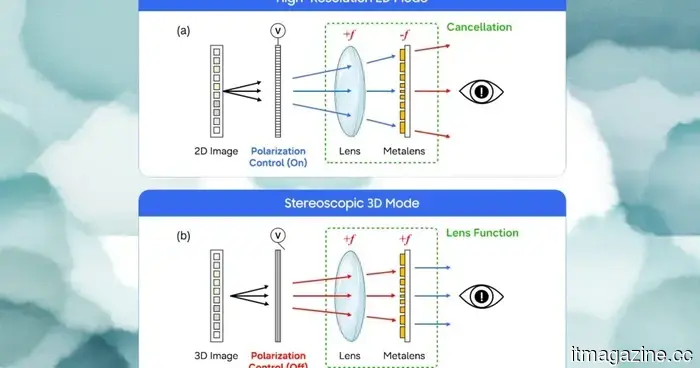
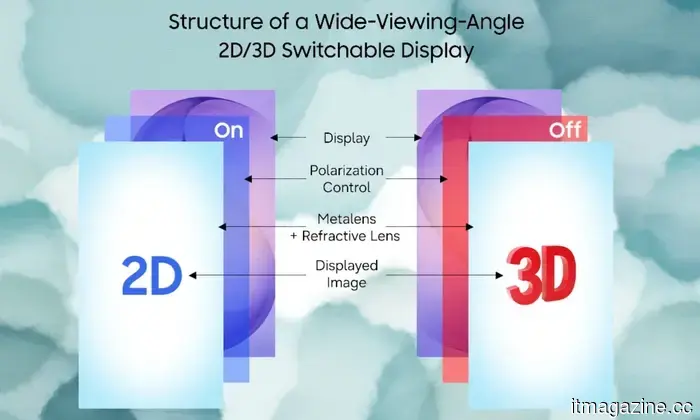
The lens uses voltage control to switch between two modes by altering the light’s polarization. In 2D mode, the lens serves as a concave component, allowing light to filter through to produce a sharp, high-resolution flat or two-dimensional image, which is familiar to us on devices such as smartphones, laptops, and standard televisions.
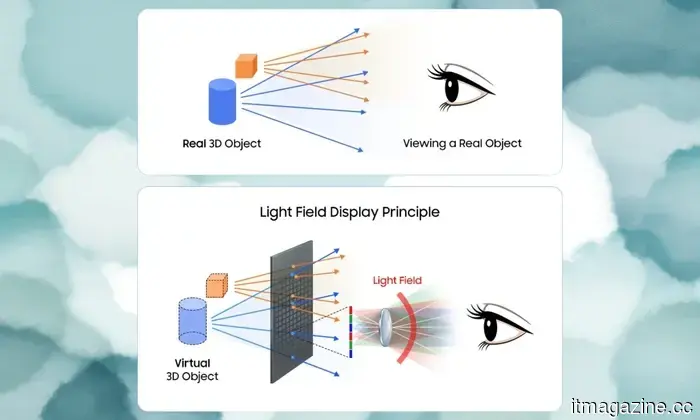
This mode is optimal for activities like reading and browsing. Conversely, when switched to 3D mode, the lens changes to a convex shape, bending light to generate depth and a stereoscopic perspective, all without the need for glasses.
It is noteworthy that this system is the first meta-optical design capable of transitioning from 2D to 3D within a single device using only voltage control.
Why is this significant?
The research team has developed a large-area metalens (50x50mm) and tested it on OLED panels, the same technology used in the majority of today’s smartphones, as well as in some TVs and laptops.
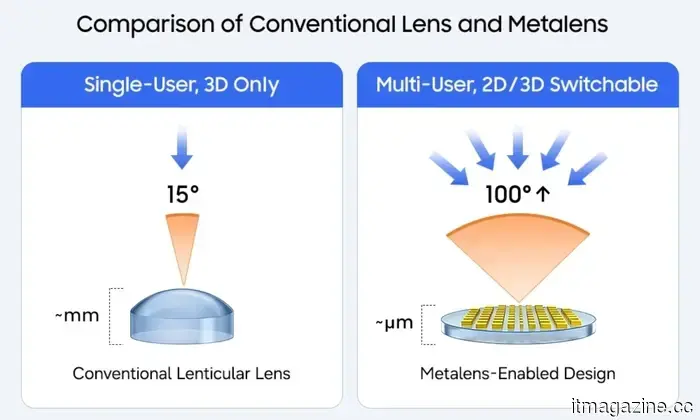
Historically, glasses-free 3D displays have had a limited viewing angle of approximately 15°, necessitating precise alignment for the 3D effect to be maintained. However, Samsung’s innovation provides a 100° viewing angle, more than six times broader.
This advancement could enable multiple users to experience 3D content simultaneously from various positions. Potential applications of this technology include tablets, augmented reality, medical imaging, and everyday use in smartphones or televisions.
It is important to note that there is currently no product launch associated with this announcement. Nevertheless, the implementation of glasses-free 3D technology, which has been proven on OLED panels and offers a wider viewing angle, marks a significant progression in display technology.
Other articles
 Instagram's new Instants app is essentially a repeat of Snapchat.
Instagram introduces Instants, a new application for sharing temporary photos and videos, providing a Snapchat-esque experience centered on private, real-time communication.
Instagram's new Instants app is essentially a repeat of Snapchat.
Instagram introduces Instants, a new application for sharing temporary photos and videos, providing a Snapchat-esque experience centered on private, real-time communication.
 OpenAI advances ChatGPT's capability for autonomous tasks with GPT-5.5.
OpenAI has introduced GPT-5.5, with an emphasis on enhancing ChatGPT's capability to manage complex tasks and real-world processes.
OpenAI advances ChatGPT's capability for autonomous tasks with GPT-5.5.
OpenAI has introduced GPT-5.5, with an emphasis on enhancing ChatGPT's capability to manage complex tasks and real-world processes.
 OpenAI advances ChatGPT's capabilities for autonomous tasks with GPT-5.5.
OpenAI has released GPT-5.5, which aims to enhance ChatGPT’s capacity for managing intricate tasks and real-world processes.
OpenAI advances ChatGPT's capabilities for autonomous tasks with GPT-5.5.
OpenAI has released GPT-5.5, which aims to enhance ChatGPT’s capacity for managing intricate tasks and real-world processes.
 Steam Machine seems to be the advancement in gaming PCs that I genuinely desire — thanks to Windows.
The new Steam Machine has caught my eye since Valve is designing it with an operating system that prioritizes gaming as the primary focus.
Steam Machine seems to be the advancement in gaming PCs that I genuinely desire — thanks to Windows.
The new Steam Machine has caught my eye since Valve is designing it with an operating system that prioritizes gaming as the primary focus.
 Microsoft Copilot can now perform real tasks within your Word, Excel, and PowerPoint documents.
Copilot's new Agent Mode can create and reorganize Word documents, formulate and create tables in Excel, and modify PowerPoint presentations, all in real time.
Microsoft Copilot can now perform real tasks within your Word, Excel, and PowerPoint documents.
Copilot's new Agent Mode can create and reorganize Word documents, formulate and create tables in Excel, and modify PowerPoint presentations, all in real time.
Samsung's latest display technology allows for switching between 2D and 3D on OLED panels without the need for glasses.
Samsung's innovative metasurface lenticular lens, detailed in Nature, transitions from clear 2D images to glasses-free 3D using voltage control and provides a 100-degree viewing angle within a 1.2mm thickness.