
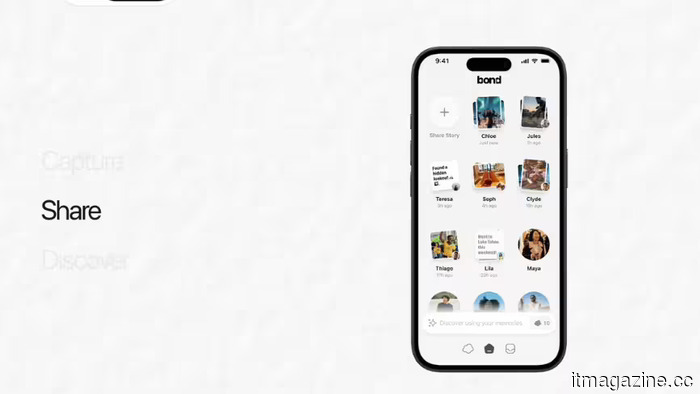
Bond introduces a post-feed social network that utilizes AI memories to combat doomscrolling, although its data model has sparked some concerns.
In summary: Bond, a new "post-feed" social network created by former Index Ventures principal Dino Becirovic and ex-Google DeepMind researcher Arthur Brazinskas, launched on April 21. The platform avoids infinite scrolling and an algorithmic feed, instead employing AI to analyze users’ photos, videos, and audio to suggest real-world activities. It joins the expanding "healthier social media" category alongside Tangle (backed by Twitter and Pinterest co-founders), BeReal, and Locket. However, its long-term business model that involves licensing user data for AI training, coupled with the absence of end-to-end encryption at launch, creates contradictions with its stance against exploitation.
Bond, which debuted on Tuesday, does not operate with a traditional feed. Users won't encounter infinite scrolling, algorithmic timelines, or endless short video carousels intended to keep them continuously engaged. Instead, users share photos, videos, and audio as "memories," and Bond’s AI analyzes these to recommend real-life experiences, such as suggesting a restaurant serving a cuisine you frequently post about or informing you of nearby concerts for bands featured in your clips. The concept is that a social network should inspire users to disconnect from their devices rather than encourage them to remain glued to them. The sustainability of this idea amidst the economic realities of consumer technology remains unclear.
Bond was established by Dino Becirovic, who previously worked as a principal at Index Ventures, focusing on consumer internet and marketplace investments, and has experience at Kleiner Perkins, Goldman Sachs, and Twitter. Co-founder Arthur Brazinskas has expertise in AI integration from his time at Google Gemini and holds a PhD from the University of Edinburgh in opinion summarization. The team includes former product builders from TikTok, Twitter, and Facebook, and the app is available on both iOS and Android from the outset. The details of its funding have not been made public.
What "post-feed" entails in practice
The interface clusters user profiles rather than offering a scrollable feed. Tapping on a profile reveals that individual’s current stories, with no equivalent to Instagram’s Explore page or TikTok’s For You feed. The design deliberately introduces more friction than typical social media by requiring users to navigate intentionally rather than consume passively.
The AI component builds on this framework, utilizing user memories—photos, videos, and audio—to learn personal preferences, interests, and habits. Consequently, Bond offers tailored recommendations for experiences, events, and activities. For example, if you've recently posted about your love for pho, Bond might suggest a nearby Vietnamese restaurant with positive reviews. If you’re into heavy metal, it may inform you about an upcoming Iron Maiden concert in your area.
Users control their data within a Memory tab or interact via what Bond calls "Memory chat," an AI chat interface for reviewing, editing, or deleting content. Users have the option to delete their entire profile. While end-to-end encryption isn’t available at launch, Becirovic has mentioned it as a priority for the near future. Meanwhile, Bond claims to securely store all user data in its database.
The issue it aims to address
Becirovic characterized Bond as “an AI-powered solution to Americans’ screen addiction,” criticizing existing social media platforms for being designed to keep users continuously engaged with their devices, resulting in endless scrolling through distracting feeds. The platform stands in opposition to what he describes as “bed rotting” and “doomscrolling” culture.
The timing of Bond's launch is strategic. A California jury recently found Meta and Google liable for deliberately creating addictive social media platforms during a landmark trial, with numerous similar lawsuits pending. Several European nations are prohibiting children from social media altogether, with countries like Australia, France, Spain, Austria, and Greece seeking to limit access for minors, while the EU Parliament is advocating for a continent-wide age minimum of 16. EU regulators have already acted against features that incentivize excessive screen time, leading to TikTok discontinuing its Lite Rewards program after a commissioner articulated that “the available brain time of young Europeans is not a currency for social media.” The current cultural and regulatory landscape is increasingly unfavorable to the engagement-maximization model that drives the industry.
Bond is not alone
The “healthier social media” category is steadily expanding. Tangle, created by Twitter co-founder Biz Stone and Pinterest co-founder Evan Sharp, raised $29 million and poses one question to users daily: “What’s your intention for today?” Sharp remarked that the motivation behind Tangle is to combat the “destruction of the human mind and heart” seen over the last 15 years. BeReal invites users to post one unedited photo daily at random times, discouraging the curated and filtered presentation prevalent on Instagram. Locket allows photos to be shared directly to friends' home screens through widgets, without likes, follower counts, or public metrics. Noplace offers a minimalist, text-based social platform featuring chronological posts without infinite scrolling.
Other articles
 Meta is facing a lawsuit regarding fraudulent advertisements on Facebook and Instagram, following the disclosure of internal documents that indicate an anticipated $16 billion in revenue from fraud.
Meta is facing legal actions in the US, Australia, and the UK due to scam advertisements. Internal records reveal that the company estimated that 10% of its revenue for 2024 would be derived from fraudulent ads.
Meta is facing a lawsuit regarding fraudulent advertisements on Facebook and Instagram, following the disclosure of internal documents that indicate an anticipated $16 billion in revenue from fraud.
Meta is facing legal actions in the US, Australia, and the UK due to scam advertisements. Internal records reveal that the company estimated that 10% of its revenue for 2024 would be derived from fraudulent ads.
 ATMOS secures €25.7M to establish routine orbital returns.
ATMOS Space Cargo has secured €25.7 million in a Series A funding round to support three PHOENIX 2 orbital return missions, establish a new defense venture called ATMOS WORKS, and facilitate the development of PHOENIX 3.
ATMOS secures €25.7M to establish routine orbital returns.
ATMOS Space Cargo has secured €25.7 million in a Series A funding round to support three PHOENIX 2 orbital return missions, establish a new defense venture called ATMOS WORKS, and facilitate the development of PHOENIX 3.
 OpenAI transitions ChatGPT advertisements to a cost-per-click model as the $60 CPM diminishes over ten weeks, and ad revenue goals reach $2.5 billion.
OpenAI has shifted the advertising model for ChatGPT from CPM to CPC, implementing bids of $3 to $5 following a decline in launch pricing. The company anticipates generating $2.5 billion in ad revenue this year, despite facing $14 billion in losses.
Unauthorized individuals accessed Anthropic's restricted Mythos AI model.
On the day of its launch, a Discord group was able to access Anthropic’s Mythos AI model by deducing its URL through a third-party vendor environment.
OpenAI transitions ChatGPT advertisements to a cost-per-click model as the $60 CPM diminishes over ten weeks, and ad revenue goals reach $2.5 billion.
OpenAI has shifted the advertising model for ChatGPT from CPM to CPC, implementing bids of $3 to $5 following a decline in launch pricing. The company anticipates generating $2.5 billion in ad revenue this year, despite facing $14 billion in losses.
Unauthorized individuals accessed Anthropic's restricted Mythos AI model.
On the day of its launch, a Discord group was able to access Anthropic’s Mythos AI model by deducing its URL through a third-party vendor environment.
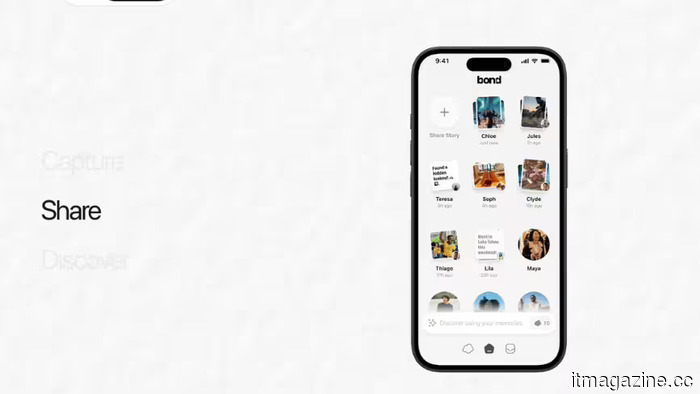 Bond has introduced a post-feed social network that utilizes AI memories to combat doomscrolling, although its data model has sparked concerns.
Bond does not feature a feed or infinite scrolling. Instead, its AI analyzes your photos and videos to suggest real-life activities. The company's business strategy includes licensing that data.
Bond has introduced a post-feed social network that utilizes AI memories to combat doomscrolling, although its data model has sparked concerns.
Bond does not feature a feed or infinite scrolling. Instead, its AI analyzes your photos and videos to suggest real-life activities. The company's business strategy includes licensing that data.
Bond introduces a post-feed social network that utilizes AI memories to combat doomscrolling, although its data model has sparked some concerns.
Bond does not feature a feed or infinite scrolling. Its AI analyzes your photos and videos to suggest real-life activities. The business model aims to monetize this data through licensing.