
Stanford AI Index 2026: China reduces the US advantage to 2.7% while investing 23 times less in AI.
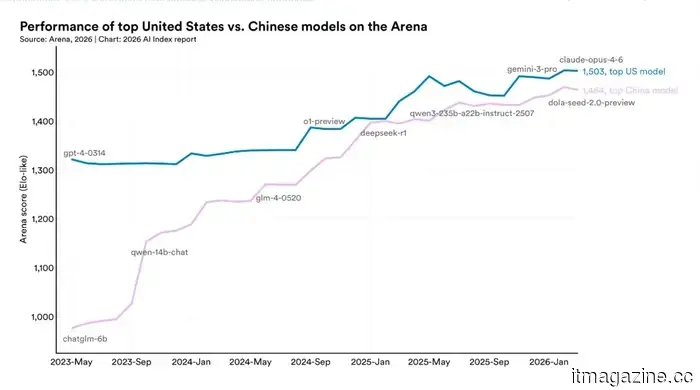
In summary, the 2026 AI Index Report from Stanford reveals that the performance disparity between the top AI models from the United States and China has diminished to 2.7%, down from a range of 17.5-31.6 percentage points in May 2023. This change occurs even as the US invests 23 times more in private AI funding, with spending of $285.9 billion compared to China's $12.4 billion. China leads in AI patents (69.7% of global filings), publications (23.2% of global output), industrial robot deployments (nearly nine times the US rate), and energy infrastructure, while the inflow of AI talent to the US has plummeted by 89% since 2017.
The report shows a current performance gap of just 2.7% between leading American and Chinese AI models, down from significantly larger gaps last year. As of March 2026, Anthropic’s Claude Opus 4.6 tops the global rankings with an Arena score of 1,503, while ByteDance’s Dola-Seed-2.0-Preview follows at 1,464, a difference of 39 points. In February 2025, DeepSeek's R1 reasoning model momentarily matched the top US model, with the leadership position switching several times in recent months.
The comprehensive report outlines a scenario where the United States significantly outspends China in private AI investment yet maintains a leadership edge of less than three percentage points in model performance. It raises questions about whether the US spending advantage is the reason for its continued leadership or if China has discovered ways to compete effectively without the same level of investment.
In terms of leadership areas, the United States excels in private AI investment, allocating $285.9 billion in 2025 compared to China's $12.4 billion, with California alone contributing $218 billion, which represents over 75% of the US total. American companies developed 50 notable AI models last year, while China produced 30—though China's output doubled from 15 the previous year, whereas the US experienced more modest growth. The US currently operates 5,427 data centers, far exceeding any other nation.
Conversely, China surpasses in volume. Chinese researchers accounted for 23.2% of global AI publications and 20.6% of citations, compared to the United States' 12.6%. Moreover, Chinese entities filed a staggering 69.7% of all AI patents worldwide. China also installed 295,000 industrial robots in the latest reporting period, almost nine-fold that of the US at 34,200. Additionally, China's electricity reserve margin consistently remains above 80%, whereas the US power grid is hindered by years of underinvestment, identified as a potential constraint on AI infrastructure expansion.
However, the investment statistics come with a crucial caveat. The report indicates that private investment figures likely underestimate China's true AI expenditures, as the government allocates resources through guidance funds and state-initiated investment channels that aren't reflected in private capital databases. This makes the 23-to-1 spending ratio perhaps less significant than it seems.
A striking finding highlights a talent crisis. The influx of AI scholars to the United States has dropped by 89% since 2017, with 80% of this decline occurring in the past year alone. The report describes this decrease as “precipitous.” Switzerland has now taken the lead globally for AI researchers and developers per capita.
The talent migration data adds complexity to the narrative suggesting that American AI leadership is secure due to its investment superiority. The diminishing presence of researchers who develop cutting-edge models in the US indicates that while spending may cover hardware and infrastructure, it does not necessarily acquire the intellectual expertise essential for translating compute power into capability. In January 2025, DeepSeek demonstrated that a Chinese lab could rival the best in Silicon Valley with far fewer resources, implying that the conditions favoring such innovation in China may be strengthening.
The report enumerates impressive performance improvements that would have seemed unlikely two years ago. For instance, model performance on SWE-bench, a coding benchmark, increased from 60% to almost 100% in just one year. In graduate-level science queries, accuracy reached 93%, surpassing the expert human validator baseline of 81.2%. Google’s Gemini Deep Think earned a gold medal at the International Mathematical Olympiad, while frontier models improved by 30 percentage points in a previously unsolvable benchmark called Humanity’s Last Exam.
Nonetheless, the report also notes a “jagged frontier.” The leading model has only a 50.1% success rate in reading analog clocks, and robotic manipulation systems achieve a success rate of 89.4% in simulations but only 12% in real-world household tasks. Almost half of the clinical AI studies reviewed relied on exam-style questions rather than real patient data, with only 5% utilizing actual clinical records. The
Other articles
 A humanoid robot surpassed the human half-marathon world record by 7 minutes during a race in Beijing that featured 112 teams.
Honor's Lightning robot finished the Beijing half-marathon in a time of 50:26, surpassing the human record of 57:20, while 112 teams and over 300 robots highlighted China's $138 billion humanoid industry.
A humanoid robot surpassed the human half-marathon world record by 7 minutes during a race in Beijing that featured 112 teams.
Honor's Lightning robot finished the Beijing half-marathon in a time of 50:26, surpassing the human record of 57:20, while 112 teams and over 300 robots highlighted China's $138 billion humanoid industry.
 Google is in discussions with Marvell Technology to develop new AI inference chips as part of its collaboration with the Broadcom TPU program.
Google is in talks with Marvell Technology regarding two new chips for AI inference, bringing a third design partner into its TPU supply chain as sales of custom ASICs are projected to increase by 45% in 2026.
Google is in discussions with Marvell Technology to develop new AI inference chips as part of its collaboration with the Broadcom TPU program.
Google is in talks with Marvell Technology regarding two new chips for AI inference, bringing a third design partner into its TPU supply chain as sales of custom ASICs are projected to increase by 45% in 2026.
 Google is in discussions with Marvell Technology to develop new AI inference chips in conjunction with the Broadcom TPU program.
Google is in talks with Marvell Technology regarding two new chips for AI inference, which will introduce a third design partner into its TPU supply chain as custom ASIC sales are expected to increase by 45% in 2026.
Google is in discussions with Marvell Technology to develop new AI inference chips in conjunction with the Broadcom TPU program.
Google is in talks with Marvell Technology regarding two new chips for AI inference, which will introduce a third design partner into its TPU supply chain as custom ASIC sales are expected to increase by 45% in 2026.
 Trump's efforts to prevent state regulation of AI are encountering opposition from both states and Congress.
The White House rejected an AI safety bill proposed by a Republican from Utah and established a DOJ task force to contest state regulations, yet Congress voted 99-1 in favor of opposing AI preemption.
Trump's efforts to prevent state regulation of AI are encountering opposition from both states and Congress.
The White House rejected an AI safety bill proposed by a Republican from Utah and established a DOJ task force to contest state regulations, yet Congress voted 99-1 in favor of opposing AI preemption.
 A humanoid robot outperformed the human half-marathon world record by 7 minutes during a race in Beijing, which featured 112 teams.
Honor's Lightning robot finished the Beijing half-marathon in 50:26, surpassing the human record of 57:20, while 112 teams and over 300 robots highlighted China's $138 billion humanoid sector.
A humanoid robot outperformed the human half-marathon world record by 7 minutes during a race in Beijing, which featured 112 teams.
Honor's Lightning robot finished the Beijing half-marathon in 50:26, surpassing the human record of 57:20, while 112 teams and over 300 robots highlighted China's $138 billion humanoid sector.
 Steam essentially operates as a monopoly in the PC gaming market, so why isn't there any outrage?
Open any gaming PC, and it's likely that the blue Steam icon is prominently displayed on the desktop. It's not concealed, nor is it a choice—it's nearly a given. Over the years, Steam has evolved from merely another launcher to the primary marketplace for PC gaming, functioning almost as an integral aspect of the experience. The Monopoly Nobody […]
Steam essentially operates as a monopoly in the PC gaming market, so why isn't there any outrage?
Open any gaming PC, and it's likely that the blue Steam icon is prominently displayed on the desktop. It's not concealed, nor is it a choice—it's nearly a given. Over the years, Steam has evolved from merely another launcher to the primary marketplace for PC gaming, functioning almost as an integral aspect of the experience. The Monopoly Nobody […]
Stanford AI Index 2026: China reduces the US advantage to 2.7% while investing 23 times less in AI.
The Stanford 2026 AI Index reveals that the performance gap in AI between the US and China has decreased to 2.7% from 31.6%, even though the US invests 23 times more. Additionally, the migration of AI talent to the US has fallen by 89%.