
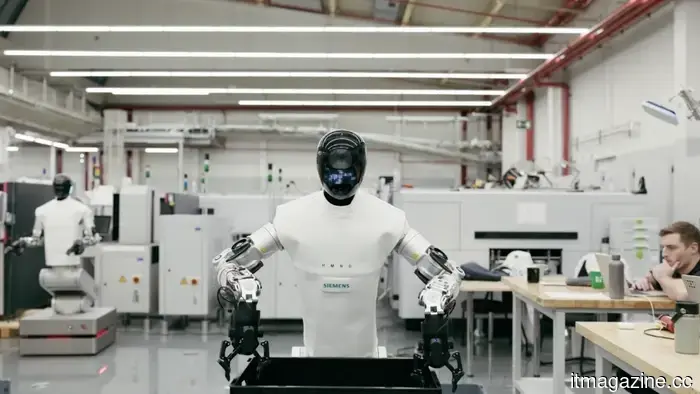
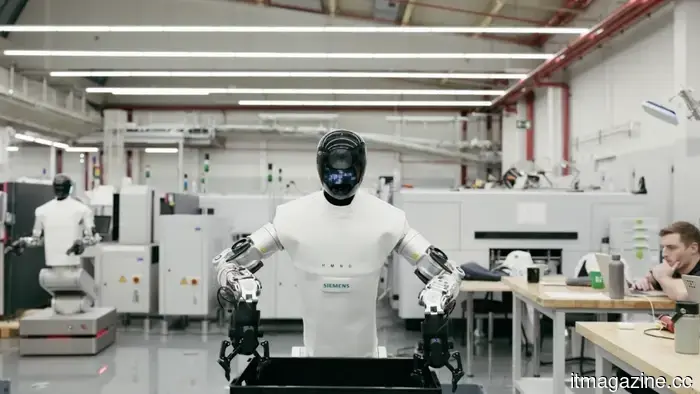
Siemens and Humanoid launched a humanoid robot powered by Nvidia.
Siemens, Nvidia, and UK robotics startup Humanoid have successfully implemented an AI-driven wheeled humanoid robot in active logistics operations at a Siemens electronics factory located in Germany. The HMND 01 Alpha executed over eight hours of autonomous tote-handling, achieving a rate of 60 moves per hour and a pick-and-place success rate exceeding 90%. This robot was integrated directly into Siemens’ production processes.
Siemens and the UK-based robotics firm Humanoid, in collaboration with Nvidia, have announced the effective deployment of an AI-powered humanoid robot in live logistics tasks at Siemens’ electronics facility in Erlangen, Germany. The wheeled HMND 01 Alpha model, developed using Nvidia’s physical AI infrastructure, autonomously performed tote-destacking operations for more than eight hours, achieving a throughput of 60 container moves per hour along with a pick-and-place success rate of over 90%.
This announcement was made at Hannover Messe 2026, building on a strategic partnership between Siemens and Nvidia that was initially unveiled at CES. The tasks assigned to the robot were intentionally simple: removing totes from storage stacks, transporting them to conveyor belts, and placing them at specified locations for human workers. These repetitive and physically demanding tasks represent the type of work that industrial automation has historically found challenging, particularly in unpredictable environments with inconsistently placed objects or tasks needing real-time human coordination.
The trial in Erlangen holds significance as it was conducted in an active production environment instead of a controlled lab, working alongside human operators and other automated systems, which could have led to real production implications if the robot had failed.
The HMND 01 Alpha features a wheeled base with a humanoid upper body designed for advanced manipulation tasks. Its integration into the Siemens factory was facilitated by the Siemens Xcelerator platform, which offers a digital twin, AI-powered perception systems, PLC-robot interfaces, fleet management capabilities, and industrial communication networks. This integration enabled real-time coordination with production systems, other autonomous guided vehicles, and human workers, showcasing a level of deep integration that distinguishes actual factory deployment from mere demonstration.
Stephan Schlauss, Global Head of Manufacturing Motion Control at Siemens, referred to the Erlangen plant as “customer zero,” indicating that Siemens tested the capability in its own facility prior to making it available to customers. From Nvidia’s perspective, the HMND 01 Alpha utilizes Nvidia Jetson Thor for edge computing, Nvidia Isaac Sim for simulation, and Nvidia Isaac Lab for reinforcement learning and policy development.
The simulation-first development strategy, which allows training and validating the robot’s behaviors in a virtual setting before real-world application, enabled Humanoid to reduce prototype development time from the industry-standard 18 to 24 months down to about seven months, according to the companies. Deepu Talla, Nvidia’s vice president of robotics and edge AI, described the deployment as a step towards enabling humanoid robots to meet real production demands on a factory floor.
Founded in 2024 by Artem Sokolov, Humanoid is headquartered in London with additional offices in Boston and Vancouver, employing over 200 engineers from various tech companies. The company also produces a bipedal variant of the HMND 01 Alpha, which features 29 degrees of freedom and is outfitted with RGB cameras, depth sensors, and 6D force/torque sensors.
The wheeled version used in Erlangen had previously been tested in a proof-of-concept with Schaeffler for picking metallic bearing rings. The Siemens trial, conducted over two weeks in January 2026 prior to the April announcement, was the most complex deployment thus far. The companies were careful not to exaggerate their timelines, describing the Erlangen trial as “a milestone in the journey to bring physical AI from vision to industrial reality” while refraining from outlining a commercial rollout schedule.
The broader importance, as Siemens emphasizes, is the creation of a “factory-grade model” for humanoid deployment that other companies may replicate, serving as a reference architecture rather than a singular occurrence. This partnership is part of a broader industrial trend: humanoid robots capable of operating in human-centric environments are increasingly being seen as answers to labor shortages in manufacturing sectors where fully automated production lines are impractical due to product variability, safety concerns, or the need for human-robot interaction.
Other articles
 ASIC collaborates with international regulators to oversee Anthropic's Mythos AI.
ASIC has announced that it is keeping an eye on Anthropic's Mythos AI model for potential banking risks, alongside the Bank of England, the Federal Reserve, the European Central Bank, and the Treasury.
ASIC collaborates with international regulators to oversee Anthropic's Mythos AI.
ASIC has announced that it is keeping an eye on Anthropic's Mythos AI model for potential banking risks, alongside the Bank of England, the Federal Reserve, the European Central Bank, and the Treasury.
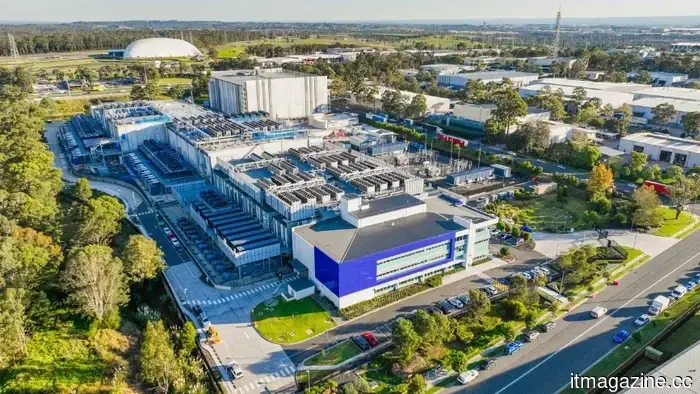 AirTrunk expands into India by purchasing Lumina CloudInfra.
AirTrunk purchases Lumina CloudInfra, which is backed by Blackstone, securing a data center pipeline in India of 600MW valued at as much as $5 billion.
AirTrunk expands into India by purchasing Lumina CloudInfra.
AirTrunk purchases Lumina CloudInfra, which is backed by Blackstone, securing a data center pipeline in India of 600MW valued at as much as $5 billion.
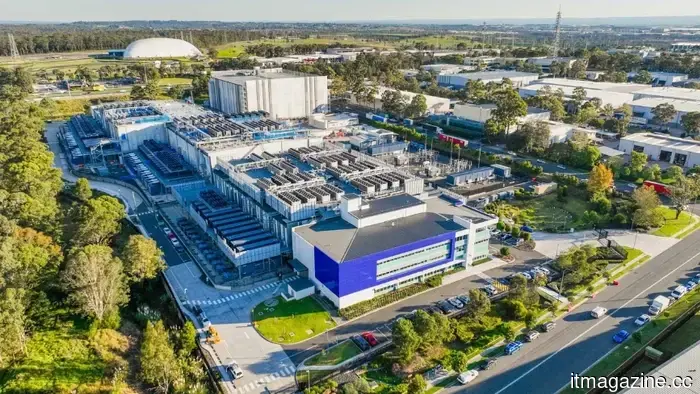 AirTrunk expands into India through the acquisition of Lumina CloudInfra.
AirTrunk has acquired Lumina CloudInfra, which is backed by Blackstone, securing a data center pipeline in India of 600MW valued at up to $5 billion.
AirTrunk expands into India through the acquisition of Lumina CloudInfra.
AirTrunk has acquired Lumina CloudInfra, which is backed by Blackstone, securing a data center pipeline in India of 600MW valued at up to $5 billion.
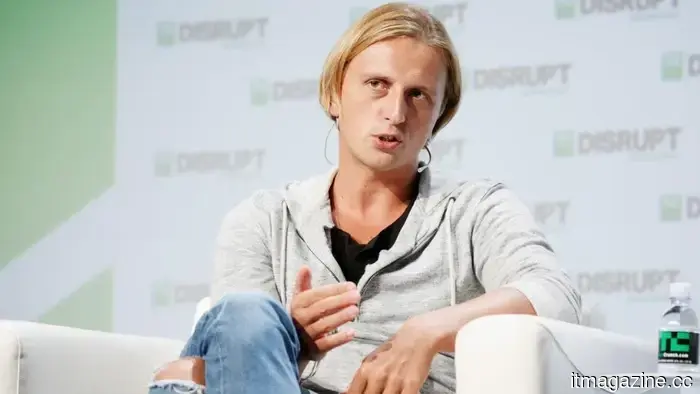 Revolut's initial public offering is scheduled for two years from now, and it will take place in the United States.
Revolut's CEO, Nik Storonsky, has indicated that the fintech's IPO is now set for two years from now and will take place in the US, narrowing his previous guidance from December of "two to three years."
Revolut's initial public offering is scheduled for two years from now, and it will take place in the United States.
Revolut's CEO, Nik Storonsky, has indicated that the fintech's IPO is now set for two years from now and will take place in the US, narrowing his previous guidance from December of "two to three years."
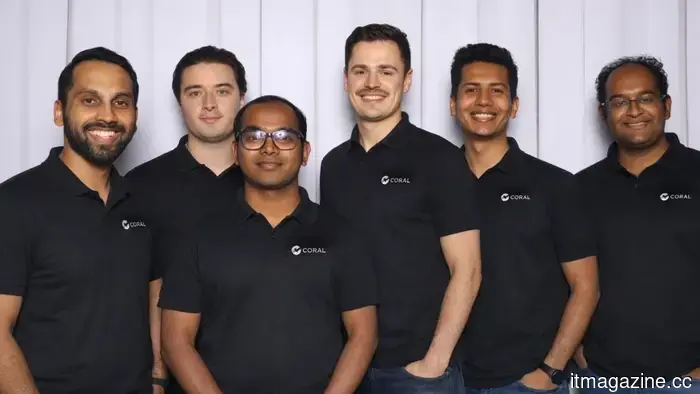 Coral secures $12.5 million to automate the administrative back office in healthcare.
Coral has secured $12.5 million in Series A funding, spearheaded by Lightspeed and Z47, with the aim of automating prior authorizations, patient intake, and fax procedures for specialty healthcare providers.
Coral secures $12.5 million to automate the administrative back office in healthcare.
Coral has secured $12.5 million in Series A funding, spearheaded by Lightspeed and Z47, with the aim of automating prior authorizations, patient intake, and fax procedures for specialty healthcare providers.
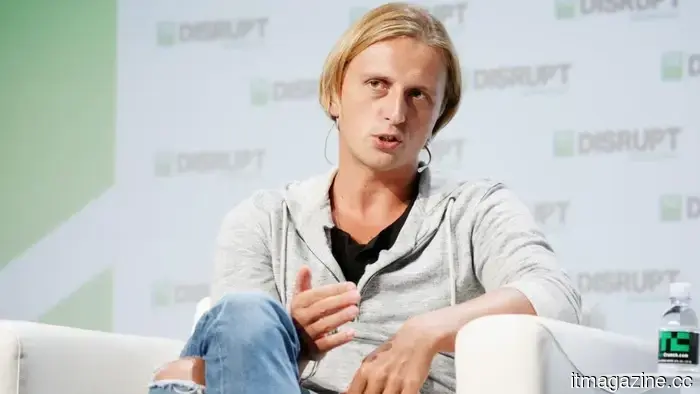 Revolut's initial public offering is set to take place in two years, and it will occur in the United States.
Revolut's CEO Nik Storonsky has stated that the fintech company's IPO is now expected to be two years away and will take place in the US, refining his earlier guidance from December of 'two to three years.'
Revolut's initial public offering is set to take place in two years, and it will occur in the United States.
Revolut's CEO Nik Storonsky has stated that the fintech company's IPO is now expected to be two years away and will take place in the US, refining his earlier guidance from December of 'two to three years.'
Siemens and Humanoid launched a humanoid robot powered by Nvidia.
Siemens and UK startup Humanoid have deployed a humanoid robot powered by Nvidia at a German electronics factory, successfully handling totes autonomously for over 8 hours.