
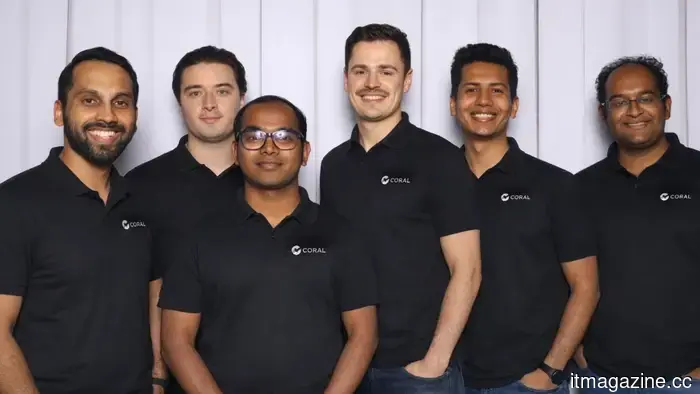
Coral secures $12.5 million to automate the administrative back office of healthcare.
The New York startup has developed an AI that interprets handwritten fax forms, manages prior authorizations, and processes patient intakes in under five minutes, all without requiring providers to alter their existing workflows. Within a year, the company has generated several million in revenue and aims for a fourfold increase by the end of 2026.
Coral, the AI startup based in New York that automates administrative tasks for specialty healthcare providers, has secured $12.5 million in a Series A funding round led by Lightspeed and Z47. The firm was established in 2024 by Ajay Shrihari, a researcher in robotics and AI, and Aniket Mohanty, who specializes in medical image processing.
In less than a year of commercial operation, Coral has achieved multi-million dollar annual revenues and is aiming for 4x growth by 2026.
The challenge that Coral addresses is not the complexity of technology, but the sheer volume of administrative tasks. In the American healthcare system, every appointment generates a cascade of prior authorization requests, referral packets, insurance eligibility checks, and discharge documents, much of which is transmitted via fax machines. Despite being an outdated technology, faxes are still a crucial part of clinical workflows. Instead of trying to displace fax infrastructure, which would necessitate costly system overhauls by providers, Coral integrates with existing EHR systems, fax lines, and payer portals to automate processes around them.
Providers maintain their operational methods, while Coral transforms the internal workflow dynamics. The company's original focus was on the durable medical equipment sector, an area heavily reliant on faxes, where a single order can demand several documentation rounds for approval. Early customer DASCO, a home medical equipment provider, reported that turnaround times have decreased from hours or days to just minutes.
Coral subsequently applied its model to infusion centers, where delays in authorization can result in missed doses rather than postponed appointments, and in specialty pharmacy settings. With each new sector, similar administrative bottlenecks emerged.
The core strength of the product lies in its document understanding capabilities, tailored to the unique disarray of healthcare documentation: handwritten faxes, scanned insurance cards, prior authorization forms, and payer portal screens. Coral’s models have demonstrated 99.7% accuracy across these document types, a threshold deemed the minimum viable standard in healthcare due to the clinical and financial ramifications of errors.
Complete patient intakes, including complex cases, are now processed in under five minutes. In cases of missing information, which occurs frequently, the platform communicates with payers, patients, and referral sources to fill the gaps without needing staff involvement.
The most compelling aspect of Coral's commercial narrative is not its revenue but its payment patterns. A segment of Coral’s clients opts to pay the full contract amount upfront, which is an atypical occurrence in enterprise software and particularly noteworthy in a sector known for slow and cautious vendor evaluations.
The reasoning is straightforward: when a process that once took hours can now be completed in under five minutes with high accuracy, the return on investment is both immediate and evident. The message is clear: commit now and eliminate the backlog promptly.
Recently, Coral released AI-driven voice and text workflows that automate follow-up communications with payers, patients, and referral sources, thereby replacing phone calls that previously required a staff member's attention.
The next stage of product development entails an AI workflow builder, allowing providers to establish and implement their own administrative processes without needing IT involvement, along with a co-pilot feature that highlights operational insights based on the data flowing through the platform, including payer denial rates, bottlenecks in the authorization process, reliable referral sources, and potential changes to enhance insurance claim resubmissions.
Rohil Bagga, an investor at Lightspeed, noted that the company is “delivering real outcomes at scale” in an arena where traditional automation has often faltered. Ashwin KP, an investor at Z47, emphasized the investment rationale based on healthcare administration's distinct features: an annual overhead exceeding a trillion dollars, a sector that remains underserved by technology, and one requiring specialized expertise to navigate.
The Series A funding will support team expansion and product development, with Coral aiming to recruit engineering talent alongside individuals experienced in healthcare operations.
Other articles
 AirTrunk expands into India by purchasing Lumina CloudInfra.
AirTrunk purchases Lumina CloudInfra, which is backed by Blackstone, securing a data center pipeline in India of 600MW valued at as much as $5 billion.
AirTrunk expands into India by purchasing Lumina CloudInfra.
AirTrunk purchases Lumina CloudInfra, which is backed by Blackstone, securing a data center pipeline in India of 600MW valued at as much as $5 billion.
 AirTrunk expands into India through the acquisition of Lumina CloudInfra.
AirTrunk has acquired Lumina CloudInfra, which is backed by Blackstone, securing a data center pipeline in India of 600MW valued at up to $5 billion.
AirTrunk expands into India through the acquisition of Lumina CloudInfra.
AirTrunk has acquired Lumina CloudInfra, which is backed by Blackstone, securing a data center pipeline in India of 600MW valued at up to $5 billion.
 Coral secures $12.5 million to automate the administrative back office in healthcare.
Coral has secured $12.5 million in Series A funding, spearheaded by Lightspeed and Z47, with the aim of automating prior authorizations, patient intake, and fax procedures for specialty healthcare providers.
Coral secures $12.5 million to automate the administrative back office in healthcare.
Coral has secured $12.5 million in Series A funding, spearheaded by Lightspeed and Z47, with the aim of automating prior authorizations, patient intake, and fax procedures for specialty healthcare providers.
 Siemens and Humanoid have launched a humanoid robot that is powered by Nvidia technology.
Siemens and UK-based startup Humanoid launched a humanoid robot powered by Nvidia at a German electronics factory, successfully handling tote operations autonomously for over 8 hours.
Siemens and Humanoid have launched a humanoid robot that is powered by Nvidia technology.
Siemens and UK-based startup Humanoid launched a humanoid robot powered by Nvidia at a German electronics factory, successfully handling tote operations autonomously for over 8 hours.
 Siemens and Humanoid launched a humanoid robot powered by Nvidia.
Siemens and UK startup Humanoid have deployed a humanoid robot powered by Nvidia at a German electronics factory, successfully handling totes autonomously for over 8 hours.
Siemens and Humanoid launched a humanoid robot powered by Nvidia.
Siemens and UK startup Humanoid have deployed a humanoid robot powered by Nvidia at a German electronics factory, successfully handling totes autonomously for over 8 hours.
Coral secures $12.5 million to automate the administrative back office of healthcare.
Coral has secured $12.5 million in a Series A funding round led by Lightspeed and Z47 to automate prior authorizations, patient intake processes, and fax workflows for specialty healthcare providers.