

Zoom introduces World ID verification to ensure that meeting attendees are humans and not deepfake representations.
Summary: Zoom has teamed up with World, the biometric identity firm co-founded by Sam Altman, to enable meeting participants to confirm their humanity using World’s Deep Face technology. This technology correlates iris-scanned biometric profiles with live video to show a “Verified Human” badge. This initiative aims to counteract the deepfake fraud that cost companies over $200 million in the first quarter of 2025, including a $25 million loss for engineering firm Arup. However, World’s iris-scanning Orb system is currently facing regulatory scrutiny in Spain, Germany, the Philippines, and several other nations.
Zoom has collaborated with World to allow meeting attendees to validate their identity as real humans rather than AI-generated deepfakes. This integration leverages World’s Deep Face technology to align a participant's live video feed with their iris-scanned biometric profile. When a match is successful, a “Verified Human” badge appears next to their name. Hosts can set up a Deep Face waiting room that mandates verification prior to anyone joining, and participants can request verification from others during the call.
This feature addresses a concern that has evolved from a theoretical issue to a costly reality. In early 2024, Arup lost $25 million after an employee in Hong Kong authorized a series of wire transfers during a video call where all other participants were AI-generated deepfakes of his colleagues, including the CFO. A similar incident affected a multinational company in Singapore in 2025. Across the industry, deepfake-related fraud exceeded $200 million in losses in the first quarter of 2025 alone, with the average loss per corporate incident now surpassing $500,000.
How verification functions
World’s Deep Face employs a three-tiered approach. It matches a signed image taken during the user’s initial registration with World’s Orb device—a spherical biometric scanner that captures iris patterns—with a real-time face scan from the participant’s phone or computer and a live video frame visible to other meeting attendees. Verification is only successful when all three inputs align. The process is executed locally on the participant’s device, and World assures that no personal data is transmitted from the phone.
This approach differs architecturally from existing deepfake detection tools available in Zoom’s marketplace. Tools from Pindrop, Reality Defender, and Resemble AI analyze video frames for indicators of AI manipulation and flag synthetic media in real-time. Both Zoom and World indicated that due to the rapid advancements in video generation models, frame-by-frame detection methods are becoming increasingly unreliable. Deep Face circumvents the detection challenge by authenticating a person’s identity against a biometric record instead of assessing whether the video pixels were produced by software.
The trade-off is that Deep Face requires users to have a World ID, necessitating a visit to one of World’s physical Orb devices for iris scanning. Currently, around 18 million verified users span 160 countries, with roughly 1,500 active Orbs. This represents a small portion of Zoom’s user base, which limits the feature's immediate application. For most meetings, existing frame-analysis tools will continue to be the practical choice. Deep Face is intended for high-stakes conversations where verifiable identity justifies the inconvenience of requiring biometric pre-registration.
The business rationale
Zoom spokesperson Travis Isaman characterized the integration as part of the company's “open ecosystem approach,” providing customers with diverse options to incorporate trust into their workflows according to their specific needs. This framing is intentional. Zoom is not positioning World ID as its primary identity platform; rather, it is presenting it as one among several options within a marketplace already featuring multiple deepfake detection and identity verification tools.
For Zoom, the collaboration is protective. The company reported $4.67 billion in revenue for fiscal 2025, marking a modest 3% growth, while facing the strategic challenge of maintaining its status as the preferred business communication platform amid competitors integrating AI features. Zoom has responded with AI avatars, an AI-driven office suite, and cross-application AI notetakers. Implementing human verification tackles a different angle: positioning Zoom as the trusted platform for sensitive discussions. In a climate where a single deepfake call can result in a $25 million loss, that trust carries tangible commercial significance.
For World, the integration with Zoom represents a significant distribution opportunity. The company, which rebranded from Worldcoin in 2024, has had difficulties transitioning beyond early adopters closely linked to cryptocurrency. Collaborations with Visa, Tinder, Razer, and Coinbase have broadened the instances where a World ID is beneficial, but none of these partnerships provoke the immediate, pressing demand that a corporate security application would create. If an organization’s treasury department requires World ID verification for any video call involving wire transfer authorization, this leads to institutional adoption that consumer partnerships do not provide.
The privacy challenges
World’s identity system based on the Orb has been subject to ongoing regulatory scrutiny. Spain’s data protection authority issued a formal warning in February 2026 regarding

Other articles
 Canva and Anthropic have introduced Claude Design, a tool for AI-driven visual creation.
Canva's Design Engine drives Claude Design, enabling users to generate on-brand visuals from text within Claude, while Canva AI 2.0 launches agentic orchestration and workspace connections.
Canva and Anthropic have introduced Claude Design, a tool for AI-driven visual creation.
Canva's Design Engine drives Claude Design, enabling users to generate on-brand visuals from text within Claude, while Canva AI 2.0 launches agentic orchestration and workspace connections.
 Anthropic's Amodei goes to the White House as Washington debates access to Mythos.
Dario Amodei from Anthropic meets with Susie Wiles at the White House to address the standoff with the Pentagon, as US agencies and UK banks look to gain access to Mythos, its AI model designed for discovering zero-day vulnerabilities.
Anthropic's Amodei goes to the White House as Washington debates access to Mythos.
Dario Amodei from Anthropic meets with Susie Wiles at the White House to address the standoff with the Pentagon, as US agencies and UK banks look to gain access to Mythos, its AI model designed for discovering zero-day vulnerabilities.
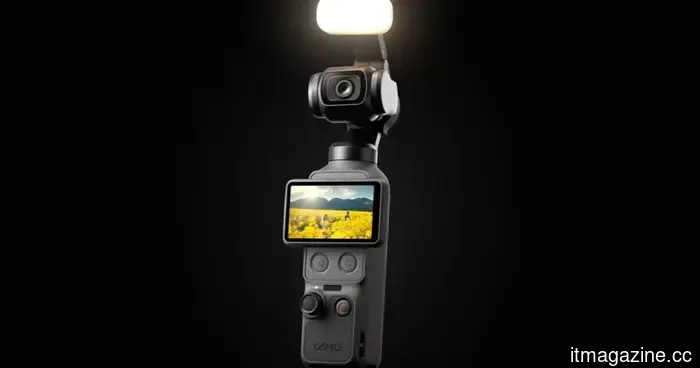 DJI Osmo Pocket 4 targets low-light videography and rapid motion.
The DJI Osmo Pocket 4 features a 1-inch sensor, 4K recording at 240fps, enhanced tracking capabilities, and built-in storage, offering pocket-sized videographers an improved tool for capturing low-light environments, action shots, and quick daily recordings.
DJI Osmo Pocket 4 targets low-light videography and rapid motion.
The DJI Osmo Pocket 4 features a 1-inch sensor, 4K recording at 240fps, enhanced tracking capabilities, and built-in storage, offering pocket-sized videographers an improved tool for capturing low-light environments, action shots, and quick daily recordings.
 Zoom introduces World ID verification to confirm that meeting participants are real humans and not deepfake representations.
Zoom incorporates World's Deep Face biometric verification to showcase "Verified Human" badges during meetings, amid deepfake fraud losses exceeding $200 million in just one quarter.
Zoom introduces World ID verification to confirm that meeting participants are real humans and not deepfake representations.
Zoom incorporates World's Deep Face biometric verification to showcase "Verified Human" badges during meetings, amid deepfake fraud losses exceeding $200 million in just one quarter.
 Allbirds rebrands itself as NewBird AI and shifts its focus from footwear to GPU cloud computing.
Allbirds sold its shoe brand for $39 million, obtained $50 million in funding, and is rebranding as NewBird AI to rent GPUs—its stock initially rose 600% before falling by 35%.
Allbirds rebrands itself as NewBird AI and shifts its focus from footwear to GPU cloud computing.
Allbirds sold its shoe brand for $39 million, obtained $50 million in funding, and is rebranding as NewBird AI to rent GPUs—its stock initially rose 600% before falling by 35%.
 Canva and Anthropic have introduced Claude Design, a tool for AI-driven visual creation.
Canva's Design Engine drives Claude Design, enabling users to generate on-brand visuals from text within Claude, while Canva AI 2.0 unveils agentic orchestration and connectors for workspaces.
Canva and Anthropic have introduced Claude Design, a tool for AI-driven visual creation.
Canva's Design Engine drives Claude Design, enabling users to generate on-brand visuals from text within Claude, while Canva AI 2.0 unveils agentic orchestration and connectors for workspaces.
Zoom introduces World ID verification to ensure that meeting attendees are humans and not deepfake representations.
Zoom incorporates World's Deep Face biometric verification to show "Verified Human" badges during meetings, as losses due to deepfake fraud exceed $200 million in just one quarter.