
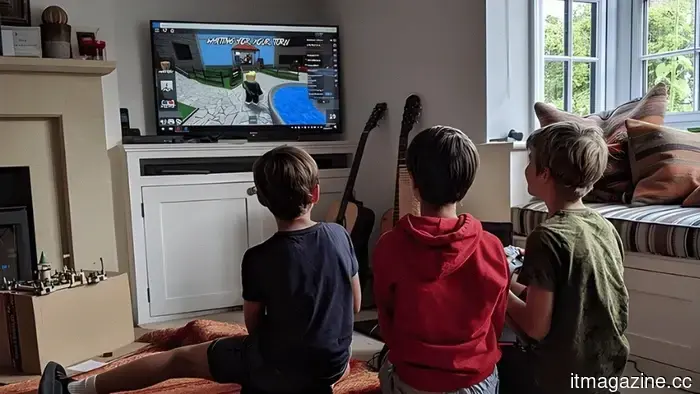
Roblox AI assistant receives agentic tools for game planning, building, and self-testing.
In summary: Roblox is enhancing its integrated AI assistant with agentic features that include a planning mode for analyzing game code before suggesting action plans, generating procedural 3D models and meshes, and incorporating self-correcting loops that test and enhance outputs. The update also introduces MCP client integration with third-party tools like Claude and Cursor, aiming towards multi-agent parallel workflows in the cloud.
Roblox is refining its integrated AI assistant to possess agentic capabilities, enabling it to plan, create, and test games instead of merely answering questions about game development. The update features a planning mode that evaluates the game's code and data model before suggesting action plans, procedural model generation that allows for the creation of editable 3D objects through prompts, and a self-correcting loop that enables the assistant to assess its work and integrate feedback into future iterations.
These advancements transform the Roblox Assistant from a simple code-suggestion tool to a more active development partner, capable of assessing an existing project, asking clarifying questions, proposing strategies, implementing them, testing outcomes, and refining its processes based on findings. This is particularly impactful for a platform with 380 million monthly active users, many of whom are creators with limited programming skills.
Overview of the new features
The Planning Mode turns the assistant into a collaborative planner. Instead of answering individual prompts with code snippets, it reviews a game's existing codebase and data model, poses clarifying questions to the developer about their goals, and converts the conversation into an editable action plan. Developers can examine, modify, and approve the plan before implementation begins. This is akin to asking an AI to design a solution rather than just coding a function.
The upcoming Procedural Models will enable developers to create 3D objects defined by code rather than fixed meshes. A developer can request assistance in generating a bookcase and subsequently adjust its characteristics such as the number of shelves, height, and material through parameters instead of manual modeling. These objects will comprehend physical relationships: for example, a staircase will understand how its steps correspond to its height, and a table will recognize that its legs support its surface. This approach emphasizes parametric design influenced by natural language rather than generative art.
Mesh Generation allows for the placement of fully textured 3D objects directly into a game environment through prompts, building upon Roblox’s Cube foundation model. The introduction of 4D generation in February 2026, enabled by Cube, adds an interactive dimension to generated objects, ensuring they function correctly in games rather than serving merely as static props. During early access, over 160,000 objects were generated, and players utilizing 4D generation experienced a 64% average increase in playtime.
The agentic loop
The most significant enhancement is the self-correcting system. The assistant can now examine various game aspects, pinpoint issues, suggest solutions, and incorporate those outcomes into its planning process. This creates what Roblox refers to as agentic loops: cycles of planning, execution, testing, and refinement that the AI can perform with diminishing human oversight over time.
The future roadmap extends these capabilities. Roblox is working to enable multiple AI agents to collaborate in parallel, facilitating extensive and intricate workflows in the cloud instead of limiting them to a local Studio session. The company is also integrating with third-party tools such as Claude, Cursor, and Codex, and has incorporated a built-in MCP client into Roblox Studio’s assistant, allowing connections to external AI services via the Model Context Protocol standard.
Roblox's long-term vision, communicated since the open-sourcing of the Cube foundation model in March 2025, is to enable developers to describe a game in natural language and have AI generate the necessary assets, environments, code, animations, and interactive behaviors to actualize it. The newly announced agentic tools are incremental steps toward this goal and signify a meaningful transition from AI as a mere autocomplete function to AI as a collaborative partner.
The vibe-coding parallel
Roblox’s update coincides with a broader trend in software development. Vibe coding, which involves describing desired outcomes in natural language and allowing AI to generate corresponding code, led to an 84% increase in App Store submissions earlier this year, prompting Apple to regulate low-quality AI-generated apps. A similar trend is unfolding in game development, where the barriers to creating playable content are rapidly diminishing.
For Roblox, this presents both an opportunity and a quality challenge. Increased game creation enhances platform engagement, but only if the games are engaging. The planning mode and self-correcting loops are partly designed to mitigate this issue by ensuring higher-quality outputs than a single prompt would typically produce, guiding creators through a structured process rather than allowing unchecked generation and publication of initial AI outputs.
Third-party AI tools for game creation on Roblox have already emerged, including Lemonade, SuperbulletAI, and BloxBot. By integrating agentic features directly into Roblox Studio, the company aims to keep the primary creation experience centralized on its platform, rather than allow it to fragment across uncontrolled external
Other articles
 Canva now connects with your work applications, allowing you to accomplish more without having to exit the platform.
Canva is broadening its scope beyond design by introducing new integrations with tools such as Slack, Gmail, and Google Drive, enabling users to gather context from various applications for their projects.
Canva now connects with your work applications, allowing you to accomplish more without having to exit the platform.
Canva is broadening its scope beyond design by introducing new integrations with tools such as Slack, Gmail, and Google Drive, enabling users to gather context from various applications for their projects.
 Roblox AI assistant acquires autonomous tools for game planning, building, and self-testing.
Roblox enhances its AI assistant by introducing a planning mode, procedural 3D models, and self-correcting agentic loops, along with MCP integration featuring Claude, Cursor, and Codex.
Roblox AI assistant acquires autonomous tools for game planning, building, and self-testing.
Roblox enhances its AI assistant by introducing a planning mode, procedural 3D models, and self-correcting agentic loops, along with MCP integration featuring Claude, Cursor, and Codex.
 AI-generated images are now being misused to create false evidence for automobile insurance fraud.
Edited vehicle photos created by AI are emerging as a new method of insurance fraud, as Admiral has connected an increase in cases to altered accident images, repeated claims, and falsified claim documentation that can escalate expenses throughout the system.
AI-generated images are now being misused to create false evidence for automobile insurance fraud.
Edited vehicle photos created by AI are emerging as a new method of insurance fraud, as Admiral has connected an increase in cases to altered accident images, repeated claims, and falsified claim documentation that can escalate expenses throughout the system.
 AI-generated images are now being misused to create false evidence for auto insurance fraud.
AI-edited images of vehicles are emerging as a new tool for insurance fraud, with Admiral noting an increase in cases associated with altered crash photos, duplicate claims, and forged documentation that can elevate expenses throughout the entire system.
AI-generated images are now being misused to create false evidence for auto insurance fraud.
AI-edited images of vehicles are emerging as a new tool for insurance fraud, with Admiral noting an increase in cases associated with altered crash photos, duplicate claims, and forged documentation that can elevate expenses throughout the entire system.
 How EverCognitive assists organizations in transforming their AI aspirations into tangible business results.
Elizabeta Gjorgievska Joshevski describes how EverCognitive assists organizations in navigating AI transformation through strategic planning, preparedness, and tangible business results.
How EverCognitive assists organizations in transforming their AI aspirations into tangible business results.
Elizabeta Gjorgievska Joshevski describes how EverCognitive assists organizations in navigating AI transformation through strategic planning, preparedness, and tangible business results.
 Trusti examines recommendations centered around human needs in digital platforms.
Trusti presents a community-focused method for recommendations, aiding small businesses and users in establishing trust through collective experiences and online platforms.
Trusti examines recommendations centered around human needs in digital platforms.
Trusti presents a community-focused method for recommendations, aiding small businesses and users in establishing trust through collective experiences and online platforms.
Roblox AI assistant receives agentic tools for game planning, building, and self-testing.
Roblox enhances its AI assistant by introducing a planning mode, procedural 3D models, and self-correcting agentic loops, along with MCP integration featuring Claude, Cursor, and Codex.