
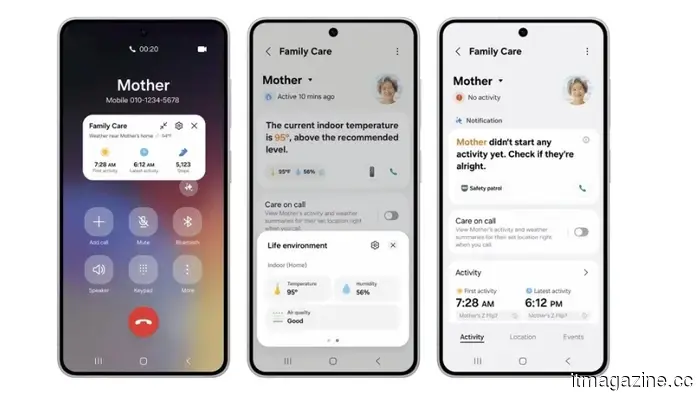
The latest Samsung SmartThings update introduces monitoring features for elderly care, incorporating ambient sensing and artificial intelligence.
In summary, Samsung has enhanced SmartThings with new family care functionalities that leverage connected devices and wearables to oversee elderly relatives remotely. This includes fall detection using the camera on a robot vacuum, screening for cognitive decline through behavioral pattern analysis, environmental safety alerts, and activity monitoring. The update introduces Galaxy AI-driven routine creation, millimeter-wave ambient sensing with local data processing, and Matter camera support on the 500-million-user SmartThings platform.
Samsung's update transforms the SmartThings smart home platform into a system for remote caregiving, utilizing data from appliances like refrigerators, air conditioners, robot vacuums, and wearables to assess if an individual is safe at home. These features align with Samsung’s broader SmartThings strategy for 2026, which focuses on AI-powered automations, ambient sensing via millimeter-wave radar, Matter camera compatibility, and energy management solutions. The most significant innovation is the family care capabilities, which reframe smart homes from simple conveniences to vital health and safety systems.
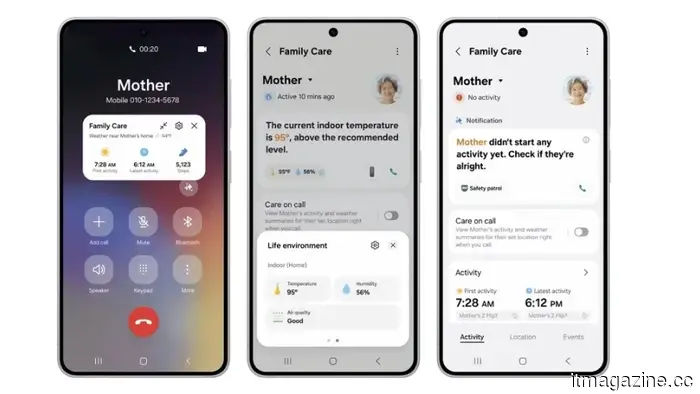
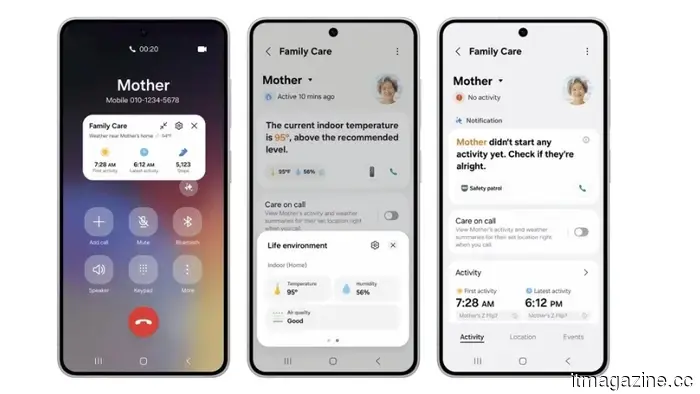
The care features include Care on Call, which provides a pop-up notification before calls with monitored family members, displaying their first and recent activities, step count, and local weather. While simple, it offers caregivers essential context before conversations. Data for this feature is sourced from SmartThings-enabled devices and Galaxy wearables.
Reassurance Patrol employs Samsung's 2026 Bespoke AI Steam Ultra robot vacuum for mobile monitoring. If activity is absent for a designated time, the vacuum sends an alert. Its integrated camera can identify if someone is lying on the floor, and it allows for two-way communication through its speaker and microphone, enabling remote check-ins.
Care Insight evaluates temperature and humidity from connected appliances and alerts caregivers when environmental conditions exceed safe limits. It also analyzes usage patterns of connected devices and activity levels, highlighting notable changes compared to previous weeks, which may indicate potential health issues.
One of the most ambitious features is cognitive decline detection. Samsung claims that SmartThings can monitor lifestyle patterns via devices to identify early indicators of cognitive decline. Alerts are generated when any changes are observed. This feature utilizes longitudinal behavioral data, traditionally collected in clinical research, to predict conditions like dementia, which has previously been challenging to gather outside of controlled environments.
These care features are supported by Samsung's ambient sensing technology that employs millimeter-wave radar along with sound sensors embedded in various appliances. This system can recognize different activities without needing cameras in most instances.
Samsung asserts that all sensory data is processed and retained locally on the SmartThings hub, rather than in the cloud, addressing privacy concerns regarding radar sensors in private spaces. The local processing enables the system to create a comprehensive overview of household activities without sending data to external servers, though alerts do require some information sharing with designated family members.
Map View, SmartThings’ spatial interface, is also being enhanced with generative AI, allowing users to photograph their rooms for precise floor plans. The system combines furniture placement data with ambient sensing to derive context about a person’s location.
Samsung stands out in this arena due to its scale, with SmartThings boasting over 500 million users. Many households already possess the necessary hardware infrastructure for these care functionalities. Collectively, devices like Samsung refrigerators, washing machines, air conditioners, TVs, robot vacuums, and Galaxy Watches generate sufficient behavioral data to outline daily living patterns.
Additionally, the company promotes interoperability, with SmartThings being the first major smart home platform to support Matter-compatible cameras across various partners. The new SmartThings hub integrates control systems like Thread, Zigbee 3.0, Wi-Fi 6E, Bluetooth 5.3, and Matter, while also functioning as a 15-watt Qi2 wireless charger for Galaxy devices. This open ecosystem approach allows care features to potentially extend beyond Samsung devices to any Matter-compatible product.
Galaxy AI integration introduces another dimension, enabling SmartThings to automatically learn routines from Galaxy phone sensor data, with a Routine Creation Assistant utilizing natural language commands for automation creation. These automations can interact with the care system; for instance, a routine that detects when a family member doesn’t turn on a light at their usual time could trigger a check-in alert.
This raises important questions. Remote monitoring of elderly family members meets a genuine need but carries ethical complexities. Samsung's features address real concerns for adult children with distant aging parents, yet they establish a surveillance framework in homes where family members, despite good intentions, might misjudge the boundaries of privacy.
Samsung asserts that participation in this system is voluntary, requiring consent from the monitored individual. However, consent in family care situations is rarely as straightforward as it may seem. An elderly parent experiencing cognitive decline may feel pressured by compassionate children to accept monitoring and might not fully understand the extent of the system's observations.
The cognitive decline detection feature raises additional concerns. Reliable cognitive assessment generally demands controlled settings, validated tools, and medical expertise. Samsung’s system relies on passive behavioral signals, which research links to cognitive decline, but its accuracy, potential for false positives, and clinical
Other articles
 Samsung SmartThings update introduces elderly care monitoring through ambient sensing and artificial intelligence.
Samsung's SmartThings update employs robot vacuums, appliances, and wearable devices to keep an eye on elderly family members, identify falls and signs of cognitive decline, and notify caregivers from a distance.
Samsung SmartThings update introduces elderly care monitoring through ambient sensing and artificial intelligence.
Samsung's SmartThings update employs robot vacuums, appliances, and wearable devices to keep an eye on elderly family members, identify falls and signs of cognitive decline, and notify caregivers from a distance.
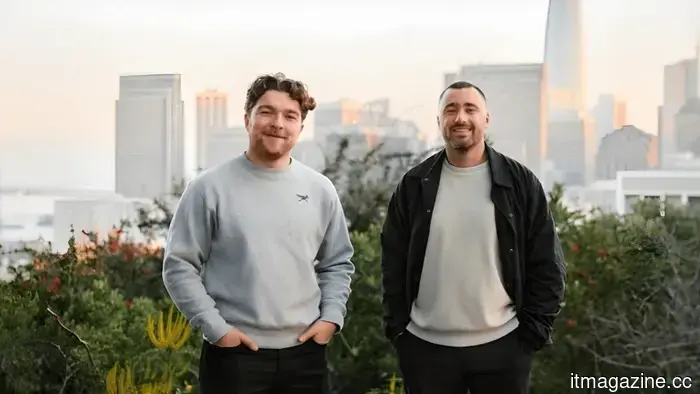 Solidroad secures $25 million in Series A funding to enhance customer support quality assurance through AI automation.
Solidroad, established by former Intercom employees, has secured $25 million in funding from Hedosophia to implement AI quality assurance across all customer support interactions for clients such as Ryanair and Crypto.com.
Solidroad secures $25 million in Series A funding to enhance customer support quality assurance through AI automation.
Solidroad, established by former Intercom employees, has secured $25 million in funding from Hedosophia to implement AI quality assurance across all customer support interactions for clients such as Ryanair and Crypto.com.
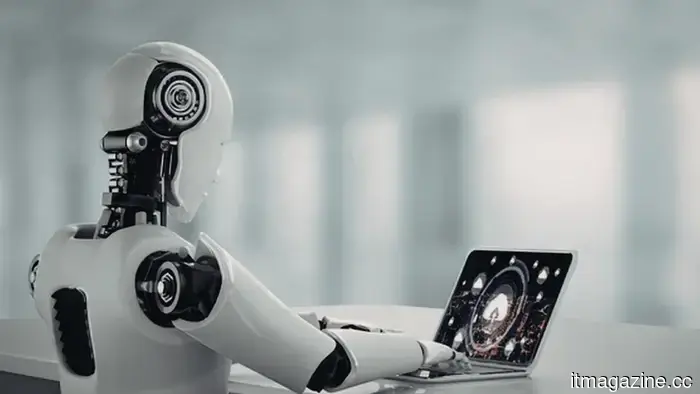 Tesla is considering its Shanghai Gigafactory for the mass production of the Optimus humanoid robot.
The president of Tesla in China refers to the Shanghai Gigafactory as a "golden key" for the production of the Optimus robot, as the facility that produces half of Tesla's vehicles looks to venture into humanoid manufacturing.
Tesla is considering its Shanghai Gigafactory for the mass production of the Optimus humanoid robot.
The president of Tesla in China refers to the Shanghai Gigafactory as a "golden key" for the production of the Optimus robot, as the facility that produces half of Tesla's vehicles looks to venture into humanoid manufacturing.
 Claude Opus 4.7 outperforms GPT-5.4 and Gemini 3.1 Pro in SWE-bench and agentic reasoning.
Anthropic's Claude Opus 4.7 achieves a score of 64.3% on SWE-bench Pro, introduces multi-agent coordination, and offers three times the vision resolution, all at the same price as the previous version.
Claude Opus 4.7 outperforms GPT-5.4 and Gemini 3.1 Pro in SWE-bench and agentic reasoning.
Anthropic's Claude Opus 4.7 achieves a score of 64.3% on SWE-bench Pro, introduces multi-agent coordination, and offers three times the vision resolution, all at the same price as the previous version.
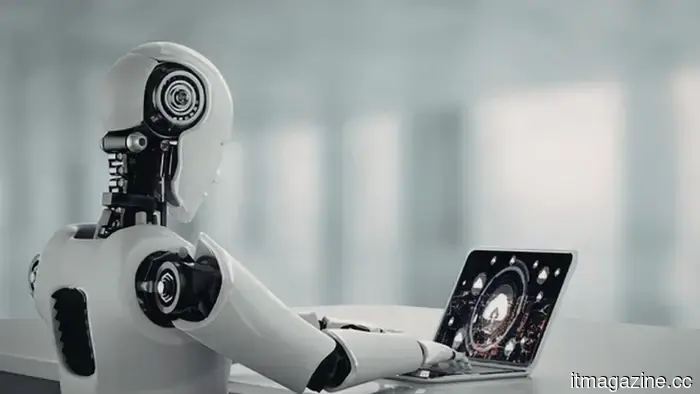 Tesla is considering its Shanghai Gigafactory for the mass production of the Optimus humanoid robot.
Tesla's president in China refers to the Shanghai Gigafactory as a "golden key" for the production of the Optimus robot, as the facility that produces half of Tesla's vehicles looks to enter the humanoid manufacturing sector.
Tesla is considering its Shanghai Gigafactory for the mass production of the Optimus humanoid robot.
Tesla's president in China refers to the Shanghai Gigafactory as a "golden key" for the production of the Optimus robot, as the facility that produces half of Tesla's vehicles looks to enter the humanoid manufacturing sector.
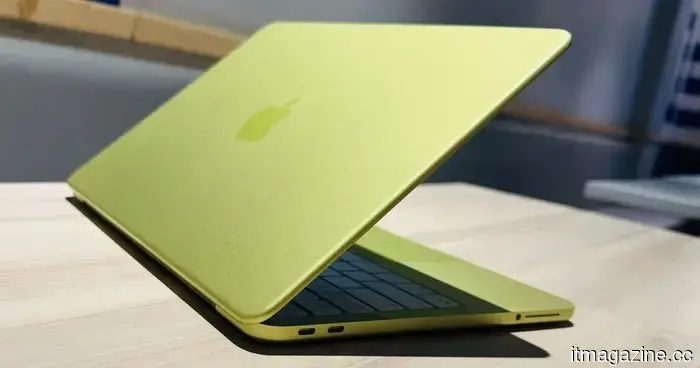 Microsoft leaks suggest what many expected: the Surface lineup lacks a response to the MacBook Neo.
Leaked details about Microsoft's Surface lineup for 2026 indicate enhancements in display technology and a phased introduction of chips; however, the company still lacks offerings for consumers considering Apple's MacBook Neo.
Microsoft leaks suggest what many expected: the Surface lineup lacks a response to the MacBook Neo.
Leaked details about Microsoft's Surface lineup for 2026 indicate enhancements in display technology and a phased introduction of chips; however, the company still lacks offerings for consumers considering Apple's MacBook Neo.
The latest Samsung SmartThings update introduces monitoring features for elderly care, incorporating ambient sensing and artificial intelligence.
Samsung's SmartThings update utilizes robot vacuums, home appliances, and wearable devices to keep an eye on elderly family members, identify falls and signs of cognitive decline, and notify caregivers from a distance.