
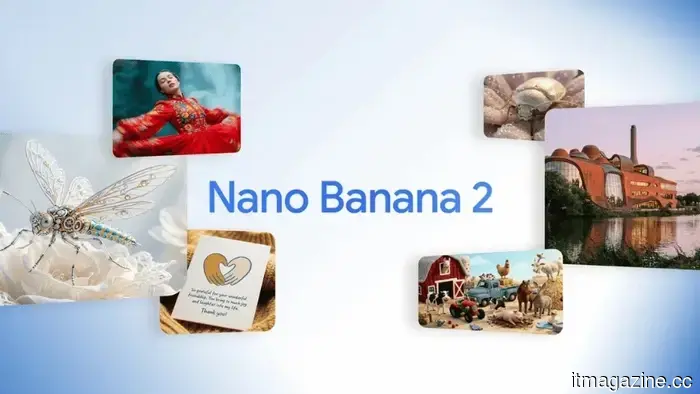
Google incorporates Nano Banana image creation into Gemini's Personal Intelligence feature.
In summary: Google has introduced Nano Banana-enabled image generation to Gemini’s Personal Intelligence feature, allowing the AI to produce images based on a user’s data from Gmail, Photos, Calendar, Drive, and other Google applications. This feature is initially available to Plus, Pro, and Ultra subscribers in the United States, while Europe is excluded from the first global launch. Nano Banana is Google’s proprietary image generation technology for Gemini, which now includes three model versions.
Google's new update means that Gemini can create images that reflect a user's personal context derived from Gmail, Photos, Calendar, Drive, and other Google services. With this enhancement, Gemini can generate images based not only on text inputs but also on the individual’s identity and activities.
This feature will start rolling out to Plus, Pro, and Ultra users in the U.S. in the coming days, with free users expected to gain access in the following weeks. Google plans to extend Gemini's functionality to Chrome on desktop and more markets, although Europe is notably absent from this initial deployment of Personal Intelligence.
Understanding Nano Banana
Nano Banana represents Google’s in-house image generation capability within the Gemini model family, differing from Imagen, which is specifically designed for text-to-image tasks. While Imagen is suited for users who prioritize high quality, rapid iteration, and professional workflows, Nano Banana focuses on conversational image creation through the Gemini interface, accepting various inputs such as text and images.
The Nano Banana family now consists of three iterations. The original Nano Banana, based on Gemini 2.5 Flash, manages basic conversational image creation. Nano Banana 2, released in February 2026 on Gemini 3.1 Flash, integrates enhanced Pro features with quicker iteration processes. Nano Banana Pro, based on Gemini 3 Pro, utilizes the model's comprehensive reasoning and world knowledge in image generation, producing results that demonstrate a deeper comprehension of prompts rather than mere pattern recognition.
Google claims a technical advantage with Nano Banana, as it leverages the Gemini model’s language skills to capture nuances in prompts in ways that independent image generators cannot. Since the image generation is built into Gemini rather than being a separate system, it can anticipate what the user is requesting by considering context from conversations and, as of now, personal data.
The personal intelligence aspect
Personal Intelligence is Google’s framework that connects Gemini to a user's Google account data. Launched in January 2026, it allows Gemini to access text, photos, and videos from Gmail, Calendar, Drive, Google Photos, YouTube, Search, Maps, and other first-party apps. This feature is opt-in, letting users control which applications Gemini can access, and Google states that the AI does not train on personal data.
Previously, Personal Intelligence primarily facilitated text-based personalization, such as responding to inquiries about travel plans using Gmail confirmations and calendar details or offering shopping suggestions based on purchase history. The addition of Nano Banana image generation extends this personalization to visual content. Google provides examples where images can be created using personal photos, tailored to user preferences and context, producing outputs that reflect an individual’s life rather than generic stock images.
A "sources" button is available, showing users how Gemini derived context for each personalized image, ensuring transparency regarding which personal data influenced the output. This feature is significant in an area where the origin of AI-generated content is increasingly debated.
The competitive landscape
While Google is not the first to link personal context with AI image generation, it possesses a unique structural advantage: it has access to more personal data than any other consumer tech company. The data from Gmail, Google Photos, Drive, Calendar, Maps, Search, and YouTube collectively provides a richer understanding of users' lives than any singular app or platform could offer. Integrating this data with an advanced image generator creates a personalization edge that is challenging for OpenAI, Apple, or Meta to replicate without similar data breadth.
Timing is also crucial. OpenAI’s ChatGPT has generated substantial user engagement due to its image generation capabilities, and Apple Intelligence has been incorporating on-device AI features throughout its iPhone ecosystem. In response, Google aims to capitalize on its strengths: cross-product integration supported by an unparalleled data infrastructure.
On-device image generation with Gemini Nano will soon be available on Pixel phones and Android devices, allowing for immediate, private image creation without reliance on cloud services. This combination of cloud-backed personalized generation for complex queries and on-device generation for speed and privacy positions Google to address a diverse range of use cases.
The privacy implications
A clear concern arises when allowing an AI image generator to access personal photos, emails, and web browsing histories, creating potential risks that Google’s opt-in controls may not fully mitigate. Google asserts it does not train on personal data, but generating images relevant to user contexts involves processing that data. The differentiation between “training on” and “using for inference” may be meaningful in theory, but users may not appreciate the nuances when encountering an AI that recognizes details about their homes, children, or vacations.
Excluding
Other articles
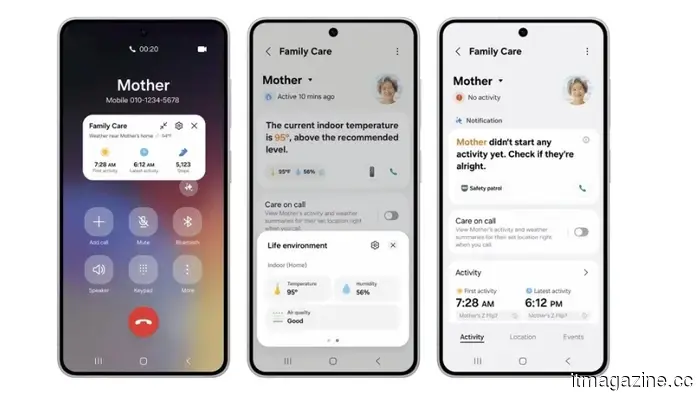 The latest Samsung SmartThings update introduces monitoring features for elderly care, incorporating ambient sensing and artificial intelligence.
Samsung's SmartThings update utilizes robot vacuums, home appliances, and wearable devices to keep an eye on elderly family members, identify falls and signs of cognitive decline, and notify caregivers from a distance.
The latest Samsung SmartThings update introduces monitoring features for elderly care, incorporating ambient sensing and artificial intelligence.
Samsung's SmartThings update utilizes robot vacuums, home appliances, and wearable devices to keep an eye on elderly family members, identify falls and signs of cognitive decline, and notify caregivers from a distance.
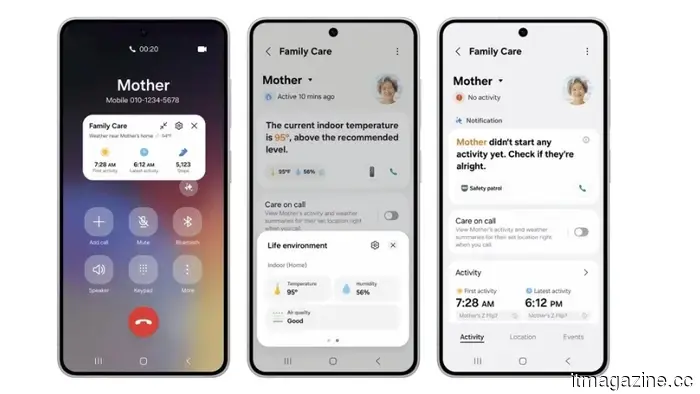 Samsung SmartThings update introduces elderly care monitoring through ambient sensing and artificial intelligence.
Samsung's SmartThings update employs robot vacuums, appliances, and wearable devices to keep an eye on elderly family members, identify falls and signs of cognitive decline, and notify caregivers from a distance.
Samsung SmartThings update introduces elderly care monitoring through ambient sensing and artificial intelligence.
Samsung's SmartThings update employs robot vacuums, appliances, and wearable devices to keep an eye on elderly family members, identify falls and signs of cognitive decline, and notify caregivers from a distance.
 Claude Opus 4.7 outperforms GPT-5.4 and Gemini 3.1 Pro in SWE-bench and agentic reasoning.
Anthropic's Claude Opus 4.7 achieves a score of 64.3% on SWE-bench Pro, introduces multi-agent coordination and features three times the vision resolution, while maintaining the same pricing as the previous version.
Claude Opus 4.7 outperforms GPT-5.4 and Gemini 3.1 Pro in SWE-bench and agentic reasoning.
Anthropic's Claude Opus 4.7 achieves a score of 64.3% on SWE-bench Pro, introduces multi-agent coordination and features three times the vision resolution, while maintaining the same pricing as the previous version.
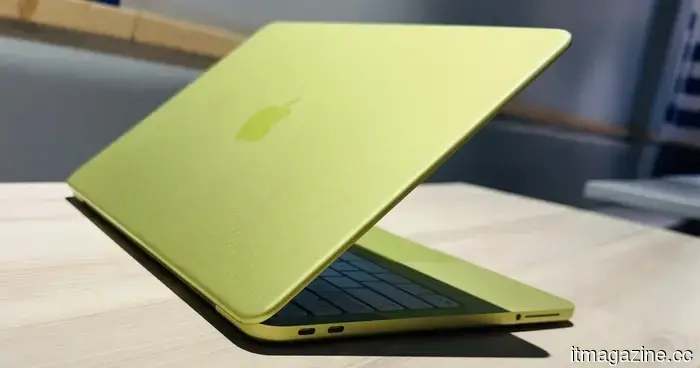 Microsoft's leaks suggest the evident: The Surface lineup lacks a response to the MacBook Neo.
Leaked information regarding Microsoft's Surface lineup for 2026 indicates display enhancements and a phased chip release, but the company still lacks offerings for consumers interested in Apple's MacBook Neo.
Microsoft's leaks suggest the evident: The Surface lineup lacks a response to the MacBook Neo.
Leaked information regarding Microsoft's Surface lineup for 2026 indicates display enhancements and a phased chip release, but the company still lacks offerings for consumers interested in Apple's MacBook Neo.
 Solidroad secures $25 million in Series A funding to enhance customer support quality assurance through automation using AI.
Solidroad, established by former Intercom employees, has secured $25 million from Hedosophia to implement AI-driven quality assurance across all customer support interactions for clients such as Ryanair and Crypto.com.
Solidroad secures $25 million in Series A funding to enhance customer support quality assurance through automation using AI.
Solidroad, established by former Intercom employees, has secured $25 million from Hedosophia to implement AI-driven quality assurance across all customer support interactions for clients such as Ryanair and Crypto.com.
 Solidroad secures $25 million in Series A funding to enhance customer support quality assurance through AI automation.
Solidroad, established by former Intercom employees, has secured $25 million in funding from Hedosophia to implement AI quality assurance across all customer support interactions for clients such as Ryanair and Crypto.com.
Solidroad secures $25 million in Series A funding to enhance customer support quality assurance through AI automation.
Solidroad, established by former Intercom employees, has secured $25 million in funding from Hedosophia to implement AI quality assurance across all customer support interactions for clients such as Ryanair and Crypto.com.
Google incorporates Nano Banana image creation into Gemini's Personal Intelligence feature.
Google's Gemini can now create images by utilizing personal context from Gmail, Photos, and Drive through Nano Banana, currently being launched for subscribers in the US while excluding Europe.