

Microsoft wants to emphasize that Copilot AI serves purposes beyond mere entertainment.
Microsoft is working to address a confusing inconsistency regarding its Copilot AI. This comes after one of its documents depicted the AI as being far less effective than the company's promotional materials would suggest.
Recently, users discovered that Microsoft’s Copilot terms of use included a disclaimer stating the service is intended for “entertainment purposes only.” It also mentioned that the AI could make errors, might not function as expected, and should not be relied upon for critical advice. Additionally, the document stated users must utilize Copilot at their own risk, which raised concerns considering Microsoft’s strong promotion of Copilot as a productivity tool for Windows, Microsoft 365, and business applications.
How is Microsoft responding to this?
Microsoft explained that the language in the document is outdated, originating from Copilot's earlier iteration as a Bing-based search assistant. In a statement to Windows Latest, the company indicated that the “entertainment purposes” wording no longer accurately portrays Copilot's current utility and will be revised in future terms.
Since the era of Bing Chat, Copilot has evolved significantly, and Microsoft now regards it as much more than just a basic chatbot. However, there are still complexities to consider.
Why is the contradiction difficult to overlook?
While legal disclaimers advising against relying on Copilot for critical advice are common in the AI sector, the combination of “for entertainment purposes only” with a product that Microsoft intends for users to utilize in creating documents, presentations, and executing workplace tasks feels jarring.
Microsoft does not believe Copilot is ineffective; however, the user feedback and slow uptake indicate a shift from an “AI-everywhere” philosophy to a more concentrated approach. The company wants to convey that Copilot is not merely for entertainment any longer, yet it serves as a reminder that even companies heavily promoting AI still find it necessary to caution users about over-reliance.
Tech journalist and product reviewer specializing in consumer electronics, Sean has covered a wide range of topics, including flagship products…
Gmail mobile now offers end-to-end encryption to safeguard your emails from prying eyes.
A year after launching on desktop, Gmail’s most robust privacy feature has finally made its way to mobile devices, where the majority of enterprise emails are often written. Google has begun rolling out end-to-end encryption for Gmail on Android and iOS, allowing eligible users to compose and read encrypted emails directly within the Gmail app without needing to install third-party applications.
On a 2024 visit to Dharamshala, a popular spiritual destination in India, I was taken aback by the number of remote workers occupying café spaces, focused intently on their laptops. At least three of my dorm mates shared that they manage social media content for US creators boasting hundreds of thousands of followers. One ambitious 17-year-old enthusiastically revealed that she manages regional YouTube channels for a prominent US creator with over three million subscribers and is eager to attract fans in the densely populated Southeast Asian market.
NVIDIA’s much-anticipated N1 chip has made another unofficial appearance, and if the latest leak is accurate, it could signal exciting developments for upcoming laptops. A listing seen on a Chinese resale platform seemingly displays an engineering sample motherboard featuring NVIDIA’s forthcoming System-on-Chip. While this is not an official announcement and skepticism is warranted, the details presented are compelling.
An early glimpse at NVIDIA's next major advancement.





Other articles
 CoreWeave finalizes a multi-year agreement with Anthropic as nine out of ten leading AI model providers integrate into its platform.
CoreWeave has finalized a multi-year agreement for GPU cloud services with Anthropic to support Claude at a production scale, marking its second significant AI infrastructure announcement within 48 hours.
CoreWeave finalizes a multi-year agreement with Anthropic as nine out of ten leading AI model providers integrate into its platform.
CoreWeave has finalized a multi-year agreement for GPU cloud services with Anthropic to support Claude at a production scale, marking its second significant AI infrastructure announcement within 48 hours.
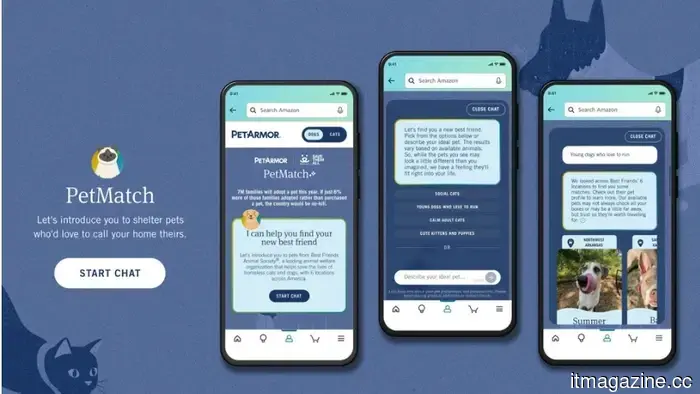 Amazon's AI tool connects shelter dogs and cats with potential adopters as part of the Protect Playtime campaign.
Amazon, PetArmor, and Best Friends Animal Society have unveiled an AI pet-matching tool along with a generative video campaign aimed at decreasing the number of killings in US shelters.
Amazon's AI tool connects shelter dogs and cats with potential adopters as part of the Protect Playtime campaign.
Amazon, PetArmor, and Best Friends Animal Society have unveiled an AI pet-matching tool along with a generative video campaign aimed at decreasing the number of killings in US shelters.
 A new free Borderlands game has just silently launched on the iPhone.
Borderlands Mobile has subtly made its way onto the App Store as a free-to-play game for iPhone, developed by Zynga, but an official Android version has yet to be released.
A new free Borderlands game has just silently launched on the iPhone.
Borderlands Mobile has subtly made its way onto the App Store as a free-to-play game for iPhone, developed by Zynga, but an official Android version has yet to be released.
 SiFive secures $400 million in a Series G funding round, achieving a valuation of $3.65 billion in its last funding round prior to going public.
SiFive, the RISC-V chip intellectual property company, secured $400 million in an oversubscribed Series G round, led by Atreides and supported by Nvidia, which values the company at $3.65 billion in anticipation of an upcoming IPO.
SiFive secures $400 million in a Series G funding round, achieving a valuation of $3.65 billion in its last funding round prior to going public.
SiFive, the RISC-V chip intellectual property company, secured $400 million in an oversubscribed Series G round, led by Atreides and supported by Nvidia, which values the company at $3.65 billion in anticipation of an upcoming IPO.
 CoreWeave establishes a multi-year agreement with Anthropic, as nine out of ten leading AI model providers become part of its platform.
CoreWeave has finalized a multi-year agreement for GPU cloud services with Anthropic to support Claude at a production scale, marking its second significant AI infrastructure announcement within 48 hours.
CoreWeave establishes a multi-year agreement with Anthropic, as nine out of ten leading AI model providers become part of its platform.
CoreWeave has finalized a multi-year agreement for GPU cloud services with Anthropic to support Claude at a production scale, marking its second significant AI infrastructure announcement within 48 hours.
 Tired of dull email apps? Avec transforms your inbox into an easy-to-navigate, swipe-friendly organizer.
Avec est une nouvelle application de messagerie pour iOS qui transforme le nettoyage de la boîte de réception en une routine de glissement de cartes, tout en offrant des réponses vocales et des fonctionnalités d'IA pour rendre la gestion des emails moins contraignante.
Tired of dull email apps? Avec transforms your inbox into an easy-to-navigate, swipe-friendly organizer.
Avec est une nouvelle application de messagerie pour iOS qui transforme le nettoyage de la boîte de réception en une routine de glissement de cartes, tout en offrant des réponses vocales et des fonctionnalités d'IA pour rendre la gestion des emails moins contraignante.
Microsoft wants to emphasize that Copilot AI serves purposes beyond mere entertainment.
Microsoft seems to be working to resolve a confusing inconsistency regarding its Copilot AI. This comes after a document from the company portrayed the AI as being significantly less effective than what their marketing implies. Recently, users observed that the terms of use for Microsoft’s Copilot included a caution stating that the service is intended for “entertainment purposes only,” which adds […]