

AI is enhancing our speed and productivity while impairing our thinking skills.
AI is omnipresent, the pressure to embrace it is unyielding, and the evidence supporting its claim of making us smarter is diminishing every quarter. On New Year’s Day 2026, a programmer named Steve Yegge introduced an open-source platform called Gas Town, which enables users to manage swarms of AI coding agents at the same time, creating software at speeds unattainable by any individual. One of the initial testers described the experience in a way that had little to do with productivity, stating, “There’s really too much going on for you to comprehend reasonably. I felt a tangible sense of stress just watching it.”
That observation should be displayed prominently in every executive office, venture capital meeting, and during CES keynotes where “intelligence” is discussed casually. A peculiar shift is taking place in the dynamic between humans and the technology we refer to as intelligent. While machines become swifter, humans interacting with them are growing increasingly fatigued, anxious, and, based on several criteria, less proficient in the one area intelligence was meant to improve: clear thinking.
The pressure to implement AI has become so widespread that it has generated its own coercive language:
You must have AI.
You must utilize AI.
You must invest in AI.
Your competitors are already using it.
Your children will lag behind without it.
This rhetoric does not stem from engineers quietly addressing issues; it arises from earnings calls, product launches, and LinkedIn updates fueled by the frantic energy of individuals who have mistaken selling a product for describing reality.
In January 2026, at the World Economic Forum in Davos, Microsoft CEO Satya Nadella shared a statement so illuminating it warrants analysis as a cultural artifact. He cautioned that AI could risk losing its “social permission” to consume large amounts of energy unless it began providing tangible benefits to people's lives.
The framing was notable: it was not about whether the technology functions, but whether the public can be kept engaged while the industry determines if it indeed works. Nadella referred to AI as a “cognitive amplifier,” providing “access to infinite minds.”
A month later, a Circana survey of US consumers revealed that 35 percent did not want AI on their devices. The leading reason was not fear or confusion; it was quite simple: they felt they didn’t need it.
The disparity between the hype and the actual evidence has become increasingly apparent. In March 2026, Goldman Sachs released an analysis of fourth-quarter earnings and found, according to senior economist Ronnie Walker, “no meaningful relationship between productivity and AI adoption at the economy-wide level.” The bank noted that a record 70 percent of S&P 500 management teams discussed AI during their earnings calls, yet only 10 percent had quantified its impact on specific use cases, and just 1 percent had assessed its effect on earnings. Meanwhile, the five largest US tech firms were collectively expected to invest $667 billion in AI infrastructure in 2026, a 62 percent rise from the previous year.
The National Bureau of Economic Research labeled this a “productivity paradox,” where the perceived benefits were greater than the measured gains.
There are indeed real productivity enhancements, but they are remarkably limited. Goldman identified a median improvement of around 30 percent in two specific areas: customer support and software development. Beyond those specific domains, the evidence of broader enhancement was, in the bank's view, virtually non-existent. For now, the anticipated revolution is taking place within two specific rooms of a vast house.
However, what is occurring in those rooms merits close examination, as even where AI proves effective, something else seems to be fractured.
In February 2026, researchers from UC Berkeley’s Haas School of Business published results from an eight-month study embedded within a 200-person US tech company. Their findings indicated that AI did not lessen workloads; rather, it exacerbated them. Tasks became quicker, which led to heightened expectations. Those expectations led to an expansion of responsibilities, with workers taking on roles that had traditionally been assigned to others. Product managers began coding, and researchers engaged in engineering tasks. The boundaries of roles blurred because the tools gave the impression that anything was possible, ultimately resulting in fatigue.
I felt exhausted just writing that.
The researchers identified a phenomenon they termed “workload creep”: a gradual buildup of tasks that goes unnoticed until cognitive fatigue impairs the quality of every decision. Harvard Business Review termed this phenomenon more bluntly as “AI brain fry.” A Boston Consulting Group study of nearly 1,500 US workers found that 14 percent of those using AI tools that required substantial oversight reported experiencing it, a specific form of mental fog characterized by difficulty concentrating, slowed decision-making, and headaches after prolonged interaction with AI.
The most affected workers were not doubters or late adopters; they were keen enthusiasts, those who followed the keynote suggestions to the letter.
The distribution of this exhaustion is
Other articles
 Estonia is one of the few EU countries that is against prohibiting social media use among children.
Estonia rejected the EU's Jutland Declaration, claiming that age restrictions are impractical and that Europe should focus on implementing GDPR on platforms rather than limiting access for children.
Estonia is one of the few EU countries that is against prohibiting social media use among children.
Estonia rejected the EU's Jutland Declaration, claiming that age restrictions are impractical and that Europe should focus on implementing GDPR on platforms rather than limiting access for children.
 Estonia is one of the few EU countries that is against prohibiting children's use of social media.
Estonia rejected the EU's Jutland Declaration, claiming that age restrictions are impractical and that Europe should focus on enforcing GDPR against platforms rather than imposing limitations on children.
Estonia is one of the few EU countries that is against prohibiting children's use of social media.
Estonia rejected the EU's Jutland Declaration, claiming that age restrictions are impractical and that Europe should focus on enforcing GDPR against platforms rather than imposing limitations on children.
 UK startup Altilium secures £18.5 million to establish the first commercial EV battery refinery in Britain.
Altilium has obtained £18.5 million in grants from the UK government to construct ACT3, a refinery in Plymouth that will extract essential minerals from 24,000 electric vehicle batteries annually.
UK startup Altilium secures £18.5 million to establish the first commercial EV battery refinery in Britain.
Altilium has obtained £18.5 million in grants from the UK government to construct ACT3, a refinery in Plymouth that will extract essential minerals from 24,000 electric vehicle batteries annually.
 UK startup Altilium secures £18.5 million to establish the country’s first commercial EV battery refinery.
Altilium has gained £18.5 million in grants from the UK government to construct ACT3, a refinery in Plymouth that will extract essential minerals from 24,000 electric vehicle batteries annually.
UK startup Altilium secures £18.5 million to establish the country’s first commercial EV battery refinery.
Altilium has gained £18.5 million in grants from the UK government to construct ACT3, a refinery in Plymouth that will extract essential minerals from 24,000 electric vehicle batteries annually.
 Estonia is an unusual EU nation that is against prohibiting children's use of social media.
Estonia rejected the EU's Jutland Declaration, contending that age restrictions are impractical and that Europe should focus on enforcing GDPR against platforms rather than imposing limitations on children.
Estonia is an unusual EU nation that is against prohibiting children's use of social media.
Estonia rejected the EU's Jutland Declaration, contending that age restrictions are impractical and that Europe should focus on enforcing GDPR against platforms rather than imposing limitations on children.
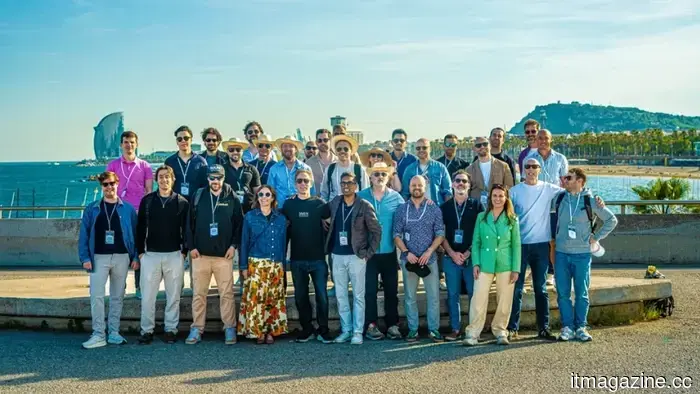 SaaS on the Beach is back in Barcelona.
SaaS on the Beach is set to return to Barcelona this May, featuring 60 SaaS founders, carefully curated discussions, and a no-pitch format designed for peer-to-peer exchange.
SaaS on the Beach is back in Barcelona.
SaaS on the Beach is set to return to Barcelona this May, featuring 60 SaaS founders, carefully curated discussions, and a no-pitch format designed for peer-to-peer exchange.
AI is enhancing our speed and productivity while impairing our thinking skills.
AI is ubiquitous, yet the proof of its worth is scant, the fatigue is palpable, and the term "intelligence" serves more as a marketing tool than a scientific concept.