
TerraSpark secures over €5 million to transmit solar energy from orbit to Earth.
The Luxembourg-based startup is intentionally adopting an earth-first strategy: demonstrating radio-frequency wireless power transmission on the ground prior to expanding to orbital applications. Its Chief Technology Officer previously managed ESA’s Solaris SBSP initiative until the agency suspended it in 2024. Daphni spearheaded the pre-seed funding round.
The individual best equipped to explain why the European Space Agency opted not to continue with its space-based solar power program is now creating one independently. Dr. Sanjay Vijendran was a key figure in ESA’s Solaris initiative, a three-year research and development program initiated in 2022 to prepare Europe for the implementation of space-based solar power.
When ESA determined in August 2024 that the technology was insufficiently developed to proceed to a demonstration mission, Vijendran departed to co-found TerraSpark.
This week, the Luxembourg startup revealed that it has secured over €5 million in a pre-seed round, with backing from Paris-based venture capital firm Daphni, as well as Sake Bosch, better ventures, Hans(wo)men Group, the Luxembourg Business Angel Network, and Karaoke Club.
The founding principle of TerraSpark is that space-based solar power has often been dismissed because it has only been envisioned at its final, massive scale: gigawatt-class satellites positioned in geostationary orbit, launched simultaneously.
The company's methodology is modular and phased. Before launching any satellites, TerraSpark is developing commercial radio-frequency wireless power transmission systems for terrestrial use, supplying energy to remote industrial sites, events, and other areas where it is impractical to run cables.
This approach generates revenue, mitigates technological risks, and meets regulatory requirements, all while progressing towards the orbital version. According to the company’s perspective, it is validating the system on Earth before seeking trust for its application in space.
The three-phase development plan is well-defined. In 2026, the company intends to demonstrate wireless power transmission over controlled distances on Earth, confirming alignment accuracy, energy density, and atmospheric tolerance.
In 2027, it plans to deploy an orbital technology demonstrator, and by 2028, it aims to transmit solar energy from a satellite prototype to a ground receiver, marking the first milestone in space-to-Earth power transmission. Full commercial rollout, featuring a constellation capable of providing continuous, weather-independent energy globally, is scheduled for 2030 and beyond.
In the short term, the company has identified a wireless power supply for a live event as its initial pilot application.
TerraSpark was established in 2025 by Jasper Deprez, a serial entrepreneur who previously transformed Tradler into a global HRTech platform, along with Vijendran and Matthias Laug, who acts as COO. Deprez serves as CEO.
The venture operates in Luxembourg, a notable European center for space-economy startups, partly due to the country's favorable regulatory environment for commercial space initiatives. Vijendran has a background in physics, holding a PhD from Cambridge, and his experience leading ESA’s Solaris program equips him with a comprehensive understanding of both the technical challenges and regulatory pathways facing space-based solar power.
TerraSpark’s European positioning and its intentional earth-first strategy set it apart, as it is not relying on an orbital demonstration initially and is focusing on infrastructure rather than defense or data center applications. The key unresolved question is whether this market will achieve commercial viability before 2030.
Other articles
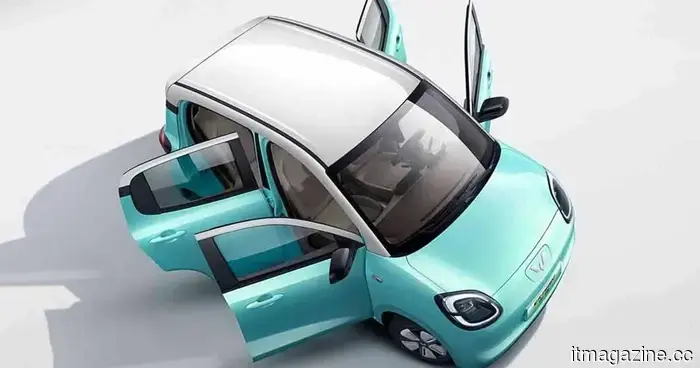 This incredibly charming Chinese electric vehicle is priced at only $6,200 and has a range of over 190 miles.
The 2026 Hongguang Mini EV is more adorable, intelligent, and has a longer wheelbase than its predecessor, and with a starting price of $6,200, it remains the most groundbreaking budget EV globally. Here, we outline all the new features.
This incredibly charming Chinese electric vehicle is priced at only $6,200 and has a range of over 190 miles.
The 2026 Hongguang Mini EV is more adorable, intelligent, and has a longer wheelbase than its predecessor, and with a starting price of $6,200, it remains the most groundbreaking budget EV globally. Here, we outline all the new features.
 Bluesky's latest app, Attie, utilizes AI to provide you with complete control over your social media feed.
Bluesky has introduced Attie, an AI application powered by the AT Protocol that enables users to generate personalized social feeds using natural language prompts.
Bluesky's latest app, Attie, utilizes AI to provide you with complete control over your social media feed.
Bluesky has introduced Attie, an AI application powered by the AT Protocol that enables users to generate personalized social feeds using natural language prompts.
 The biggest AI survey to date uncovers what people truly desire.
Anthropic’s study involving 81,000 individuals on AI interviews indicates that people's expectations from the technology are not centered on productivity. Instead, they seek time, respite, and the ability to engage with their lives.
The biggest AI survey to date uncovers what people truly desire.
Anthropic’s study involving 81,000 individuals on AI interviews indicates that people's expectations from the technology are not centered on productivity. Instead, they seek time, respite, and the ability to engage with their lives.
 The biggest AI survey conducted so far uncovers what humans truly desire.
Anthropic's study involving 81,000 participants on AI interviews indicates that what individuals seek from this technology is not increased productivity but rather time, relief, and improved access to their lives.
The biggest AI survey conducted so far uncovers what humans truly desire.
Anthropic's study involving 81,000 participants on AI interviews indicates that what individuals seek from this technology is not increased productivity but rather time, relief, and improved access to their lives.
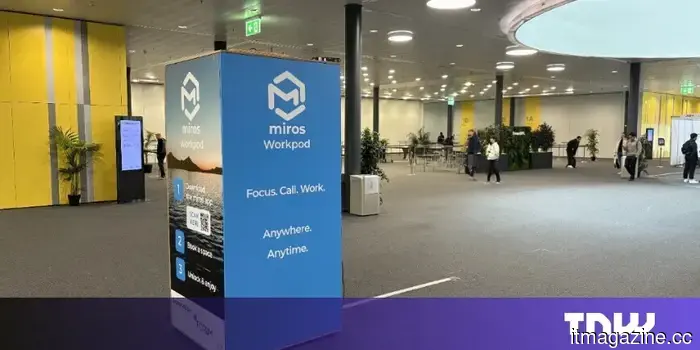 Swiss startup miros secures €1.1 million for reserveable workpods.
Lausanne-based startup miros has secured €1.1 million to grow its network of bookable acoustic workpods throughout Switzerland, aiming for a total of 100 units by the end of 2026.
Swiss startup miros secures €1.1 million for reserveable workpods.
Lausanne-based startup miros has secured €1.1 million to grow its network of bookable acoustic workpods throughout Switzerland, aiming for a total of 100 units by the end of 2026.
 The biggest AI survey to date uncovers what people truly desire.
Anthropic's study involving 81,000 individuals highlights that what people desire from AI technology is not increased productivity, but rather time, relief, and improved access to their lives.
The biggest AI survey to date uncovers what people truly desire.
Anthropic's study involving 81,000 individuals highlights that what people desire from AI technology is not increased productivity, but rather time, relief, and improved access to their lives.
TerraSpark secures over €5 million to transmit solar energy from orbit to Earth.
TerraSpark has secured €5 million to advance space-based solar energy, beginning with wireless transmission from the ground and aiming to achieve orbital capability by 2027.