

The biggest AI survey to date uncovers what people truly desire.
Anthropic’s extensive AI interview study transcends mere technology; it serves as the largest reflection of human desire ever created.
In December 2025, a software engineer in Mexico concluded his workday early enough to pick up his children from school, while a lawyer in India, with the help of an AI tutor, read Shakespeare for the first time without hesitation. A Ukrainian soldier, kept awake by shelling, opened a chat window to learn something new, as the act of learning was the only way to alleviate his panic.
Though these individuals were unknown to each other, they all participated in an open-ended conversation with an AI interviewer designed by Anthropic, the company behind Claude, during the same week. They responded to seemingly straightforward questions: what do you desire from AI, has it met your expectations, and what concerns you? In a week, 80,508 individuals across 159 countries and 70 languages provided answers, resulting in what Anthropic calls the largest and most multilingual qualitative study ever undertaken.
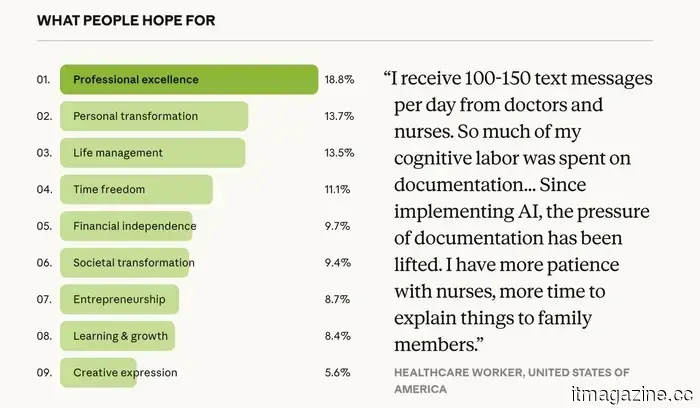
What participants desired from AI, categorized by Claude based on their open-ended reply to “If you could wave a magic wand, what would AI do for you?” revealed that only 1% of respondents did not express a vision.
This assertion is plausible, given that previous standards included the USC Shoah Foundation’s Visual History Archive, which contains approximately 52,000 to 59,000 genocide testimonies in 40 languages, and the World Bank’s “Voices of the Poor” project, which synthesized experiences of over 60,000 individuals in 60 countries.
Anthropic’s study surpasses both in participant numbers, although careful consideration is needed in comparisons since the depth and significance of those earlier projects differed greatly.
However, the importance of the Anthropic study lies not in its scale but in what the scale uncovers. When 81,000 people are asked an open-ended question about their hopes for a technology and the most prevalent response is not “increase my productivity,” but something akin to “restore my life,” the focus shifts from product feedback to a reflection of human longing.
The calculus of desire
The Anthropic Interviewer, a version of Claude designed for adaptive conversations, posed a consistent set of questions to each participant and then explored the discussion as it unfolded. Claude-powered classifiers categorized each response, offering a remarkable blend of depth and breadth at a pace that was unthinkable two years before.
While the headline statistics are revealing, they do not capture the full narrative. Approximately 19% of respondents sought AI for “professional excellence,” the predominant category. Another 14% aimed for “personal transformation” through emotional growth or health assistance. Nearly 10% expressed a desire for increased family time and leisure, while about 10% sought financial independence.
These neatly organized statistics may resemble a product roadmap, but they do not serve that purpose.
Interviewers consistently discovered that initial responses often concealed deeper sentiments. Participants might start by discussing the automation of emails or coding efficiency, but when probed further about what those improvements would enable, they expressed desires like wanting to cook with a parent rather than merely completing tasks.
The initial focus on productivity stemmed from the language of technology; the underlying aspiration was timeless and deeply human: relief from the cognitive burdens of modern existence. Such patterns are familiar to anyone involved in qualitative research, yet their significance increases when evidenced across tens of thousands of conversations in 70 languages, from Lagos to Lyon.
Stories beyond the capabilities of surveys
Surveys measure what people select; interviews explore the reasons behind their hesitations. The most valuable insights from Anthropic’s report are not the categorized data but rather the quotes, which feel more like personal narratives than typical customer feedback.
A butcher from Chile, who had minimal experience with computers, recounted his journey into entrepreneurship and how he found motivation he never anticipated. A homeless healthcare worker in the U.S. utilized AI to brainstorm a digital marketing business and saw a path to home ownership for the first time. A physician in Israel, facing an undiagnosed neurological condition, used AI to find two studies that led to effective treatment. A mute worker in Ukraine created a text-to-speech bot using Claude, allowing him to communicate with friends almost in real time.
These narratives are not solely about productivity; they revolve around access and revolve around specific AI capabilities that emphasize patience, availability, and the absence of judgment.
A student in India shared that, while his professor taught a class of 60 and rarely entertained questions, AI afforded him the opportunity to ask anything at 2 a.m. A lawyer in the same country spoke about overcoming a lifelong fear of mathematics and realizing she was more capable than she once believed.
Eighty-one percent of participants reported that AI had already made concrete progress toward their stated goals, a notably high fulfillment rate for a technology often labeled as overhyped. This suggests that the divide between what individuals
Other articles
 Bluesky's latest app, Attie, utilizes AI to provide you with complete control over your social media feed.
Bluesky has introduced Attie, an AI application powered by the AT Protocol that enables users to generate personalized social feeds using natural language prompts.
Bluesky's latest app, Attie, utilizes AI to provide you with complete control over your social media feed.
Bluesky has introduced Attie, an AI application powered by the AT Protocol that enables users to generate personalized social feeds using natural language prompts.
 This incredibly charming Chinese electric vehicle is priced at only $6,200 and has a range of over 190 miles.
The 2026 Hongguang Mini EV is more adorable, intelligent, and has a longer wheelbase than its predecessor, and with a starting price of $6,200, it remains the most groundbreaking budget EV globally. Here, we outline all the new features.
This incredibly charming Chinese electric vehicle is priced at only $6,200 and has a range of over 190 miles.
The 2026 Hongguang Mini EV is more adorable, intelligent, and has a longer wheelbase than its predecessor, and with a starting price of $6,200, it remains the most groundbreaking budget EV globally. Here, we outline all the new features.
 Swiss startup miros secures €1.1M in funding for reservable workpods.
Lausanne-based startup miros has secured €1.1M to grow its network of bookable acoustic workpods throughout Switzerland, with a goal of reaching 100 units by the end of 2026.
Swiss startup miros secures €1.1M in funding for reservable workpods.
Lausanne-based startup miros has secured €1.1M to grow its network of bookable acoustic workpods throughout Switzerland, with a goal of reaching 100 units by the end of 2026.
 Swiss startup miros secures €1.1 million for reserveable workpods.
Lausanne-based startup miros has secured €1.1 million to grow its network of bookable acoustic workpods throughout Switzerland, aiming for a total of 100 units by the end of 2026.
Swiss startup miros secures €1.1 million for reserveable workpods.
Lausanne-based startup miros has secured €1.1 million to grow its network of bookable acoustic workpods throughout Switzerland, aiming for a total of 100 units by the end of 2026.
 The biggest AI survey to date uncovers what people truly desire.
Anthropic’s study involving 81,000 individuals on AI interviews indicates that people's expectations from the technology are not centered on productivity. Instead, they seek time, respite, and the ability to engage with their lives.
The biggest AI survey to date uncovers what people truly desire.
Anthropic’s study involving 81,000 individuals on AI interviews indicates that people's expectations from the technology are not centered on productivity. Instead, they seek time, respite, and the ability to engage with their lives.
 The biggest AI survey conducted so far uncovers what humans truly desire.
Anthropic's study involving 81,000 participants on AI interviews indicates that what individuals seek from this technology is not increased productivity but rather time, relief, and improved access to their lives.
The biggest AI survey conducted so far uncovers what humans truly desire.
Anthropic's study involving 81,000 participants on AI interviews indicates that what individuals seek from this technology is not increased productivity but rather time, relief, and improved access to their lives.
The biggest AI survey to date uncovers what people truly desire.
Anthropic's study involving 81,000 individuals highlights that what people desire from AI technology is not increased productivity, but rather time, relief, and improved access to their lives.