
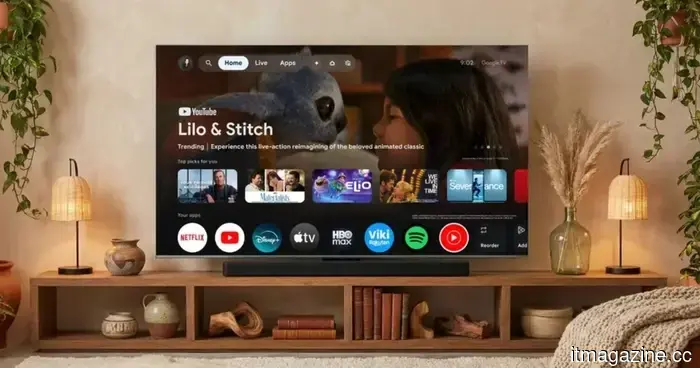
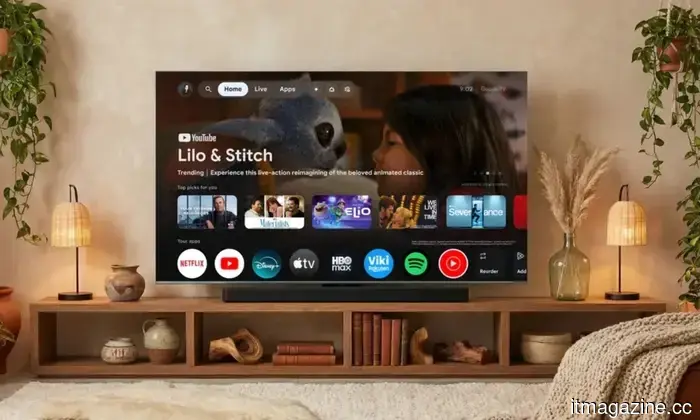
Warner, Disney, and NBC are in a battle with Google and Apple for dominance over your smart TVs.
Your smart TV might seem like just a screen for entertainment, but there's a significant struggle happening behind the scenes.
Major broadcasters such as Disney, NBCUniversal, and Warner Bros Discovery are urging European regulators to rein in technology giants like Google, Apple, Amazon, and Samsung regarding content management and distribution.
As reported by Reuters, these companies have reached out to EU antitrust regulators, advocating for smart TVs and set-top boxes to be governed by the Digital Markets Act (DMA). This legislation aims to curb the influence of large platforms (often referred to as gatekeepers) that regulate user and market access.
Why broadcasters claim your TV is influenced by gatekeepers
Broadcasters assert that smart TV platforms and operating systems are increasingly biased. They determine which apps are visible, how content is promoted, and the ease of accessing various services.
For this reason, they seek to have these platforms categorized as gatekeepers under the DMA. If their request is granted, this would compel companies like Google and Apple to adhere to more stringent regulations regarding fairness and competition.
Their concerns are evident in a statement which says, “A limited number of operators are therefore gaining growing ability to shape outcomes for millions of users and businesses by controlling access to audiences and content distribution.”
The lobbying coalition highlights the increasing dominance in smart TV operating systems. According to industry data, Samsung’s Tizen TV platform holds a 24% market share, followed closely by Android TV at 23%, and Amazon’s Fire TV OS at 13%.
The involved companies and the significance of this issue
The initiative comes from a diverse group of broadcasters, including Canal+, Disney, ITV, NBCUniversal, Paramount+, RTL, Sky, TF1 Groupe, and Warner Bros Discovery. Collectively, they encompass a substantial portion of Europe’s media landscape and connect with millions of viewers.
These companies depend on smart TV platforms to distribute their content, yet they contend that the balance of control is shifting toward the platform owners. This change can influence visibility, app placement, and even revenue sharing.
Conversely, technology firms argue that their platforms serve as tools that enhance access and improve the viewing experience.
This dispute also reflects an ongoing power struggle between broadcasters and platforms, underscored by Disney’s recent conflict with YouTube TV, which resulted in a three-week blackout in November 2025.
If regulators intervene, your smart TV may function differently in the future, with increased regulations on how content is displayed and who has control over what you watch.
Other articles
 Xbox might reduce the price of Game Pass and potentially include it as a part of a bundle with Netflix.
According to recent reports, Xbox CEO Asha Sharma is said to be investigating the possibility of more affordable Game Pass tiers and a potential bundle with Netflix.
Xbox might reduce the price of Game Pass and potentially include it as a part of a bundle with Netflix.
According to recent reports, Xbox CEO Asha Sharma is said to be investigating the possibility of more affordable Game Pass tiers and a potential bundle with Netflix.
 Samsung introduces its new 2026 televisions featuring Mini LED enhancements and improved AI capabilities.
Samsung has introduced its 2026 television lineup, featuring new Neo QLED and Mini LED models, emphasizing AI-driven picture improvements and a wider range of pricing choices.
Samsung introduces its new 2026 televisions featuring Mini LED enhancements and improved AI capabilities.
Samsung has introduced its 2026 television lineup, featuring new Neo QLED and Mini LED models, emphasizing AI-driven picture improvements and a wider range of pricing choices.
 macOS 26.4 has been released, featuring minor enhancements and a significant indication of what's to come.
macOS 26.4 has been released, featuring new emojis, battery charge limitations, enhancements to Safari, and performance improvements, though there are no significant upgrades to Siri's AI at this time.
macOS 26.4 has been released, featuring minor enhancements and a significant indication of what's to come.
macOS 26.4 has been released, featuring new emojis, battery charge limitations, enhancements to Safari, and performance improvements, though there are no significant upgrades to Siri's AI at this time.
 I long for the days when enhancing your gaming PC was thrilling rather than a foolish financial decision.
I was considering my upcoming PC upgrade, but instead, the year 2026 makes it increasingly difficult to rationalize the entire hobby.
I long for the days when enhancing your gaming PC was thrilling rather than a foolish financial decision.
I was considering my upcoming PC upgrade, but instead, the year 2026 makes it increasingly difficult to rationalize the entire hobby.
 Xbox might lower the price of Game Pass and potentially offer it in a bundle with Netflix.
According to recent reports, Xbox CEO Asha Sharma is said to be considering more affordable Game Pass tiers and a potential bundle with Netflix.
Xbox might lower the price of Game Pass and potentially offer it in a bundle with Netflix.
According to recent reports, Xbox CEO Asha Sharma is said to be considering more affordable Game Pass tiers and a potential bundle with Netflix.
 Nvidia's CEO Jensen Huang claims that we have reached AGI. But what exactly is it?
Jensen Huang's assertion that AGI is already present has sparked renewed discussion, as experts remain divided on what constitutes human-level artificial intelligence.
Nvidia's CEO Jensen Huang claims that we have reached AGI. But what exactly is it?
Jensen Huang's assertion that AGI is already present has sparked renewed discussion, as experts remain divided on what constitutes human-level artificial intelligence.
Warner, Disney, and NBC are in a battle with Google and Apple for dominance over your smart TVs.
Disney, NBCUniversal, and several others are urging for more stringent EU regulations regarding smart TV platforms, stating that firms such as Google, Amazon, and Samsung are gaining greater control over what is displayed on your television.