
OpenAI Sora is no longer available. The artists continue to be active.
Last September, when OpenAI discreetly introduced the Sora 2 app to the public, the surrounding conversation was anything but subdued. Commentators, who had spent months viewing preview clips of the model—such as a golden retriever leaping through autumn leaves or a nearly lifelike Tokyo street scene—lined up to proclaim that a significant change had occurred. Not merely an incremental one, but a fundamental shift. The argument was that a technology capable of creating moving images from a simple text prompt marked the beginning of the end for certain types of human jobs. Actors, animators, and cinematographers found their hard-earned skills suddenly characterized as temporary. Hollywood unions released statements, while illustrators circulated open letters. The term “replacement” appeared in numerous headlines, feeling less like a prediction and more like a weather report, delivered with casual certainty.
On March 24, 2026, OpenAI declared it would be discontinuing Sora after only six months of operation, during which it had not displaced anyone. This is significant not because Sora failed technically; the underlying model was seen as genuinely impressive and capable of creating videos that could deceive a casual viewer, complemented by audio generation that enhanced the illusion further. OpenAI described Sora 2 as possibly marking a “GPT-3.5 moment for video,” indicating a milestone. It garnered a million downloads faster than ChatGPT. For a brief period, it held the top position on Apple’s App Store. However, it could not inspire users to return.
By January 2026, downloads had dropped by 45%. The social features that OpenAI integrated, resembling a TikTok-style feed of AI-generated clips, failed to become a daily routine for users. The company informed its employees this week that shutting down Sora would free up computational resources for developing its next generation of models. The research team would shift to “world simulation research” for robotics, indicating a move away from creativity towards practicality.
This transition is worthy of reflection, as it contradicts the premise of the narrative that AI would replace artists. This narrative is based on a specific understanding of creative work: that the value people find in art, film, and performance lies mainly in the output—the image, the sound, the story. It posited that if a machine can convincingly replicate that output, the human who created it becomes unnecessary. Sora was intended to serve as proof of this concept.
Instead, Sora exposed a crucial aspect often overlooked by those advocating for replacement: audiences do not merely consume outputs; they interact with them based on their origins. A deepfake of a deceased civil rights leader engaging in a comedy sketch is not equivalent to a film about that leader’s life, regardless of the technical quality of the deepfake.
When the families of Martin Luther King Jr. and Robin Williams publicly objected to AI-generated videos featuring their likenesses on the Sora platform, they were not making an abstract ethical stance. They were expressing a sentiment shared by users who encountered these AI clips: the context of creation is a crucial factor in what makes a creative work meaningful.
OpenAI appeared to grasp this dynamic, or at least recognized it, which is why it pursued the deal with Disney so urgently. A licensing agreement covering over 200 Disney, Marvel, Pixar, and Star Wars characters was not merely a business arrangement; it aimed to acquire cultural legitimacy and connect AI-generated video to something the audience already felt a connection with. This deal was announced in December 2025 but was reversed this week, with Disney confirming that no financial transactions had occurred.
The pattern is clear. OpenAI attempted to cultivate an audience for AI creativity first by making the output impressive, then personalizable (the “cameo” feature, allowing users to upload their likenesses for others to generate deepfakes, was the app's main draw), and finally by linking it to existing intellectual properties with established fanbases. Yet none of these efforts led to sustained engagement. The app meant to replace creative professionals failed to hold the attention of those it aimed to entertain.
This does not imply that AI video generation lacks impact on creative industries. The tools are available, and they will be utilized, resulting in some displacement of traditional jobs. These are indeed valid concerns, and the unions and guilds advocating for contractual protections are justified in their efforts. However, the prevailing narrative surrounding Sora’s launch that AI was on the brink of rendering human creativity obsolete, with actors and artists facing imminent redundancy, has confronted a fundamental challenge in the history of cultural technology: people do not just desire content; they desire content created by someone.
The streaming era was expected to obliterate cinema, yet it merely made theatrical releases more selective and did not diminish the longing to experience films on a large screen with an audience, created by a director whose prior work you admired. Similarly, the MP3 was forecasted to destroy music; it did significantly disrupt the industry but live performances have only increased.
Every
Other articles
 ChatGPT can now provide you with real-time weather information using AccuWeather.
ChatGPT now offers real-time weather assistance via a new AccuWeather app, enabling users to access forecasts, alerts, and live conditions directly in their chats.
ChatGPT can now provide you with real-time weather information using AccuWeather.
ChatGPT now offers real-time weather assistance via a new AccuWeather app, enabling users to access forecasts, alerts, and live conditions directly in their chats.
 OpenAI Sora is no longer available. The artists continue their efforts.
OpenAI's AI video application claimed to revolutionize creative tasks. However, six months after the introduction of Sora 2, it struggled to retain users.
OpenAI Sora is no longer available. The artists continue their efforts.
OpenAI's AI video application claimed to revolutionize creative tasks. However, six months after the introduction of Sora 2, it struggled to retain users.
 Your finance team continues to pursue outstanding invoices - here’s the actual expense.
Manual accounts payable costs between $15 and $40 for each invoice. BILL streamlines the entire process, from capture to payment, for over 400,000 businesses. You can try it for free or access the complimentary Spend & Expense plan.
Your finance team continues to pursue outstanding invoices - here’s the actual expense.
Manual accounts payable costs between $15 and $40 for each invoice. BILL streamlines the entire process, from capture to payment, for over 400,000 businesses. You can try it for free or access the complimentary Spend & Expense plan.
 ChatGPT can now provide real-time weather information using AccuWeather.
ChatGPT now offers real-time weather assistance via a new AccuWeather app, allowing users to view forecasts, alerts, and live weather updates right within their conversations.
ChatGPT can now provide real-time weather information using AccuWeather.
ChatGPT now offers real-time weather assistance via a new AccuWeather app, allowing users to view forecasts, alerts, and live weather updates right within their conversations.
 Granola secures $125 million at a valuation of $1.5 billion to transform meetings into enterprise AI contexts | TNW
London-based AI meeting application Granola secured $125 million in Series C financing, achieving a $1.5 billion valuation, with Index Ventures and Kleiner Perkins as the lead investors.
Granola secures $125 million at a valuation of $1.5 billion to transform meetings into enterprise AI contexts | TNW
London-based AI meeting application Granola secured $125 million in Series C financing, achieving a $1.5 billion valuation, with Index Ventures and Kleiner Perkins as the lead investors.
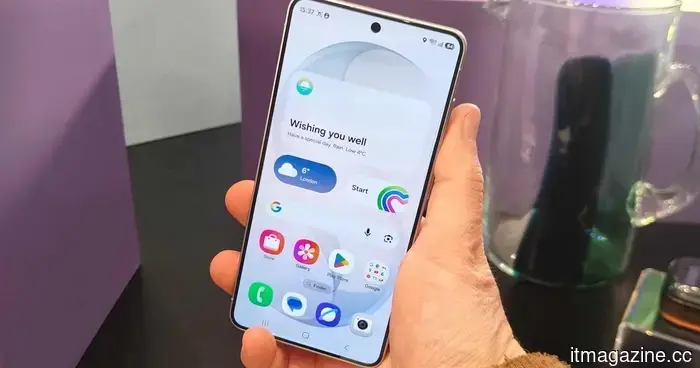 The Samsung Galaxy S26 Ultra is amazing, but it can be problematic when it comes time for repairs.
iFixit's teardown of the Galaxy S26 Ultra uncovered a mix of findings: a wonderfully straightforward battery replacement, a troublesome screen swap, and a replacement parts system that is so poor it's almost amusing.
The Samsung Galaxy S26 Ultra is amazing, but it can be problematic when it comes time for repairs.
iFixit's teardown of the Galaxy S26 Ultra uncovered a mix of findings: a wonderfully straightforward battery replacement, a troublesome screen swap, and a replacement parts system that is so poor it's almost amusing.
OpenAI Sora is no longer available. The artists continue to be active.
OpenAI's AI video application was expected to revolutionize creative tasks. However, six months after the introduction of Sora 2, it struggled to retain users.