

Apple discreetly addresses Family Sharing’s most significant issue a decade after it was introduced.
No longer will you need to explain your app purchases to the person who manages the family credit card.
Apple's Family Sharing feature has proven to be genuinely beneficial since its launch in June 2014. It enables users to share apps, subscriptions, and purchases with up to five family members, eliminating the necessity to buy them multiple times.
Since its introduction, Family Sharing has undergone numerous updates, yet one aspect has remained constant: every transaction made through Purchase Sharing is charged to the family organizer’s credit card, regardless of the purchaser.
This arrangement is fine when children are involved, but what happens when other adults in the Family Sharing plan make purchases? This has been a longtime source of frustration for families, and Apple has finally responded with the release of iOS 26.4.
What has changed?
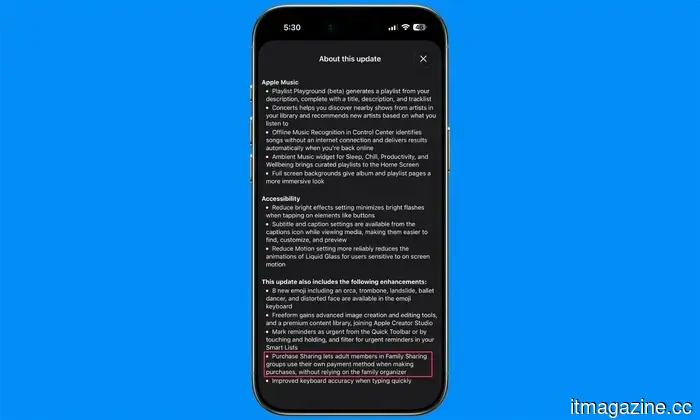
With the iOS 26.4 RC update today, Apple has modified the billing process for Family Sharing. Adult members can now utilize their own payment methods for purchases, instead of relying solely on the family organizer’s card.
Apple’s official release notes affirm this modification: “Purchase Sharing allows adult members in Family Sharing groups to use their own payment methods when making purchases, without depending on the family organizer.”
Apple also updated its support documentation to clarify that while the family organizer is responsible for purchases, they can opt out of Purchase Sharing or adults can choose their own payment options.
Does this impact any other aspects of Family Sharing?
The fundamental experience remains unchanged. Users can still share apps, subscriptions, and purchases within the family. The key difference is that adults now have the option to pay for their own purchases, which should have been the case from the beginning.
Over time, Apple has added features like Apple Cash Family, Apple Card Family, and parental spending controls to Family Sharing. However, the crucial element that was missing was granting adults their own financial independence within the group. This small yet significant update is one that many families have eagerly anticipated.
Rachit is an experienced tech journalist with over seven years of experience covering the consumer technology landscape.
Samsung's Galaxy S26 Ultra’s 25W wireless charging may not function as advertised.
In the Galaxy S26 Ultra, Samsung implemented various improvements to battery and charging capabilities, including a slight increase in battery size and enhancements in wired and wireless charging speeds. After years of feedback from users, Samsung's latest flagship finally raised the wireless charging capability to 25W, a significant upgrade from the previous 15W standard seen in its premium devices. However, achieving these speeds may prove to be more challenging than expected.
A newly identified issue in Android 16 has sparked worries among security specialists and VPN providers, as it appears a system-level bug could inadvertently impair VPN connections on impacted devices. This problem has reportedly lingered for months, potentially leaving users unaware that their internet traffic remains vulnerable while they think it is protected.
Samsung has introduced a novel approach to attract more customers to the Galaxy S26 series in one of its key markets. Through a press release released earlier today, the company unveiled the "Galaxy Forever" program in India. The name might be somewhat misleading, but it is essentially a program that allows for ownership or periodic upgrades, enabling buyers to get the Galaxy S26 Ultra (priced from $1502) or Galaxy S26 Plus (with a starting price of $1,288) by initially paying 50% of the device's price and then spreading the remaining cost over 12 interest-free monthly payments. The standard Galaxy S26 is not eligible for this program.




Other articles
 You may need to wait several months for the latest Intel chips to be available in your preferred laptop brands.
Intel's Core Ultra 200HX laptop processors are being released in phases, which means that certain brands will receive them months ahead of others.
You may need to wait several months for the latest Intel chips to be available in your preferred laptop brands.
Intel's Core Ultra 200HX laptop processors are being released in phases, which means that certain brands will receive them months ahead of others.
 AI is bringing Val Kilmer back to life in the new film “As Deep as the Grave.”
As Deep as the Grave employs AI to bring Val Kilmer back into a role that was originally created for him, with his family's support for the choice, even amidst ongoing discussions about technology in the film industry.
AI is bringing Val Kilmer back to life in the new film “As Deep as the Grave.”
As Deep as the Grave employs AI to bring Val Kilmer back into a role that was originally created for him, with his family's support for the choice, even amidst ongoing discussions about technology in the film industry.
 The VPN problems on your phone seem to be an unresolved bug in Android 16.
Android 16 users might want to review their privacy settings.
The VPN problems on your phone seem to be an unresolved bug in Android 16.
Android 16 users might want to review their privacy settings.
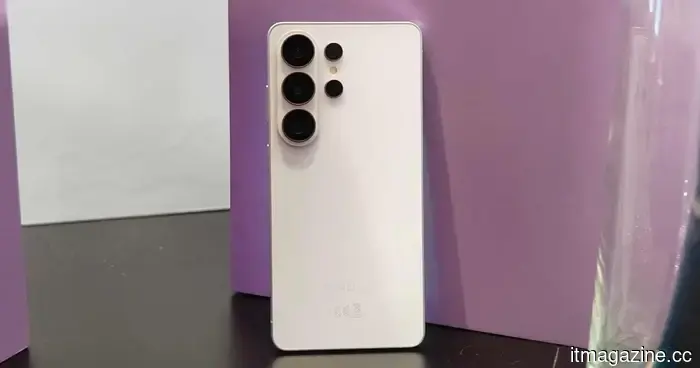 Samsung will lease you a Galaxy S26 Ultra for a year at 50% of its retail price.
Galaxy Forever reshapes flagship ownership in India — pay half now and then, after a year, choose whether to keep, return, or upgrade to the next Galaxy.
Samsung will lease you a Galaxy S26 Ultra for a year at 50% of its retail price.
Galaxy Forever reshapes flagship ownership in India — pay half now and then, after a year, choose whether to keep, return, or upgrade to the next Galaxy.
 You may need to wait several months for Intel’s newest chips to be available in laptops from your preferred brands.
Intel's Core Ultra 200HX laptop processors are being released in phases, which means that certain brands will receive them months ahead of others.
You may need to wait several months for Intel’s newest chips to be available in laptops from your preferred brands.
Intel's Core Ultra 200HX laptop processors are being released in phases, which means that certain brands will receive them months ahead of others.
 Hydrogen fuel vehicles failed to gain popularity, but they could potentially power the next generation of long-range drones.
Hydrogen has not been successful in powering cars, but scientists in Norway have developed a drone that operates on hydrogen, replacing batteries with a fuel cell to manage long-distance tasks such as inspecting power lines.
Hydrogen fuel vehicles failed to gain popularity, but they could potentially power the next generation of long-range drones.
Hydrogen has not been successful in powering cars, but scientists in Norway have developed a drone that operates on hydrogen, replacing batteries with a fuel cell to manage long-distance tasks such as inspecting power lines.
Apple discreetly addresses Family Sharing’s most significant issue a decade after it was introduced.
Apple has recently resolved a billing issue related to Family Sharing that has existed since the feature was introduced in 2014.