

Chrome might soon implement Gemini antiscam protection to identify scams, but it won’t monitor every website you access.
Google is testing server-side Gemini checks that activate only on suspicious pages, introducing an additional scam filter without scanning every page you visit.
Google Chrome may soon receive an upgrade aimed at combating scams via Gemini. This involves Google testing Gemini's anti-scam protection in Chrome, which serves as an extra verification that comes into play only when the browser identifies a site as potentially risky.
This system isn't always active and doesn't analyze every page you visit. Instead, Chrome intervenes during higher-risk situations and forwards the flagged page for more thorough examination, while maintaining the current scam protection measures.
The feature, discovered by Windows Report, is linked to Enhanced Safe Browsing (referred to as Enhanced protection in Safe Browsing settings) and is turned off by default. If you choose not to opt-in, you won't benefit from this additional check.
It activates only when risks arise.
Chrome already utilizes AI-based detection to help prevent phishing and tech support scams when Enhanced protection is enabled. This defense mechanism combines local scans on your device with server-side signals to identify potentially harmful pages before you become involved.
The Gemini layer acts as an escalation measure. When Chrome identifies a page that raises concerns, it can forward the page for a server-side evaluation that assesses the likelihood of it being linked to scam activities. It's akin to a second opinion when the first analysis has already raised a concern.
What the Gemini check can detect.
In this trial phase, the server-side Gemini model analyzes a page using its URL and visible text content. This is sufficient to identify many common scam phrases without needing a comprehensive look at your entire browsing activity.
Google sends this information to one of its own services for processing, and cookies are not included in the data sent. However, some page information does leave your device if a site is flagged, even if the scope is limited.
When you might see this feature.
Currently, Gemini Antiscam Protection appears as an experimental option in Chrome Canary, as noted by Windows Report. Associated commits connect the feature to Enhanced Safe Browsing and hint at a possible rollout around Chrome version 146 for Windows, macOS, Linux, ChromeOS, and Android.
While this isn't a guarantee for release on that timeline, it implies that Google is preparing for widespread platform integration. If you already utilize Enhanced protection, keep an eye out for Chrome updates as version 146 approaches. To avoid server-side analysis, you can opt to disable Enhanced protection and stick with Chrome's standard scam warnings.
Paulo Vargas is an English major turned journalist and technical writer, with a career that has always come full circle.
Mozilla is allowing users to disable AI features in Firefox, if desired.
Mozilla will also give users options regarding their AI preferences.
If you prefer a browser experience with minimal AI, Mozilla is providing a way to completely turn off these features in Firefox. The company has confirmed that an AI "kill switch" will first appear in Firefox Nightly builds before being rolled out to everyone on February 24 with Firefox 148.
Once available, users will be able to deactivate all AI-driven features in the browser with a single toggle. Mozilla's decision comes as many AI-enhanced browsers are rapidly incorporating more automated tools, regardless of user demand. With Firefox, you can enable AI if it suits you, but you also have the choice to not have it if it's unnecessary.
Google’s Android PCs may come equipped with a basic version of the Pixel Camera app.
An early listing has revealed Google's Desktop Camera app, which could be featured on devices running Aluminium OS.
Google is developing a new series of Android PCs that will be powered by a fresh operating system called Aluminium OS. Although the initial devices are anticipated to launch later this year, we have already glimpsed the software in action on an HP Elite Dragonfly 13.5 Chromebook. Recently, a report has provided an early preview of the camera app Google might integrate into this desktop environment.
Android Authority has identified a Play Store listing for a Desktop Camera app by Google, likely intended for the forthcoming Android PCs. The app is described simply as a "Camera app for desktop," and the provided screenshots showcase its interface for the first time.
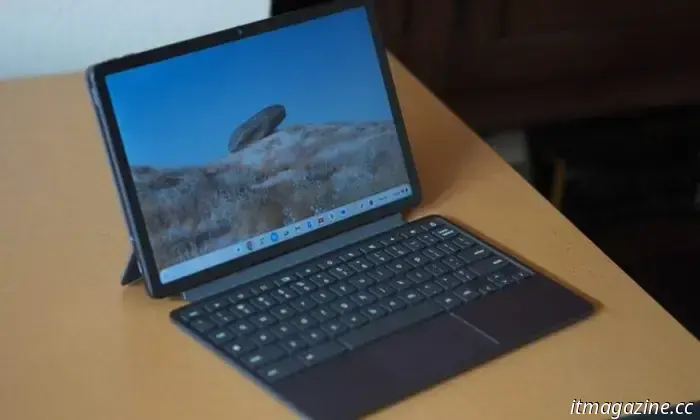
Your wait for an updated Apple Studio Display may soon come to an end.
A new report indicates that Apple's updated Studio Display could be released in the first half of 2026.
The Apple Studio Display is in need of a refresh. Released in 2022, the current model features a 27-inch 5K IPS display with a 60Hz refresh rate and is powered by the A13 Bionic chip. Recent leaks imply that Apple is gearing up for a substantial upgrade, which may include a new chip, a 120Hz display, and HDR support. According to a recent report, the redesigned Studio Display could be launching in the coming months.
As per Bloomberg's Mark Gurman, Apple's new Studio Display "has been in development for some time" and is "expected to launch in the first half of




Other articles
 Sony's innovative patent for a PlayStation controller allows for buttons to be placed wherever you desire.
Sony has obtained a new patent that envisions a PlayStation controller featuring reconfigurable on-screen buttons. This concept replaces many of the traditional fixed top-face controls with a sizable touchscreen area. Rather than being constrained to a single D-pad and a cluster of face buttons, you could position touch zones according to where your thumbs naturally rest. Additionally, you would have the option to resize these zones or rotate them.
Sony's innovative patent for a PlayStation controller allows for buttons to be placed wherever you desire.
Sony has obtained a new patent that envisions a PlayStation controller featuring reconfigurable on-screen buttons. This concept replaces many of the traditional fixed top-face controls with a sizable touchscreen area. Rather than being constrained to a single D-pad and a cluster of face buttons, you could position touch zones according to where your thumbs naturally rest. Additionally, you would have the option to resize these zones or rotate them.
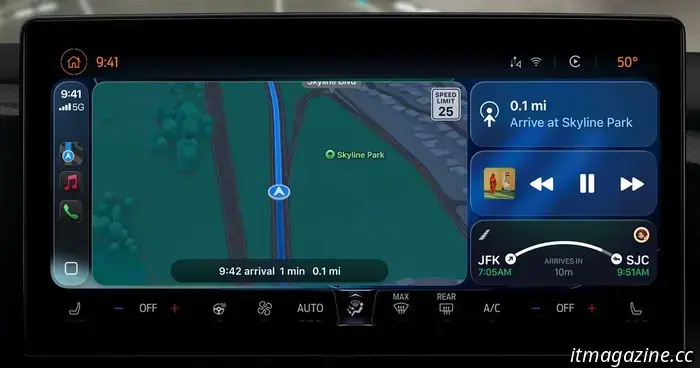 You may soon encounter CarPlay Ultra outside of a $200,000 Aston Martin.
CarPlay Ultra has been difficult to come by outside of a $200,000 Aston Martin, but it could finally debut in a common Hyundai or Kia model later this year, marking Apple’s first significant opportunity to expand its custom dashboard system.
You may soon encounter CarPlay Ultra outside of a $200,000 Aston Martin.
CarPlay Ultra has been difficult to come by outside of a $200,000 Aston Martin, but it could finally debut in a common Hyundai or Kia model later this year, marking Apple’s first significant opportunity to expand its custom dashboard system.
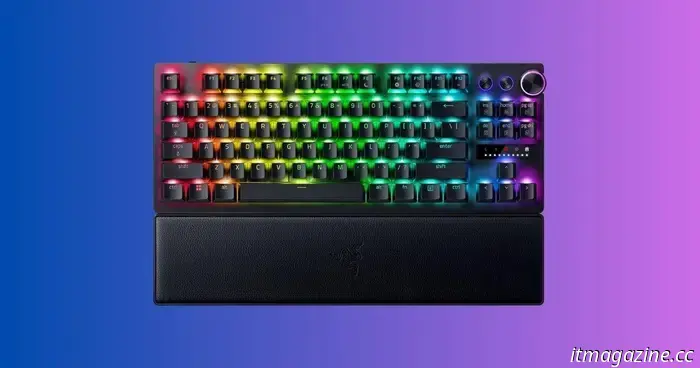 The "rapid trigger" revolution: the end of mechanical switches.
Over the past ten years, "Cherry MX Red" has been regarded as the benchmark for gaming. However, by 2026, this mechanical switch has become officially outdated for competitive gaming. The current trend is "Hall Effect" (magnetic) technology. In contrast to a mechanical switch, which requires a physical contact to log a keypress, a Hall Effect switch employs a […]
The "rapid trigger" revolution: the end of mechanical switches.
Over the past ten years, "Cherry MX Red" has been regarded as the benchmark for gaming. However, by 2026, this mechanical switch has become officially outdated for competitive gaming. The current trend is "Hall Effect" (magnetic) technology. In contrast to a mechanical switch, which requires a physical contact to log a keypress, a Hall Effect switch employs a […]
 Samsung's 2026 OLED televisions incorporate Nvidia G-SYNC for your configuration.
Samsung has announced that Nvidia G-SYNC Compatible will be available on its 2026 OLED TVs, beginning with the S95H, S90H, and S85H models. Combine that with refresh rates of up to 165Hz, and you have a more refined big-screen PC gaming experience.
Samsung's 2026 OLED televisions incorporate Nvidia G-SYNC for your configuration.
Samsung has announced that Nvidia G-SYNC Compatible will be available on its 2026 OLED TVs, beginning with the S95H, S90H, and S85H models. Combine that with refresh rates of up to 165Hz, and you have a more refined big-screen PC gaming experience.
-could-launch-soon-and-heres-what-to-expect.jpg) The affordable Headphone (a) may be released soon, and here’s what you might anticipate.
A recent leak has disclosed some information regarding Nothing's forthcoming budget-friendly headphones, the Headphone (a).
The affordable Headphone (a) may be released soon, and here’s what you might anticipate.
A recent leak has disclosed some information regarding Nothing's forthcoming budget-friendly headphones, the Headphone (a).
 A leak from Sony reveals a fresh design for the forthcoming WF-1000XM6 earbuds along with a significant audio enhancement.
According to a comprehensive new leak, Sony's upcoming flagship true wireless earbuds are expected to feature advanced AI audio capabilities, enhanced noise cancellation, updated design elements, and a higher price point.
A leak from Sony reveals a fresh design for the forthcoming WF-1000XM6 earbuds along with a significant audio enhancement.
According to a comprehensive new leak, Sony's upcoming flagship true wireless earbuds are expected to feature advanced AI audio capabilities, enhanced noise cancellation, updated design elements, and a higher price point.
Chrome might soon implement Gemini antiscam protection to identify scams, but it won’t monitor every website you access.
Google is trialing Gemini antiscam protection in Chrome, a server-side scam verification that operates only when a page appears to be potentially harmful. It is disabled by default and necessitates Enhanced Safe Browsing to be enabled.