
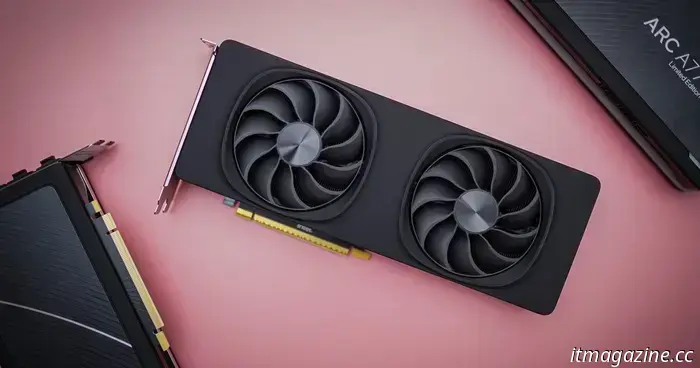
The GPU I’m most looking forward to in 2026 isn't from AMD or Nvidia.
Each year, the GPU market follows a familiar pattern. Nvidia leads at the high end, AMD responds where possible, and the most significant headlines highlight flagship performance. For the majority of consumers, this still means choosing between these two companies, even though Nvidia clearly holds the upper hand.
However, the GPU I’m most eager to see as we approach 2026 isn’t from either company. Instead, it’s an unverified card that has the potential to shift the market dynamics – Intel’s Arc B770, often referred to in leaks as Big Battlemage.
Intel’s foray into discrete Arc GPUs hasn’t been seamless, but it's been significant. The first generation showed promise but faced challenges with drivers, consistency, and market positioning. Nonetheless, Intel persevered. It quietly addressed foundational issues through updates and refinements for the Arc A-series (Alchemist). More crucially, with the newer B-series (Battlemage), Intel began focusing on what is most important to consumers – practical performance at a competitive price.
The B-series GPUs, including the B580 and B570, may not have dominated benchmarks, but they gained recognition for their strong value, rapid improvement through driver updates, and competitive pricing against Nvidia and AMD.
This momentum makes the Arc B770 intriguing, as it indicates that Intel might be moving beyond mere experimentation and working towards something more substantial. To clarify, the B770 isn’t likely to be a flagship in the conventional sense. Rather, it appears to be Intel's first serious endeavor in creating a true midrange performance GPU that targets the market where most gamers purchase hardware.
Reasons the Arc B770 feels distinctive
At the core of the anticipated Arc B770 is Intel’s larger BMG-G31 Battlemage chip, which has appeared in developer tools and profiling software, indicating that a product is actively being tested rather than just in planning stages. This chip is projected to be significantly larger and more powerful than any previous Arc offerings.
Rumors suggest the B770 may include up to 32 Xe2 cores, representing a major improvement over earlier Arc designs. Coupled with architectural advancements in Battlemage, this should lead to noticeably enhanced raster performance, superior ray tracing capabilities, and fewer limitations that previously hindered earlier Arc GPUs.
Memory is another area where the B770 could finally show competitive potential. Recent reports indicate it may feature 16GB of GDDR6 memory, likely combined with a wider memory bus than its predecessors. This is crucial as modern games and creative applications increasingly require more VRAM. If Intel achieves the anticipated 16GB, the B770 would avoid one of the common criticisms faced by today’s midrange GPUs.
Power consumption is also expected to increase. Some leaks imply the Arc B770 could be a 300W-class GPU, which might seem high, but it indicates that Intel is focusing more on sustained performance rather than solely prioritizing efficiency. This suggests an emphasis on higher clock speeds and sufficient thermal capacity to effectively compete in the 1440p gaming market.
None of this has been officially verified, but Intel's own actions hint at a larger undertaking. Earlier this year, Intel’s gaming social media account acknowledged the Arc B770 in response to a fan query. Although the comment was quickly retracted, it confirmed that the name and product exist internally.
A GPU aimed at the actual gaming audience
The excitement surrounding the Arc B770 doesn't stem from expectations to surpass Nvidia or AMD at the top tier. Instead, Intel seems to be targeting 1440p gaming, where the majority of PC gamers play. This resolution tends to offer a balance between performance, visual quality, and hardware cost, and competition in this area has felt increasingly limited.
If the B770 can provide steady frame rates at 1440p, manage ray tracing effectively, and possess ample VRAM to prevent memory-related issues, it could finally present consumers with a genuine third option. This is something the GPU market hasn't offered in a long time.
Intel also has the chance to stand out in areas beyond just performance. Battlemage is anticipated to bring enhancements to media engines, AI acceleration, and upscaling technologies. The company has demonstrated a willingness to aggressively update software, and a more robust hardware base would amplify the impact of these advancements.
The broader significance beyond a single GPU
The Arc B770 isn’t merely about Intel showing it can produce a faster graphics card. It’s about whether Intel can establish itself as a long-term contender in the discrete GPU market. This has far-reaching implications beyond one product cycle.
A credible third player can affect pricing, compel better value propositions, and alleviate the stagnation that often creeps into markets dominated by two companies. Even if the B770 doesn’t top the benchmark rankings, its mere existence could enhance the overall health of the midrange GPU market.
Intel's broader portfolio also provides it with unique advantages. Unlike its competitors, it designs CPUs, integrated graphics, and discrete GPUs all within one company.

Other articles
 Here’s how LG’s soon-to-be-released robot might simplify your home life.
LG is set to introduce its CLOiD home robot at CES 2026, emphasizing its commitment to smart home automation and a future in which robots alleviate everyday household tasks.
Here’s how LG’s soon-to-be-released robot might simplify your home life.
LG is set to introduce its CLOiD home robot at CES 2026, emphasizing its commitment to smart home automation and a future in which robots alleviate everyday household tasks.
 Asus may develop its own RAM since other companies are preoccupied.
Due to a worldwide memory shortage, Asus might explore DRAM manufacturing or seek alternative suppliers to mitigate price increases as costs for DDR4 and DDR5 continue to climb.
Asus may develop its own RAM since other companies are preoccupied.
Due to a worldwide memory shortage, Asus might explore DRAM manufacturing or seek alternative suppliers to mitigate price increases as costs for DDR4 and DDR5 continue to climb.
 I have been covering games for several years – here are the most significant events that took place in 2026.
From GTA 6 to the latest Steam Machines, here’s everything to look forward to in 2026.
I have been covering games for several years – here are the most significant events that took place in 2026.
From GTA 6 to the latest Steam Machines, here’s everything to look forward to in 2026.
 LG Display is ready to unveil its 27-inch 4K OLED RGB stripe panel at CES 2026.
LG Display is introducing the first-ever 27-inch 4K OLED RGB stripe panel with a refresh rate of 240Hz, aimed at high-end gaming and professional displays, offering enhanced clarity, speed, and versatility.
LG Display is ready to unveil its 27-inch 4K OLED RGB stripe panel at CES 2026.
LG Display is introducing the first-ever 27-inch 4K OLED RGB stripe panel with a refresh rate of 240Hz, aimed at high-end gaming and professional displays, offering enhanced clarity, speed, and versatility.
 You inquired: What are the top TV recommendations for frequent daily use, and are all-in-one soundbars a wise choice?
In this episode of You Asked, we discuss the value of all-in-one soundbars, identify which TVs are suitable for frequent daily use, and explore strategies for creating accessible TV setups for individuals with visual impairments.
You inquired: What are the top TV recommendations for frequent daily use, and are all-in-one soundbars a wise choice?
In this episode of You Asked, we discuss the value of all-in-one soundbars, identify which TVs are suitable for frequent daily use, and explore strategies for creating accessible TV setups for individuals with visual impairments.
 How to utilize your fitness tracker to achieve your best fitness in 2026.
We will guide you through five key tips to help you maximize the use of a fitness tracker and enhance your health.
How to utilize your fitness tracker to achieve your best fitness in 2026.
We will guide you through five key tips to help you maximize the use of a fitness tracker and enhance your health.
The GPU I’m most looking forward to in 2026 isn't from AMD or Nvidia.
Each year, the GPU market appears to adhere to a recognizable pattern. Nvidia remains at the forefront in the high-end segment, AMD reacts when possible, and the most notable news is often centered around flagship performance. For the majority of consumers, this still translates to a choice between the same two companies—even as the dynamics clearly […]