
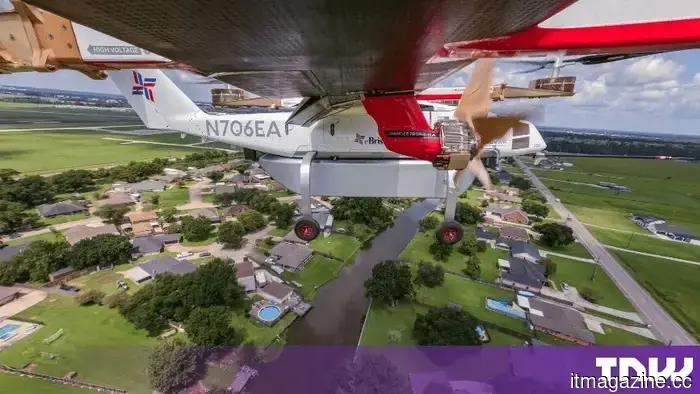
The FAA has just permitted a pilotless cargo aircraft to take off from an operational airport.
An unmanned aircraft autonomously departed from a functioning airport in Louisiana last week. It was laden with spare parts, medical supplies, and cans of water, flying over residential areas.
Elroy Air announced on Wednesday that it had successfully conducted the first uncrewed autonomous flights as part of a federal program aimed at integrating self-flying aircraft into U.S. airspace.
Aircraft specifics and route
Elroy Air refers to the aircraft as Chaparral. This hybrid-electric model is designed for vertical takeoff and can transport over 500 pounds of cargo, with a range of up to 450 miles. It does not require a runway or charging infrastructure.
The flights took place over a week in late August at Houma-Terrebonne Airport, which the company claims is among the busiest rotorcraft airports in the nation. Air traffic control managed the aircraft along with the standard traffic.
The payload was intentionally ordinary, consisting of packages, medical supplies, a toolbox with spare parts, food, and jerry cans of water. This choice emphasizes the objective; the company is demonstrating the aircraft's capability to handle the mundane, repetitive tasks that currently require a helicopter and a pilot.
Elroy Air collaborated with two partners during this week: Bristow Group, a helicopter operator supporting Gulf of Mexico energy platforms, and a state initiative known as LIFTOFF Louisiana.
Regulatory endorsement
What distinguishes this from a standard company demonstration is the input from officials. FAA Administrator Bryan Bedford remarked that these flights illustrated the potential for such aircraft to enhance cargo delivery across communities nationwide and improve logistics infrastructure.
It’s uncommon for regulators to provide quotes in a startup’s press release. Josh Duplantis from the Louisiana Department of Transportation and Development went further, stating he witnessed the operation and described it as disciplined and safe.
The program is known as the eVTOL Integration Pilot Program, established under an executive order titled Unleashing American Drone Dominance. This initiative pairs manufacturers and operators with state and federal agencies, using operational data to inform future aviation policy.
Elroy Air participated in March 2026 through Louisiana’s application and asserts that Chaparral is the sole heavy-payload cargo drone built specifically for this program.
A busy week for the FAA
Simultaneously, the FAA has been approving other autonomous systems for domestic airspace. Tests at White Sands facilitated a safety agreement between the Department of War and the FAA, which cleared a laser weapon for operation within U.S. airspace, as reported on Wednesday, even before the Army acquired it.
This pattern is noteworthy: one autonomous system transports water while another is designed to shoot down drones. Within days, both systems were granted access to American airspace.
The program has had previous success, having completed its initial flights in July with aircraft carrying transplant organs instead of passengers, with pilots on board. These recent flights did not include pilots.
Cargo delivery has generally been prioritized first. DoorDash secured FAA clearance for its own drone operation in July, while Zipline is conducting medical deliveries for the Cleveland Clinic.
Scrutinizing the pipeline figures
Elroy Air claims its commercial demand pipeline exceeds 1,400 aircraft, translating to over $5 billion in potential revenue. This sum stands out for a company that has yet to deliver a production aircraft.
However, the language in their filings dilutes that assertion. The company notes that this pipeline only consists of non-binding letters of intent and memorandums of understanding, with no guarantee that any will turn into actual orders, advising investors not to view the figure as a future revenue indicator.
This caution stems from Elroy Air's plans to go public via a merger with a special purpose acquisition company, Inflection Point Acquisition Corp VII. A registration statement has been filed in draft form with the SEC.
Reporting the number without this context would serve the company’s interests rather than providing an objective account.
Who is behind the aircraft
Chaparral will be manufactured by Kratos Defense and Security Solutions, which holds exclusive U.S. manufacturing rights and is expanding its facility in Sacramento for this purpose. The first production aircraft is anticipated by late 2026.
Investors include Lockheed Martin Ventures, alongside Shield Capital, Marlinspike Partners, and others.
The defense aspect is significant. Elroy Air secured a $46 million multi-year contract with the Army in August for an autonomous VTOL aircraft capable of carrying modular payloads. In July, it developed three unattended delivery modes for Chaparral under a different Army contract.
The company labels the design as dual-use, with tactical resupply among its intended applications. Defense funding has notably influenced this sector, as the Pentagon’s push for drones has increased valuations across the industry.
Thus, the aircraft that transported water over Houma last week shares its airframe with what the Army is funding to develop for battlefield logistics.
What’s next
Bristow notes that its energy and government customers are seeking low-risk, high-frequency methods to transport cargo throughout the Gulf Coast,
Other articles
 Schools are adopting AI technologies. However, New York City has prohibited its use for over half a million students.
New York City is pausing the use of generative AI for its younger students. Over 500,000 children will return to school without access to AI tools designed for students.
Schools are adopting AI technologies. However, New York City has prohibited its use for over half a million students.
New York City is pausing the use of generative AI for its younger students. Over 500,000 children will return to school without access to AI tools designed for students.
 A UNICEF study reveals that 60% of online sexual abuse of children occurs on social media platforms.
A UNICEF study involving 21,000 children from 21 countries estimates that 20 million faced online sexual exploitation or abuse within a single year, with nearly 60% of the incidents occurring on social media and less than 1% ever reported.
A UNICEF study reveals that 60% of online sexual abuse of children occurs on social media platforms.
A UNICEF study involving 21,000 children from 21 countries estimates that 20 million faced online sexual exploitation or abuse within a single year, with nearly 60% of the incidents occurring on social media and less than 1% ever reported.
 CrowdStrike integrated OpenAI into their product offerings and placed Anthropic at the payment stage.
CrowdStrike will operate OpenAI's GPT-5.6 Cyber within a specially designed cyber harness. A day prior, a report identified the harness as the genuine risk.
CrowdStrike integrated OpenAI into their product offerings and placed Anthropic at the payment stage.
CrowdStrike will operate OpenAI's GPT-5.6 Cyber within a specially designed cyber harness. A day prior, a report identified the harness as the genuine risk.
 Schools are welcoming AI technology. However, New York City has prohibited its use for over half a million students.
New York City is pausing the use of generative AI for its younger students. Over 500,000 children will return to school without the availability of AI tools designed for students.
Schools are welcoming AI technology. However, New York City has prohibited its use for over half a million students.
New York City is pausing the use of generative AI for its younger students. Over 500,000 children will return to school without the availability of AI tools designed for students.
 Texas Republicans are opposing data centers, and both candidates for the Senate support the same regulations regarding water.
Data centers have emerged as a pivotal topic in the gubernatorial and Senate races in Texas. Ken Paxton and James Talarico have both suggested implementing closed-loop water mandates, while Abbott is campaigning on the water connection pause he initiated in August.
Texas Republicans are opposing data centers, and both candidates for the Senate support the same regulations regarding water.
Data centers have emerged as a pivotal topic in the gubernatorial and Senate races in Texas. Ken Paxton and James Talarico have both suggested implementing closed-loop water mandates, while Abbott is campaigning on the water connection pause he initiated in August.
 An inexpensive software program wiped out Booz Allen's internal AI threat ranking.
Booz Allen evaluated 18 AI models for infiltrating a live network. Only Claude Mythos succeeded. Subsequently, an inexpensive harness bridged the difference.
An inexpensive software program wiped out Booz Allen's internal AI threat ranking.
Booz Allen evaluated 18 AI models for infiltrating a live network. Only Claude Mythos succeeded. Subsequently, an inexpensive harness bridged the difference.
The FAA has just permitted a pilotless cargo aircraft to take off from an operational airport.
Elroy Air conducted a flight with an uncrewed 500-pound cargo aircraft from a regulated airport in Louisiana, marking the initial flights under an FAA pilot program.