
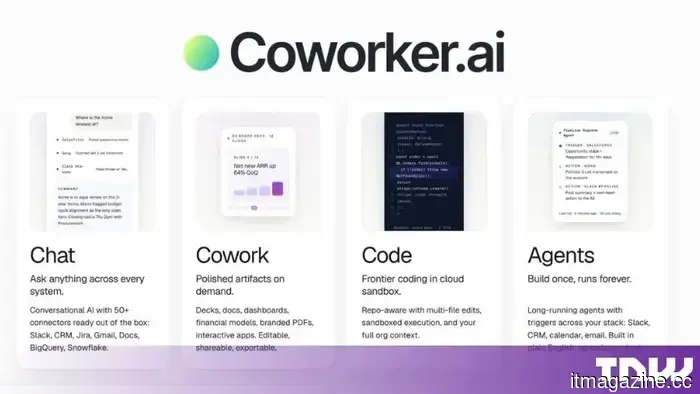
Coworker.ai introduces OM2, an organizational memory layer that claims to reduce enterprise AI token consumption by nine times.
Coworker.ai is introducing OM2, a consolidated organizational memory layer that assimilates data from over 50 enterprise platforms and transforms it into precomputed, permission-aware facts. Rather than reconstructing context anew for each AI query, OM2 leverages existing structured intelligence across sessions, leading to a ninefold decrease in token expenditures and a 64% increase in response speed. With more efficient model routing, overall savings can reach up to 51 times.
Currently, when a standard enterprise AI agent activates to respond to an internal query, it experiences significant memory loss. To make the AI functional, organizations find themselves in a costly and repetitive cycle of scraping thousands of documents, Slack conversations, and CRM records, and inputting them into the prompt for context. This brute-force method of data retrieval is estimated to consume more than 50% of enterprise AI token budgets.
To address this issue, Coworker AI is launching OM2, a cohesive organizational memory layer that significantly optimizes how AI accesses corporate data. Instead of constructing the company context from scratch for each session, OM2 continuously ingests data from over 50 enterprise platforms and condenses it into a living, permission-aware neural graph.
OM2 Precomputes Corporate Knowledge to Cut Token Usage by 9 Times
Standard enterprise AI depends on document-level retrieval, extracting large text segments whenever an employee poses a question. In contrast, Coworker.ai’s OM2 employs a more precise method. As new information circulates within the organization—be it a closed deal in Salesforce, a product shift in Slack, or a strategic decision captured in meeting notes—OM2 extracts it into compact, precomputed facts.
These facts clearly outline who was involved, what was decided, and which accounts are influenced. Since this structured intelligence is computed once and reused across queries, the AI can avoid re-deriving context for each prompt. The company claims that this structural change alone results in a 9x reduction in token usage and enhances response times by 64%, while providing preferred answers 84.5% of the time in terms of quality.
Eliminating Vendor Lock-In & Reducing Costs
Coworker is also tackling the ‘one-size-fits-all’ usage model that raises enterprise costs. By incorporating the company’s Optimized Routing engine, OM2 dynamically prioritizes tasks. It directs simpler data retrieval to more affordable, quicker models, while reserving complex reasoning for advanced models. When combined with the precomputed context layer, Coworker asserts that cost savings can reach an impressive 51x.
Importantly, this architecture allows companies to retain true data sovereignty. Rather than confining their institutional knowledge within a single vendor’s closed ecosystem, OM2 functions as an agnostic intelligence layer. Through its Model Context Protocol (MCP) or native applications, it seamlessly integrates with the tools teams are already using, such as Claude, ChatGPT, Gemini, Perplexity, or custom internal agents.
"Token costs are soaring, and most AI still struggles to operate effectively within a real company," said Alex Calder, Co-Founder and CEO of Coworker.ai. "OM2 continuously learns and comprehends your business while enforcing strict permissions at every junction. That's how we achieve 9x savings before routing is even considered. Unlike many players in the AI industry, we aren't incentivized to make you spend more tokens; our goal is to help you use fewer."
Security & Tangible Benefits
In the enterprise domain, intelligence is only as valuable as the security measures in place; a junior engineer should never inadvertently access the CEO's M&A discussions. OM2 tackles this by embedding access policies directly into every fact and connection within the graph. Operating on a secure, single-tenant infrastructure that complies with SOC 2, GDPR, and CASA Tier 2 standards, the platform ensures that users and agents only access the nodes they are explicitly authorized to view.
Early adopters are already leveraging the platform to connect data silos. At RapidSOS, the Revenue Operations team previously dedicated hours to manually cross-referencing Salesforce records with disorganized communication logs to validate data. “Now, the answer is immediately available, accurate, and up-to-date when we ask,” remarked Anna Waring, RapidSOS’s Director of Revenue Operations and Systems.
Supported by prominent Silicon Valley investors, including Ramtin Naimi and former Google SVP Jeff Huber, Coworker.ai is banking on a practical transformation in the AI landscape. While foundational model developers compete to create increasingly larger context windows, Coworker demonstrates that the true key to enterprise success lies not in a bigger brain, but in a more effective memory.
Other articles
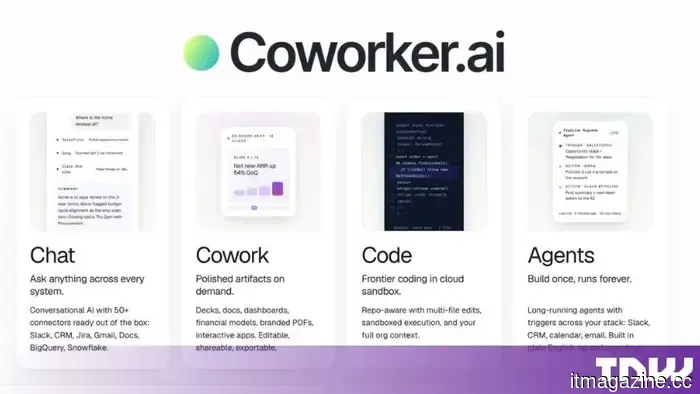 Coworker.ai introduces OM2, an organizational memory layer that aims to reduce enterprise AI token usage by nine times.
Coworker.ai’s OM2 precomputes organizational knowledge into a permission-aware neural graph, reducing token expenditures by 9 times and accelerating AI response times by 64%. The system directs queries through various models to maximize total savings up to 51 times.
Coworker.ai introduces OM2, an organizational memory layer that aims to reduce enterprise AI token usage by nine times.
Coworker.ai’s OM2 precomputes organizational knowledge into a permission-aware neural graph, reducing token expenditures by 9 times and accelerating AI response times by 64%. The system directs queries through various models to maximize total savings up to 51 times.
 From a Single Corridor to Multiple Pathways: Indonesia as the Model for Asia’s Stablecoin Prospects
Ratio CEO John Cho discusses the necessity of banking, liquidity, foreign exchange, and compliance for local-currency stablecoins to operate effectively as a unified corridor, beginning with Indonesia.
From a Single Corridor to Multiple Pathways: Indonesia as the Model for Asia’s Stablecoin Prospects
Ratio CEO John Cho discusses the necessity of banking, liquidity, foreign exchange, and compliance for local-currency stablecoins to operate effectively as a unified corridor, beginning with Indonesia.
Coworker.ai introduces OM2, an organizational memory layer that claims to reduce enterprise AI token consumption by nine times.
Coworker.ai's OM2 transforms corporate knowledge into a permission-aware neural graph, reducing token expenditure by nine times and enhancing AI response times by 64%. The system directs queries through different models, achieving total savings of up to 51 times.