
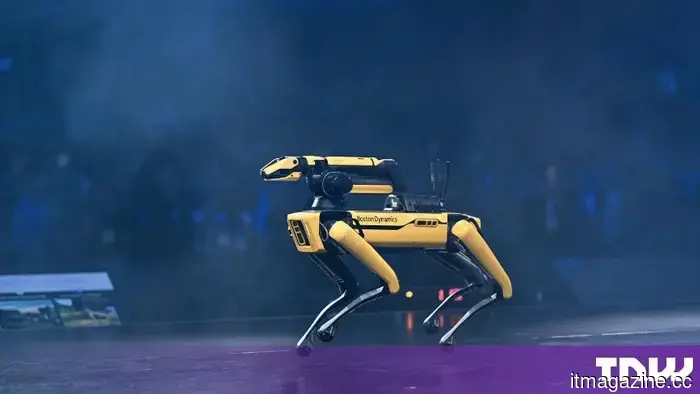
ICE intends to purchase robot dogs from Boston Dynamics without conducting a competitive bidding process.
U.S. Immigration and Customs Enforcement (ICE) has announced plans to acquire a fleet of robot dogs from Boston Dynamics, with projected spending between $1 million and $2 million. The announcement states that ICE does not intend to open the purchase to competition.
Joseph Cox discovered this plan for 404 Media on Friday, located in the Department of Homeland Security’s Acquisition Planning Forecast System, a public database where federal buyers list intended purchases months prior to going to market. While anyone can access this information, very few do.
ICE made this record public on August 27 under the title "Boston Dynamics SPOT Robots Procurement."
What the record reveals
ICE is seeking the robots for various purposes including inspection, situational awareness, and hazard assessment in potentially risky environments for personnel. The documentation indicates that this capability enhances officer safety, allowing the agency to access "dangerous, confined, unstable, or difficult-to-reach areas."
Three notable details were not covered in the coverage. The competition field indicates "NO," meaning ICE plans to purchase these robots without a competitive bidding process, utilizing FAR Subpart 13.5, which provides a streamlined procedure for commercially available items to avoid full competition for routine equipment. The robots are categorized under miscellaneous general-purpose machinery.
The performance location specified is Fort Benning, Georgia, an Army installation, rather than a border sector or office, and the reasoning for this choice is not provided in the record.
The third detail addresses status: this is a forecast rather than a contract. The solicitation was expected to be released on September 4, with an anticipated award in the last quarter of the fiscal year, concluding in April 2027. ICE has indicated this will be a firm fixed-price arrangement, meaning they have a predetermined budget.
Spot units typically have a list price of around $75,000, suggesting that ICE's planned purchase could consist of a limited number of machines, although the record includes accessories and support in addition to the robots.
The second purchase that week
The robots are not the only items ICE has been procuring. Ryan J. Foley reported for the Associated Press that the agency awarded a $16.7 million contract for 6,000 pairs of electric shock gloves, with the announcement made during the same week. This contract was also awarded without a competitive process, going to Compliant Technologies, a manufacturer from Kentucky. The gloves function as regular patrol gloves until the officer activates a button, requiring contact with bare skin to deliver a shock.
ICE stated these gloves would be used in “high-tension environments,” including during arrests, transporting combative detainees, and dealing with disturbances outside detention facilities.
Hours before the announcement, sixteen senators, led by Catherine Cortez Masto, had urged ICE’s acting director to reconsider the purchase, citing safety concerns regarding the agency's ability to deploy such devices responsibly. They highlighted incidents of "the blatant and tragic misuse of force" in various cities across the U.S. However, the agency proceeded with the procurement notice.
ICE defended its justification for the gloves, stating the aim is to avoid escalating to "more severe force," including firearms, and to gain control quickly enough to prevent injury on both sides.
DHS responded to critics in a statement, calling it "despicable" for "sanctuary politicians" to attempt to prohibit federal law enforcement from having safety equipment.
Police departments have previously acquired Spot but have returned them
The Spot robot, which walks on four legs, climbs stairs, and carries sensors, can be operated remotely or programmed to follow a specific route. TNW observed Boston Dynamics testing it for parcel delivery in July, transporting packages from a van to the front door.
Police departments were among the first to use the robot, although their experiences have been mixed. The New York Police Department terminated its Spot contract in 2021 after public backlash, while Honolulu police utilized it to engage with homeless individuals, a deployment covered by Vice at the time.
Robot dogs are increasingly common in security operations; TNW reported in June about their role in securing the 2026 World Cup and in August about their use to fill gaps due to the high turnover of security personnel.
However, generally, these robots are not equipped to exercise authority. Recently, China deployed robot traffic officers that can perform various tasks except for stopping individuals.
Boston Dynamics maintains a stance against weaponization
In 2022, Boston Dynamics led six robotics companies in signing an open letter pledging not to weaponize their robots, a commitment that extends to their customers as well. The signees expressed that they would not support the arming of their machines and called on the industry to follow suit.
There is no indication in the ICE record that weapons will be involved; it focuses on inspection and situational awareness, which aligns with Spot's intended functions.
The oversight question remains
Civil rights advocates have raised concerns about ICE officers, who already face scrutiny over their use of force, lacking sufficient oversight or accountability, as noted by
Other articles
 These 6 smart home deals for Labor Day address genuine issues.
Six smart home offers for Labor Day from Amazon and Best Buy that can genuinely enhance the functionality of your home.
These 6 smart home deals for Labor Day address genuine issues.
Six smart home offers for Labor Day from Amazon and Best Buy that can genuinely enhance the functionality of your home.
 Eddy Cue has subtly emerged as the most influential executive at Apple.
Phil Schiller's departure grabbed attention. A less publicized shift is that Eddy Cue now oversees the App Store, Arcade, Health, and services.
Eddy Cue has subtly emerged as the most influential executive at Apple.
Phil Schiller's departure grabbed attention. A less publicized shift is that Eddy Cue now oversees the App Store, Arcade, Health, and services.
 Dyson has created a toothbrush equipped with a camera, priced at $499.
The CameraJet employs a 100,000-pixel lens along with an AI algorithm to detect spaces between teeth and subsequently projects a jet of mouthwash at those areas.
Dyson has created a toothbrush equipped with a camera, priced at $499.
The CameraJet employs a 100,000-pixel lens along with an AI algorithm to detect spaces between teeth and subsequently projects a jet of mouthwash at those areas.
 A researcher took control of Claude Code by requesting it to summarize a webpage.
A researcher deceived Claude Code into executing attack code as much as 80% of the time. Anthropic states that this behavior is functioning as intended.
A researcher took control of Claude Code by requesting it to summarize a webpage.
A researcher deceived Claude Code into executing attack code as much as 80% of the time. Anthropic states that this behavior is functioning as intended.
 Eddy Cue has discreetly risen to become the most influential executive at Apple.
Phil Schiller's departure garnered significant attention. A less noticed shift is that Eddy Cue has now taken over the App Store, Arcade, Health, and services.
Eddy Cue has discreetly risen to become the most influential executive at Apple.
Phil Schiller's departure garnered significant attention. A less noticed shift is that Eddy Cue has now taken over the App Store, Arcade, Health, and services.
 Apple has appointed a new CEO, with Tim Cook endorsing the decision by referencing Steve Jobs.
John Ternus has become Apple's CEO following Tim Cook's 15-year tenure. In Cook's farewell message, he referenced Steve Jobs, and Cook will remain as executive chair.
Apple has appointed a new CEO, with Tim Cook endorsing the decision by referencing Steve Jobs.
John Ternus has become Apple's CEO following Tim Cook's 15-year tenure. In Cook's farewell message, he referenced Steve Jobs, and Cook will remain as executive chair.
ICE intends to purchase robot dogs from Boston Dynamics without conducting a competitive bidding process.
ICE has announced intentions to purchase $1 million to $2 million worth of Boston Dynamics SPOT robots, without a competitive bidding process, for delivery to Fort Benning.