

HIZERO believes that your vacuum cleaner could be overworking.
Step into nearly any household after a hectic day, and the floor reveals a more intricate narrative than what a vacuum is equipped to tackle. You might find crumbs beneath the dining table, some moisture beside the sink, strands of hair by the sofa, and a faint trace of dirt tracked in by shoes. Individually, these messes aren't particularly challenging to clean. The issue arises because they don’t arrive one type at a time.
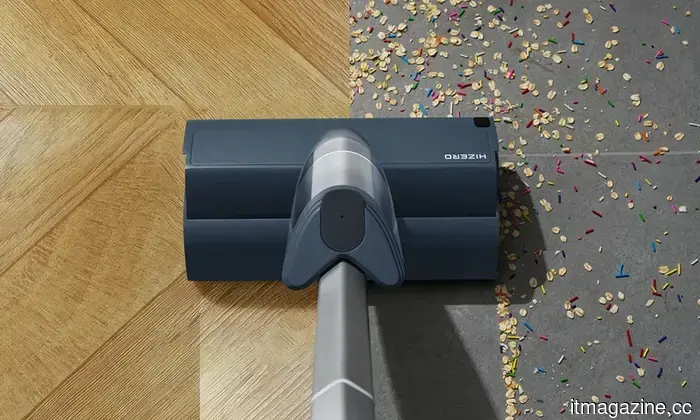
HIZERO has structured its entire cleaning philosophy around this inconvenient reality. Rather than inquiring how much suction a cleaner requires to handle various messes on hard surfaces, the company has questioned whether suction should even be the solution. Its patented No Suction Technology employs a unique bionic polymer roller to directly collect dry debris and liquids from the surface, subsequently separating and managing what it captures.
The cleaner has become more complex than the mess
The conventional response from the cleaning industry has been to increase the machine's capabilities. Motors are now more powerful, rollers are more specialized, filters are more intricate, and wet-and-dry cleaners are better equipped to manage diverse types of debris. Each enhancement addresses a particular limitation in the system but also adds another element that must function correctly and be maintained.
HIZERO
Suction is still favored for valid reasons. Airflow effectively lifts loose particles from surfaces and channels them into a collection system. Issues arise when the materials on the floor include more than just dust or crumbs. Liquids, hair, food bits, and dirt behave uniquely, yet traditional wet-and-dry cleaners must somehow accommodate all of them within a suction-based system.
The trade-offs are known. Solid waste and dirty water may mix, leading to clogs that hinder performance, while the powerful motors required for suction introduce noise and energy consumption issues. Exhaust airflow can stir up fine particles, and various components like rollers, filters, and tanks necessitate their own cleaning and maintenance routines.
HIZERO shifts the collection process back to the surface. Its proprietary bionic polymer roller is engineered to gather dry debris and liquids directly, while the system manages what it collects without routing everything through the same suction pathway.
The roller is where HIZERO diverges from convention
Traditional fiber rollers and pads usually serve as one element of a broader cleaning system. They make contact with surfaces while suction, water delivery, filters, and other components perform the rest of the cleaning tasks. HIZERO’s innovative polymer roller, however, takes on an active role. It’s designed to gather dry debris and liquids straight from hard surfaces, making the roller integral to the cleaning system's operation.
The material's significance becomes evident with debris that may remain after addressing the obvious messes. Pet hair, for instance, can tangle around cleaning components, leading to more maintenance chores instead of simply being eliminated with the rest of the dirt. HIZERO’s design aims to collect hair and other solid waste during the same cleaning process while ensuring these materials remain distinct from the liquid waste encountered.
HIZERO clearly differentiates its polymer roller from standard fiber rollers and pads, integrating the material as a vital part of its patented No Suction Technology rather than as a mere accessory in a suction-dependent system. The company’s approach places the collection mechanism at the surface, where the roller is already interacting with the debris.
EAZY Bionic Mop follows the same principle for manual cleaning. A single push-and-pull motion is crafted to sweep, mop, wash, and wipe simultaneously. A trigger dispenses fresh water to rejuvenate the roller, while dry debris and liquid waste are kept separate for disposal. There is no need for a bucket or cleaning solution, and the mop doesn’t require a motor or charging. It can also be rinsed under running water.
The simplicity of EAZY is advantageous because it eliminates complicated automation between the user and the cleaning surface. The roller handles collection, the system regulates what it picks up, and the user avoids alternating between a vacuum, a mop, and a bucket for different stages of the same cleanup.
GLIDE automates the idea further
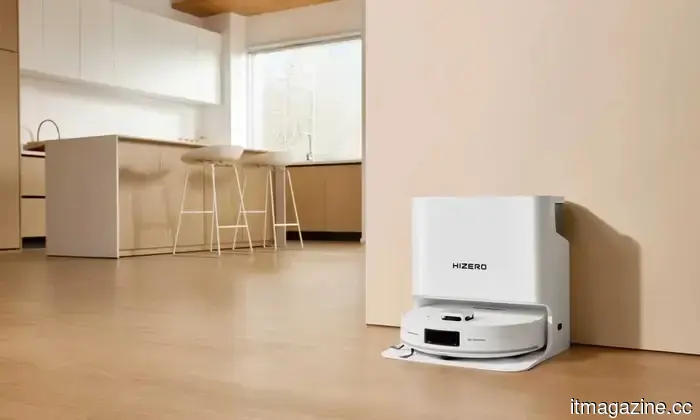
A manual cleaner is one approach to reimagining the mechanism. HIZERO has also embedded the same principle into an autonomous floor cleaner called GLIDE, touted by the company as the world's first no-suction robotic cleaner.
GLIDE utilizes HIZERO’s bionic cleaning system to eliminate wet messes, stains, debris, and hair. Its waste intake is designed to separately handle hair, solid waste, and dirty water as they are collected, while the no-suction design eliminates the need for HEPA filters and dust bags typical of conventional suction-based robotic cleaners.
The robot operates at a specified noise level of 56 dB and boasts a runtime of up to 220 minutes. Its multi-roller system functions alongside dedicated clean and waste-water tanks in both the robot and its docking station.
The quieter operation has practical implications. Cleaning can proceed without turning the space into a chaotic environment, which is crucial in homes where
Other articles
 Lucid is recalling 27,185 Air sedans due to a software issue with a fuse that failed to disconnect the power.
Lucid is recalling 27,185 Air sedans due to a software fuse issue that can cause lighting circuits to overheat. The filing mentions three incidents of fires, with the first occurring in June 2023.
Lucid is recalling 27,185 Air sedans due to a software issue with a fuse that failed to disconnect the power.
Lucid is recalling 27,185 Air sedans due to a software fuse issue that can cause lighting circuits to overheat. The filing mentions three incidents of fires, with the first occurring in June 2023.
 Do you require three 200-megapixel cameras on your smartphone? Oppo believes you'll appreciate it.
A recent leak indicates that Oppo might feature three 200MP cameras in the Find X10 Pro Max, potentially advancing smartphone camera technology even further.
Do you require three 200-megapixel cameras on your smartphone? Oppo believes you'll appreciate it.
A recent leak indicates that Oppo might feature three 200MP cameras in the Find X10 Pro Max, potentially advancing smartphone camera technology even further.
 Lucid is recalling 27,185 Air sedans due to a software issue with a fuse that failed to disconnect the power.
Lucid is recalling 27,185 Air sedans due to a software fuse that may cause the lighting circuits to overheat. The recall report mentions three incidents of fires, with the initial one occurring in June 2023.
Lucid is recalling 27,185 Air sedans due to a software issue with a fuse that failed to disconnect the power.
Lucid is recalling 27,185 Air sedans due to a software fuse that may cause the lighting circuits to overheat. The recall report mentions three incidents of fires, with the initial one occurring in June 2023.
 a16z has collected $1.1 billion to invest in the physical infrastructure of AI.
The Machine Age Fund will invest in chips, memory, networking, storage, data centers, robotics, and home AI devices, a16z announced today.
a16z has collected $1.1 billion to invest in the physical infrastructure of AI.
The Machine Age Fund will invest in chips, memory, networking, storage, data centers, robotics, and home AI devices, a16z announced today.
 Lambda secures $1 billion in private debt for Nvidia chip agreement.
According to Bloomberg, Lambda secured approximately $1 billion in private debt to finance Nvidia chips that Microsoft will lease. Similarly, Europe's largest neocloud is funded through the same method.
Lambda secures $1 billion in private debt for Nvidia chip agreement.
According to Bloomberg, Lambda secured approximately $1 billion in private debt to finance Nvidia chips that Microsoft will lease. Similarly, Europe's largest neocloud is funded through the same method.
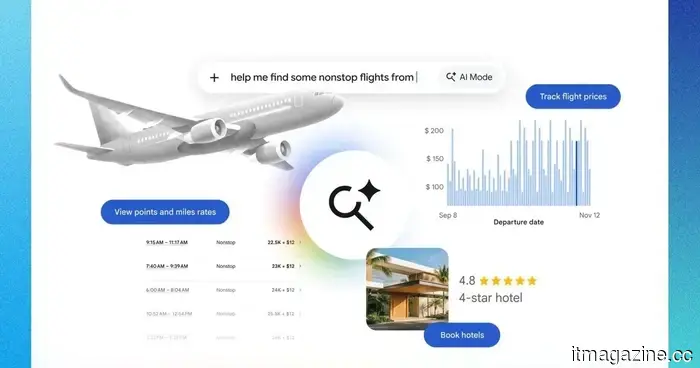 Google AI Mode can now inform you about flight price drops and assist you in booking your hotel.
Google has introduced three new travel features in AI Mode, allowing you to monitor flight prices, compare rewards points, and make hotel reservations, all within a single chat.
Google AI Mode can now inform you about flight price drops and assist you in booking your hotel.
Google has introduced three new travel features in AI Mode, allowing you to monitor flight prices, compare rewards points, and make hotel reservations, all within a single chat.
HIZERO believes that your vacuum cleaner could be overworking.
HIZERO is re-evaluating the role of suction in hard-surface cleaning. With its bionic polymer roller and expanding No Suction ecosystem, it presents an alternative method for cleaning a variety of surfaces, including daily floors, countertops, and for use in autonomous cleaning.