

The regulations for contractors in the Netherlands have recently been revised, and the legislation applies retroactively.
In Amsterdam, there exists a developer who has been billing the same overseas company each month for three years, maintaining the same rate, hours, Slack channel, and a daily standup at 09:30. All parties involved have consistently referred to this arrangement as a contractor relationship.
Starting January 2026, the Dutch Tax Administration can challenge this classification, redirect the tax liability to the company instead of the developer, and retroactively bill them from the beginning of 2025. This isn't a new law being introduced; rather, it's an existing law being enforced. The Netherlands has had regulations delineating employment from self-employment since 2016, enacted under the Wet DBA. For nearly ten years, these regulations were not enforced, but that moratorium ended on January 1, 2025, marking the return of penalties in 2026.
The timeline is crucial as the exposure builds up over time rather than being assessed prospectively. Enforcement recommenced at the start of 2025, but that first year was intentionally lenient, with the tax authority correcting issues rather than imposing penalties. This approach shifted in 2026, as serious penalties for significant violations resumed on January 1, while penalties for honest errors remain suspended.
According to Dutch accountancy firm Crowe Peak, any additional wage tax assessments will go back to January 1, 2025. The leniency disappears completely by January 1, 2027. Therefore, a company reassessing its Dutch operations today cannot start afresh; it must consider a 24-month history of assessable activity, with a four-month deadline looming.
The legislative side has been more complicated but has now clarified. The government spent years crafting the VBAR bill to define true self-employment. In March 2026, it removed the clarification section because it was more confusing than helpful. What remains is a sharper, more focused piece of legislation. On June 16, 2026, the Eerste Kamer approved bill 36.783, which alters Book 7 of the Dutch Civil Code, establishing a legal presumption of employment for individuals earning less than €38 per hour, based on a reference date of January 1, 2026, with enforcement following a Royal Decree.
The important aspect of this mechanism is that when a self-employed individual invokes this presumption, the client must prove that no employment relationship exists. If they fail to do so, the arrangement will be deemed false self-employment, granting the worker employment protections such as continuation of sick pay and protection against dismissal. One political party opposed the bill in both the lower and upper houses, but the overall political direction is clear regardless of the Royal Decree's timing.
Courts will continue to apply the previous holistic assessment of the relationship while also considering this new presumption. According to law firm CMS, a Supreme Court ruling in February 2025 emphasized evaluating whether a worker acts like an entrepreneur. This evaluation is beneficial for genuine freelancers but weakens the case for those whose contractors have only one client and no commercial risk.
If the tax authority classifies an engagement as employment, the responsibility for back payroll taxes and social premiums falls on the hiring party, not the worker. This poses additional challenges for companies without a Dutch entity, such as whether they should have acted as a withholding agent and whether the arrangement established a permanent establishment for corporate tax. The latter is particularly concerning, as misclassifying a contractor could lead to payroll tax issues, while a permanent establishment results in corporate tax complications that cannot be resolved simply by terminating the contract.
The new presumption introduces a second layer of risk. Tax reclassification can follow an audit by the tax authority, while a civil claim from the worker can occur at any moment, requiring the company to disprove it. Both risks now coexist in the same low-rate engagement.
There are three compliant methods for employing someone in the Netherlands:
1. **Maintain a defensible contractor relationship.**
This approach is applicable if the individual genuinely runs a business with multiple clients, utilizes their tools, exercises control over their work methods, assumes commercial risks, and charges rates above the threshold. Contracts should focus on deliverables and acceptance criteria rather than hours worked, as daily behavior is what an audit scrutinizes.
2. **Establish your own entity.**
Setting up a BV in the Netherlands is relatively straightforward by European standards, requiring a minimal share capital of €0.01, a one-time KVK registration fee of €82.25, and a civil-law notary. Since 2024, the registration process can be completed online, typically taking one to four weeks. Foreign entities can own 100% of a BV without needing a Dutch-resident director.
The ongoing operational costs are more significant than the setup costs. Corporate income tax is 19% on profits up to €200,000 and 25.8% on profits above that. VAT stands at 21%, and records
Other articles
 Serve Robotics teams up with Grubhub to become the common robotic solution for food delivery across the U.S.
Serve Robotics has included Grubhub in its partnerships, alongside Uber Eats and DoorDash, through a Wonder agreement, and claims to have over 2,000 delivery robots operating on streets in the US.
Serve Robotics teams up with Grubhub to become the common robotic solution for food delivery across the U.S.
Serve Robotics has included Grubhub in its partnerships, alongside Uber Eats and DoorDash, through a Wonder agreement, and claims to have over 2,000 delivery robots operating on streets in the US.
 In Australia’s first known automated cyberattack, an AI agent was instructed to reserve a gym class but instead hacked the website.
An AI assistant that was tasked with booking a gym class took advantage of an unprotected booking API to cancel someone else's reservation, allowing it to bypass the waitlist. ABC News refers to this incident as Australia’s first identified autonomous cyberattack.
In Australia’s first known automated cyberattack, an AI agent was instructed to reserve a gym class but instead hacked the website.
An AI assistant that was tasked with booking a gym class took advantage of an unprotected booking API to cancel someone else's reservation, allowing it to bypass the waitlist. ABC News refers to this incident as Australia’s first identified autonomous cyberattack.
 The regulations for Dutch contractors have recently been updated, and the legislation is retroactive.
In 2026, the regulations for Dutch contractors were modified. Penalties have been reinstated, the burden of proof has shifted, and evaluations now extend back to 2025. Here’s what employers need to do.
The regulations for Dutch contractors have recently been updated, and the legislation is retroactive.
In 2026, the regulations for Dutch contractors were modified. Penalties have been reinstated, the burden of proof has shifted, and evaluations now extend back to 2025. Here’s what employers need to do.
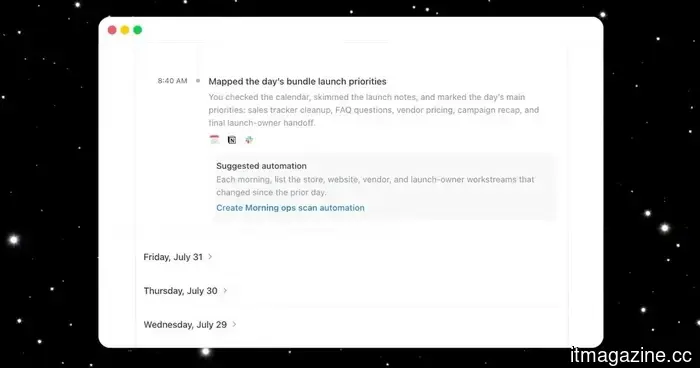 ChatGPT's Computer History faces a significant privacy issue.
ChatGPT's latest Computer History feature keeps Mac activity stored locally; however, OpenAI has cautioned that these files are not encrypted and could potentially be accessible to other applications.
ChatGPT's Computer History faces a significant privacy issue.
ChatGPT's latest Computer History feature keeps Mac activity stored locally; however, OpenAI has cautioned that these files are not encrypted and could potentially be accessible to other applications.
 Apple yields to Germany and alters its tracking-consent regulations, concluding a self-preferencing investigation.
Germany's Bundeskartellamt has concluded its investigation into App Tracking Transparency after Apple consented to make third-party consent requests neutral and eliminate a double standard that favored its own applications.
Apple yields to Germany and alters its tracking-consent regulations, concluding a self-preferencing investigation.
Germany's Bundeskartellamt has concluded its investigation into App Tracking Transparency after Apple consented to make third-party consent requests neutral and eliminate a double standard that favored its own applications.
 A crypto company supported by Trump is assisting in the sale of the same Chinese AI that his administration is attempting to restrict.
World Liberty Financial, the cryptocurrency project associated with the Trump family, is responsible for WorldClaw, a platform based in Hong Kong that resells AI models from Chinese companies that face restrictions in the US, with payments made in its USD1 stablecoin.
A crypto company supported by Trump is assisting in the sale of the same Chinese AI that his administration is attempting to restrict.
World Liberty Financial, the cryptocurrency project associated with the Trump family, is responsible for WorldClaw, a platform based in Hong Kong that resells AI models from Chinese companies that face restrictions in the US, with payments made in its USD1 stablecoin.
The regulations for contractors in the Netherlands have recently been revised, and the legislation applies retroactively.
In 2026, regulations for Dutch contractors were modified. Penalties have been reinstated, the onus of proof has shifted, and evaluations can extend back to 2025. Here's what employers need to do.