

I never believed that fake shopping could deceive my brain until I experimented with the popular dopamine websites.
I spent some time in the internet's most phony mall, filling a shopping cart with items I couldn't buy, searching for discounts on non-existent products, and checking out three times for a total of $0.00. Then I simulated a food order and smoked a cigarette I couldn't taste, with strangers I would never encounter, on a rooftop that isn't real. My bank account remained unchanged, but, annoyingly, my mind did.
When I first learned about South Korea’s rise in “dopamine sites,” I thought they were just another internet quirk I'd explore briefly and forget by lunchtime. Instead, I uncovered a surprisingly clever concept hidden within the absurdity. You can browse an endless array of imaginary items, add them to your cart, and complete a transaction that isn’t real. These sites aren't trying to sell you anything; instead, they aim to recreate the shopping experience while eliminating the financial aspect.
In South Korea, “dopamine sites” have gained popularity among Gen Z. These include fake food delivery apps where you look at menus, fill a cart, and simulate placing an order you never actually make; fake shopping sites where you track a courier that doesn't exist; and virtual smoke break rooms where you sit with strangers.
Inside the sites designed to mimic the shopping high
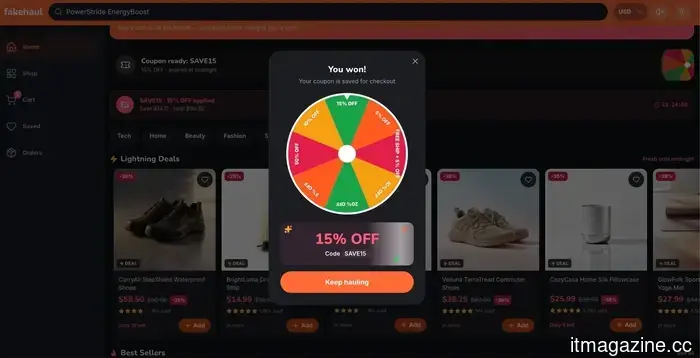
FakeHaul is where I spent the most time, and I genuinely mean that as a compliment to whoever names these items. I added a pair of “CarryAll StepShield Waterproof Shoes” discounted to $59.50 from a suspiciously precise $92.00, a yoga mat I have no use for, and a dress I can’t wear.
A countdown timer insisted that my deal would expire at midnight, which is absurd for something that was never produced, yet I felt a flicker of urgency that made me click ‘Add to cart’ before my mind caught up with the reality that none of this is genuine. Every time I checked out, the total was exactly $0.00, regardless of the price tags, and I kept returning for more, not solely out of curiosity anymore. There was a small, undeniable thrill involved.
The purchase was never real, but the dopamine rush was.
Next, I tried the fake food delivery site FoodNeverComes, where I ordered steamed bao buns and watched a tiny bee icon move across a map to my fictional address. Watching that tracker gave me the same small thrill I experience with a real delivery app—complete with anticipation, countdown, and a little rush of “it’s almost here.” When the tracking window disappeared and nothing arrived, I genuinely felt a tinge of disappointment, which illustrates just how convincing this illusion is.
Shopping isn’t the only behavior these sites mimic.
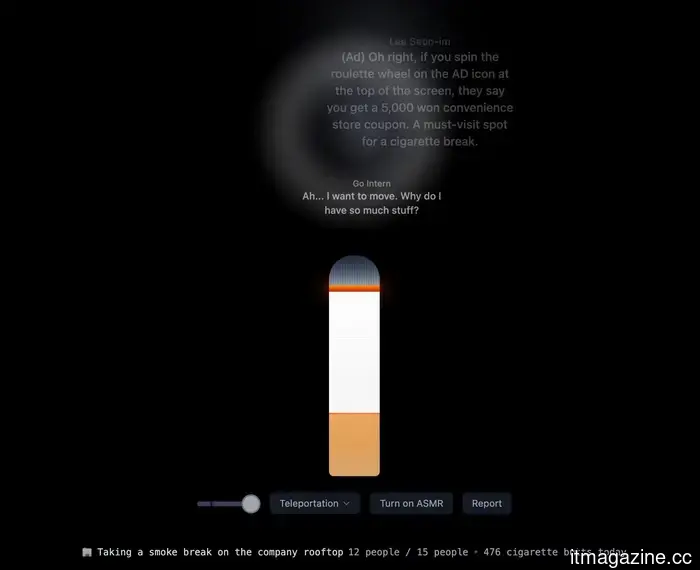
Damta.world is another dopamine site that allows you to take a virtual smoke break, which somehow worked the best of the three. You can tap to light the cigarette, tap again to ash it, and hold the filter to blow a doughnut-shaped smoke ring, complete with crackling ASMR sound effects.
A live counter showed how many strangers were smoking with me in real-time, while anonymous messages scrolled from people getting through their day. I spent a few minutes there, and it felt like an actual break, unexpectedly calm for simply tapping an animated cigarette on my screen.
Do these sites genuinely help or just replace one habit with another?
Psychologists interviewed about dopamine sites say they might fulfill the urge to spend without the financial repercussions, but they also note that users are still engaging in the same behaviors. Browsing, comparing, adding items to a cart, and checking out are rituals many seek to escape from.
Even FakeHaul's creator acknowledges the blurred line. Features like a daily coupon wheel could encourage repeat visits, suggesting that a tool intended to reduce compulsive shopping could morph into another engagement loop.
Considering how easily I succumbed to the dopamine hit, I don’t believe these websites are a solution for impulse buying. However, they do shed light on how shopping apps and addictive habits function. Shopping or social media apps essentially trigger a psychological loop, and these fake sites merely strip away the products, leaving the underlying psychology exposed. What remains is an unexpectedly entertaining reminder that the greatest reward was never the purchase itself; it was everything leading up to checkout.


Other articles
 Voyah duplicated Mercedes’ inverted tunnel advertisement and subsequently released the vehicle for $33,800.
Voyah presented its new electric SUV by showcasing it driving on a tunnel ceiling. The starting price for the vehicle is approximately $33,800, boasting 637hp and equipped with Huawei lidar.
Voyah duplicated Mercedes’ inverted tunnel advertisement and subsequently released the vehicle for $33,800.
Voyah presented its new electric SUV by showcasing it driving on a tunnel ceiling. The starting price for the vehicle is approximately $33,800, boasting 637hp and equipped with Huawei lidar.
 Anthropic conducted 133 million contractor conversations with its bioweapon filters disabled.
The Anthropic Risk Report indicates that bioweapon classifiers were inaccurate for 133 million contractor exchanges and revises its previous assessment from February.
Anthropic conducted 133 million contractor conversations with its bioweapon filters disabled.
The Anthropic Risk Report indicates that bioweapon classifiers were inaccurate for 133 million contractor exchanges and revises its previous assessment from February.
 LG's humanoid robot will debut in 2027, powered by Nvidia's Isaac GR00T.
In early 2027, LG is set to reveal a bipedal humanoid powered by Nvidia's Jetson Thor and Isaac GR00T, along with plans for an 80MW AI factory in South Korea.
LG's humanoid robot will debut in 2027, powered by Nvidia's Isaac GR00T.
In early 2027, LG is set to reveal a bipedal humanoid powered by Nvidia's Jetson Thor and Isaac GR00T, along with plans for an 80MW AI factory in South Korea.
 Samsung is said to be developing a competitor to the AirPods Max 2.
Samsung may be getting ready to launch its first new wireless headphones in years, as references to the Galaxy H1 have allegedly been found within the Galaxy Wearable app.
Samsung is said to be developing a competitor to the AirPods Max 2.
Samsung may be getting ready to launch its first new wireless headphones in years, as references to the Galaxy H1 have allegedly been found within the Galaxy Wearable app.
 The United States is set to urge 35 nations to decide between alignment with itself or China regarding artificial intelligence.
A preliminary US letter cautions the 35 signatories of the Pax Silica and AI Opportunity Statement that they cannot simultaneously participate in China's competing AI framework.
The United States is set to urge 35 nations to decide between alignment with itself or China regarding artificial intelligence.
A preliminary US letter cautions the 35 signatories of the Pax Silica and AI Opportunity Statement that they cannot simultaneously participate in China's competing AI framework.
 Lamborghini's newest Revuelto SV adds an element of enjoyment with a unique driving mode.
Lamborghini's latest Revuelto SV delivers 1,050 hp, enhanced handling, GT3-inspired technology, and a specialized Pilota driving mode in its V12 hybrid supercar.
Lamborghini's newest Revuelto SV adds an element of enjoyment with a unique driving mode.
Lamborghini's latest Revuelto SV delivers 1,050 hp, enhanced handling, GT3-inspired technology, and a specialized Pilota driving mode in its V12 hybrid supercar.
I never believed that fake shopping could deceive my brain until I experimented with the popular dopamine websites.
South Korea's trendy "dopamine sites" replicate the experience of shopping without actually making a purchase, and testing these environments has shown why the psychological reward remains impactful.