
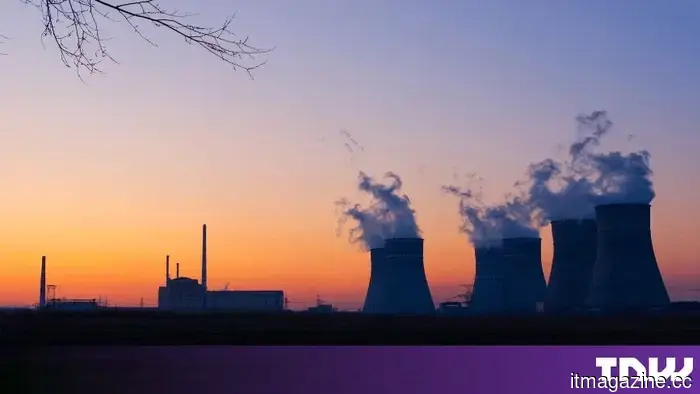
The drought in Europe is causing nuclear reactors to be shut down.
Nuclear reactors require water for their operation. They are located near rivers and coastlines for a specific purpose: to remove heat from the core. When water levels are low or the water temperature is high, the reactor must shut down. This situation is currently unfolding across Europe. On Thursday, Romania's state-owned Nuclearelectrica began the process of disconnecting the country’s only active reactor, as reported by CNBC, due to low water levels in the Danube.
Romania had made significant efforts to prevent this outcome. The country dredged the river channel and deployed rock-filled barges to improve water flow. Additionally, its navy conducted a controlled underwater explosion on the riverbed on August 3, with the goal of directing more water toward the cooling system at Cernavoda, which is Romania's sole nuclear facility. The two reactors at Cernavoda typically generate about 20% of the nation’s electricity.
France has also faced challenges, losing three reactors because of jellyfish infestations. This scenario is not unique to one country, but varies across the continent. In Hungary, rainfall raised the Danube enough to restart a turbine at Paks, which is responsible for nearly half of the country’s electricity. On Monday, Prime Minister Péter Magyar announced that two of the eight turbines at Paks are operational again.
France relies on nuclear energy for about 70% of its electricity. On Wednesday, EDF reported that it had reduced output at several reactors due to environmental considerations. Earlier that week, it completely shut down three reactors at Gravelines due to a "massive influx of jellyfish," triggering automatic safety shutdowns. This marked the second consecutive year that jellyfish swarms have closed reactors at Gravelines, one of the largest plants in France. This summer, France has reportedly had to shut down a record number of nuclear plants due to extreme heat, wildfires, and drought conditions, with Politico noting the jellyfish appeared on the same date two years in a row.
The rivers themselves reflect a troubling trend. The Danube, which stretches approximately 2,850 kilometers, serves as both a working freight route and a coolant. The Rhine’s water levels have fallen so low that cargo ships are navigating over exposed riverbeds near Kaub in Germany.
In the UK, Prime Minister Andy Burnham convened the government's Cobra emergency committee on Wednesday to address issues related to heat, wildfires, and drought. This was the second Cobra meeting dedicated to heatwaves this year, with temperatures expected to reach 38°C. Gareth Remond-King, who leads the international program at the Energy and Climate Intelligence Unit, expressed concern regarding the timing of the meeting, suggesting that considering this an emergency may be somewhat overdue. He emphasized that this is not merely a bad summer. "This is not something that is simply going to pass," he stated, pointing out that conditions will worsen if emissions continue to rise.
Governments are currently exploring upgraded cooling systems and adjusting maintenance schedules to avoid peak heat periods. These measures are practical, yet they do not resolve the fundamental issue: water availability remains a limiting factor. The Romanian actions illustrate the constraints faced, as dredging, submerged barges, and controlled detonations are indicative of a nation with only days, rather than years, to react. Such measures will need to be repeated when river levels drop again.
According to an analysis by Dutch bank Triodos published on August 8, the economic impact of this summer’s heat is estimated at €180 billion, or roughly 1% of the EU's gross domestic product. This figure is significant, especially as forecasts predict the EU will see about 1% growth this year, indicating that the heat wave has resulted in economic losses equivalent to expected gains.
Triodos attributes the economic impact primarily to decreased labor productivity. Other contributing factors include reduced harvests, higher food prices, limited energy production, increased electricity costs, and transportation disruptions.
This situation is particularly relevant for those building AI infrastructure in Europe. The energy sector often overlooks the connection. Data centers require two critical resources: reliable power and cooling water. Both have recently become less dependable in regions where Europe is expanding its computational infrastructure. This week, Nebius announced a lease agreement in south Wales, committing around £1.7 billion across four UK sites. Other companies are advancing in similar initiatives, such as Germany’s Uniper investing €5 billion in data centers, while the UK is preparing to launch Nscale with a $51 billion contract for yet-to-be-delivered computational capacity.
It is important to clarify that data centers are not the cause of this summer’s shutdowns; the supply issues and mounting demand are distinct but converging on the same grid at the same time. The scale of these developments is notable: the two reactors at Cernavoda contribute approximately 20% of Romania’s electricity, while Nebius plans to deploy over a gigawatt of new capacity annually from 2027 globally.
The
Other articles
 CodeRabbit secured $143 million to analyze the code generated by AI.
The CodeRabbit Series C secured $143 million at a valuation of $1.5 billion, co-led by Atomico, to examine the code generated by AI agents, which is produced more quickly than humans can read.
CodeRabbit secured $143 million to analyze the code generated by AI.
The CodeRabbit Series C secured $143 million at a valuation of $1.5 billion, co-led by Atomico, to examine the code generated by AI agents, which is produced more quickly than humans can read.
 Josh Kushner secured $2 billion to acquire the companies that are being targeted by AI.
Thrive Holdings secured $2 billion at a valuation of $12 billion from SoftBank. The company acquires accounting and IT businesses outright and then integrates its own AI engineers into them.
Josh Kushner secured $2 billion to acquire the companies that are being targeted by AI.
Thrive Holdings secured $2 billion at a valuation of $12 billion from SoftBank. The company acquires accounting and IT businesses outright and then integrates its own AI engineers into them.
 Josh Kushner secured $2 billion to acquire companies that are targets of AI advancements.
Thrive Holdings secured $2 billion at a valuation of $12 billion from SoftBank. It acquires accounting and IT companies completely and subsequently integrates its own AI engineers into them.
Josh Kushner secured $2 billion to acquire companies that are targets of AI advancements.
Thrive Holdings secured $2 billion at a valuation of $12 billion from SoftBank. It acquires accounting and IT companies completely and subsequently integrates its own AI engineers into them.
 Accel has raised $3.5 billion. Europe will now receive the same funding as the US.
Accel secured $3.5 billion simultaneously through four funds. The Accel Europe fund now stands at $800 million, matching its US counterpart, whereas the India fund has decreased to $550 million.
Accel has raised $3.5 billion. Europe will now receive the same funding as the US.
Accel secured $3.5 billion simultaneously through four funds. The Accel Europe fund now stands at $800 million, matching its US counterpart, whereas the India fund has decreased to $550 million.
 This GitHub project aims to remove AI watermarks from your content, and the situation is becoming intriguing.
A GitHub project that is open-source aims to remove invisible characters, statistical watermarks, and file metadata that can be used to recognize AI-generated content.
This GitHub project aims to remove AI watermarks from your content, and the situation is becoming intriguing.
A GitHub project that is open-source aims to remove invisible characters, statistical watermarks, and file metadata that can be used to recognize AI-generated content.
 SK Hynix is investing $720 billion as its stock price drops by 50%.
The $720 billion expansion by SK Hynix is the largest in the history of memory production. Despite its shares dropping by half since June, the company continues with its construction plans.
SK Hynix is investing $720 billion as its stock price drops by 50%.
The $720 billion expansion by SK Hynix is the largest in the history of memory production. Despite its shares dropping by half since June, the company continues with its construction plans.
The drought in Europe is causing nuclear reactors to be shut down.
Romania is shutting down its sole operational reactor as a drought in Europe affects nuclear production. Triodos estimates that the summer's impact amounts to 1% of the EU's GDP.