

Three Chinese car manufacturers—BYD, Geely, and Chery—have entered the global top 10.
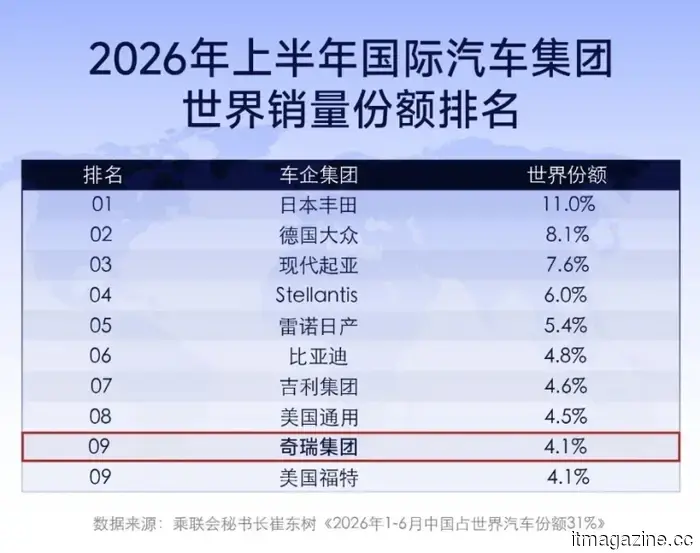
This week, the latest global automaker sales rankings for the first half of 2026 were published, marking the first instance where three Chinese automakers are simultaneously among the world’s top 10 based on sales. The new rankings showcase the ongoing growth of China's automotive sector and the changing landscape of the global auto market. Together, BYD, Geely, and Chery represented 13.5% of worldwide vehicle sales during this period.
In the most recent global sales rankings for the first half of 2026, Toyota retains its position as the world’s largest automaker with an 11% market share. Volkswagen follows with 8.1%, while Hyundai Motor Group has a share of 7.6%, Stellantis at 6.0%, and the Renault-Nissan Alliance at 5.4%, completing the top five. BYD has risen to sixth place with a 4.8% share, and Geely Group is seventh with 4.6%. General Motors is in eighth place with 4.5%, and Chery Group shares the ninth spot with Ford at 4.1%.
A significant part of this momentum has been attributed to exports. China exported 5.096 million vehicles in the first half of 2026, marking a 65.3% increase compared to the previous year. In June, China's monthly vehicle exports exceeded one million units for the first time.
New energy vehicles (NEVs) were at the forefront, with exports reaching 2.355 million units—more than doubling from the previous year. Chinese brands have also been gaining traction in international markets, increasing their presence in Europe and steadily improving market share in emerging regions like South Africa.
The rise of Chinese automakers does not indicate the decline of traditional giants. Toyota, Volkswagen, and Hyundai Motor Group still lead the global rankings; however, some European and American manufacturers are experiencing slower growth as they adapt to the transition towards electrification and face rising supply chain costs. In contrast, Chinese brands are leveraging their advantages in electric vehicles while expediting their global growth.
A significant portion of this development has been fueled by China's robust EV supply chain and ongoing improvements in battery technology, electric drivetrains, and smart vehicle innovations. Additionally, Chinese automakers are transcending mere car exports by investing in international R&D, manufacturing, and sales networks, with localization becoming an increasingly vital aspect of their global strategy.
According to the China Association of Automobile Manufacturers (CAAM), exports have become a crucial growth driver for the industry as competition intensifies within the domestic market. Looking ahead, the emphasis is expected to shift toward deeper localization, enhanced compliance with local regulations, and ongoing investment in technology, branding, and after-sales services to ensure sustained growth abroad.
Jessie Wu is a tech reporter based in Shanghai. She covers consumer electronics, semiconductors, and the gaming sector for TechNode. Reach her via e-mail: jessie.wu@technode.com. More by Jessie Wu.



Другие статьи
 NASA constructed the Roman Space Telescope to investigate dark matter, but it can also assist in safeguarding Earth from harmful asteroids.
Although NASA's Roman Space Telescope wasn't specifically intended for asteroid detection, its extensive field of view positions it as a significant asset to Earth's planetary defense system.
NASA constructed the Roman Space Telescope to investigate dark matter, but it can also assist in safeguarding Earth from harmful asteroids.
Although NASA's Roman Space Telescope wasn't specifically intended for asteroid detection, its extensive field of view positions it as a significant asset to Earth's planetary defense system.
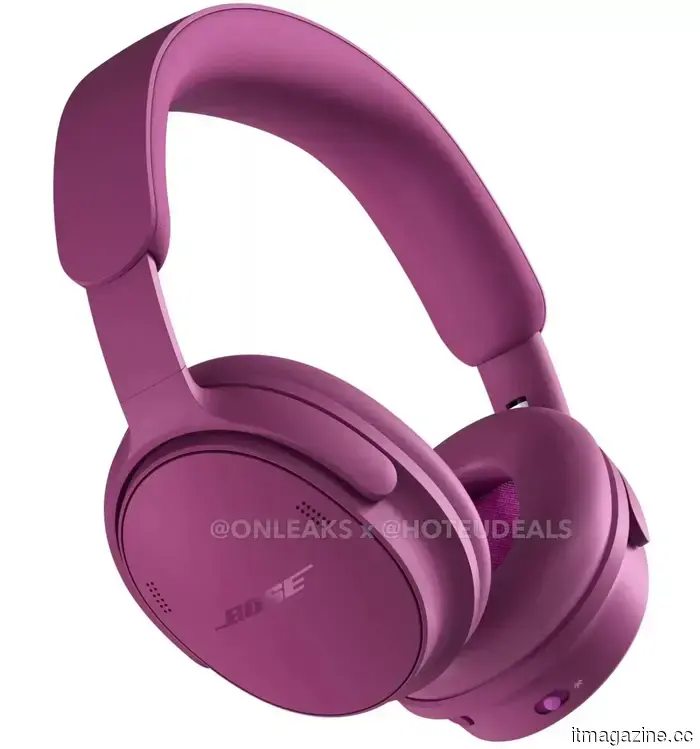 Bose's forthcoming QuietComfort headphones have surfaced online in six stunning colors.
The upcoming QuietComfort headphones from Bose have been spotted online in six color options, which include Rosewood Mauve, DewDrop Mint, Eucalyptus Green, and Hazelnut Taupe. Their anticipated release date is August 13.
Bose's forthcoming QuietComfort headphones have surfaced online in six stunning colors.
The upcoming QuietComfort headphones from Bose have been spotted online in six color options, which include Rosewood Mauve, DewDrop Mint, Eucalyptus Green, and Hazelnut Taupe. Their anticipated release date is August 13.
 The Interactive Storytime feature of Google Home makes me curious about who really requested this.
The newest update for Google Home allows families to collaboratively create interactive bedtime stories using Gemini, and it also broadens camera compatibility.
The Interactive Storytime feature of Google Home makes me curious about who really requested this.
The newest update for Google Home allows families to collaboratively create interactive bedtime stories using Gemini, and it also broadens camera compatibility.
 Apple's iPhone Air might be the model for its 20th anniversary iPhone.
Leaked information suggests that the iPhone 20 will adopt its frame design from the iPhone Air, featuring a larger vapor chamber and bigger displays typical of Pro models.
Apple's iPhone Air might be the model for its 20th anniversary iPhone.
Leaked information suggests that the iPhone 20 will adopt its frame design from the iPhone Air, featuring a larger vapor chamber and bigger displays typical of Pro models.
 Three Chinese car manufacturers, BYD, Geely, and Chery, have entered the global top 10.
This week, the newest global sales rankings for automakers for the first half of 2026 were published, highlighting the first occurrence of three Chinese automakers having
Three Chinese car manufacturers, BYD, Geely, and Chery, have entered the global top 10.
This week, the newest global sales rankings for automakers for the first half of 2026 were published, highlighting the first occurrence of three Chinese automakers having
Three Chinese car manufacturers—BYD, Geely, and Chery—have entered the global top 10.
This week, the most recent global sales rankings for automakers in the first half of 2026 were published, indicating that it is the first occasion on which three Chinese automakers have