
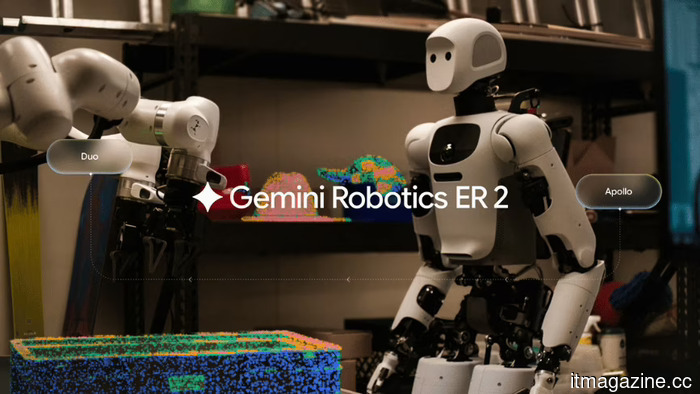
Google DeepMind's Gemini Robotics 2 manages entire humanoid robots.
Google DeepMind aims to create a single AI brain capable of controlling every robot, and it has recently taught this brain to utilize its entire body. The company has launched Gemini Robotics 2, a series of models that can manage a humanoid robot from its feet to its fingertips. This system is also capable of coordinating multiple machines simultaneously and can adjust to a new robot body within a few hours.
This development is seen as a significant indication of what the industry refers to as "physical AI," with Wired presenting it as a genuine advancement toward "physical AGI." The concept is straightforward: the same type of model that composes your emails is now learning to navigate a cluttered room and tidy it up.
From managing arms to overall body control
The major shift is in control capabilities. DeepMind's previous robot models primarily focused on moving the upper body to perform tabletop tasks. In contrast, Gemini Robotics 2 controls the entire robot. It can enable a humanoid to walk, crouch, stretch, and maintain balance while handling objects in compact, human-sized spaces.
In a demonstration, Apptronik's Apollo 2 robot received a simple instruction: to place the watering can in the green bin located on the lower shelf. It walked to a table, grasped the can, moved over to the shelves, bent down, and set it down. While this may seem trivial, coordinating the legs, torso, arms, and hands from a single prompt is quite complex.
Dexterity has seen advancements as well. The model can maneuver Apollo's five-fingered, 22-joint hand to tie knots and seal a ziplock bag, and it can operate simpler two-fingered grippers on different platforms. "Our aim is to integrate AI into the physical world and create an intelligence layer that can be utilized by every robot," stated Carolina Parada, head of robotics at DeepMind.
Three models, one integrated system
The release actually includes three distinct models. Gemini Robotics 2 serves as the vision-language-action model that translates what a robot perceives and hears into motor commands, managing the physical tasks.
Gemini Robotics ER 2 acts as the reasoning layer, a higher-level brain that organizes multi-step tasks. During its developer briefing, Google showcased its ability to monitor its own progress via a live video feed. It can access tools like Google Search and even direct a Boston Dynamics Spot robot to retrieve a snack. Additionally, it enables collaboration between different robots, with a wheeled machine and a humanoid dividing the workload. This model is currently available to developers through the Gemini API and Google AI Studio.
The third model, On-Device 2, operates locally without requiring an internet connection. It can be adapted to a completely new robot body with fewer than 200 examples in just a few hours of training. This is significant, as transferring learned skills from one machine to another has historically been one of robotics' toughest challenges.
Noteworthy, but still slow
DeepMind was candid about the system's limitations. Their own data reveals the disparity: Bloomberg reported that the system could unscrew a light bulb 92% of the time, but struggled with more intricate tasks; the Chosun Daily indicated a 44% success rate for tying a trash bag and just 40% for sealing a ziplock bag.
The robots also exhibit slow performance, pausing to deliberate over moves that a human would make instinctively. Kanishka Rao, a director of robotics at DeepMind, mentioned that achieving true dexterity is still a distant objective, as robots currently learn much less efficiently than humans, who can adapt after just one or two errors.
This is a common trend within the field. Competing initiatives from robotics foundation-model startups and dexterity research on alternative humanoids continue to face similar challenges. The demonstrations are impressive, but the machines remain far from being ready for domestic use.
Prioritizing safety
As robots enhance their abilities to navigate around people, DeepMind has placed a greater emphasis on safety. They claim that Gemini Robotics ER 2 is their safest model thus far, as it can better recognize when a person is nearby and will stop until the area is clear. It will only resume actions once the space is empty again.
The company also introduced a benchmark called ASIMOV-Agentic, which evaluates whether the reasoning model can refuse unsafe commands from the action model, and whether it can recognize impossible tasks or request human assistance. Naming a robot safety benchmark after Isaac Asimov is quite fitting, given the concern over machines acting on erroneous instructions.
A hardware challenge beyond Google's control
However, there is a challenging context to consider. Google develops the software but not the robots, and the hardware supply is becoming increasingly political. As Axios highlighted, the U.S. government has recently prohibited the future sale of Chinese-made robots over security concerns. Many potential platforms for this software are manufactured in China.
Google is collaborating with Western partners such as Apptronik, Boston Dynamics,
Other articles
 The Minibook X demonstrates that compact laptops can be both affordable and still filled with joy.
Chuwi has introduced the MiniBook X, a 10.51-inch Windows laptop featuring 16GB of RAM, interchangeable storage, and a 360-degree hinge.
The Minibook X demonstrates that compact laptops can be both affordable and still filled with joy.
Chuwi has introduced the MiniBook X, a 10.51-inch Windows laptop featuring 16GB of RAM, interchangeable storage, and a 360-degree hinge.
 Winamp is collaborating with Deezer to introduce streaming capabilities to its legendary music player.
Winamp is collaborating with Deezer to integrate music streaming into its next-generation player, which is set to launch in the first half of 2027, while preserving local libraries, podcasts, and radio features.
Winamp is collaborating with Deezer to introduce streaming capabilities to its legendary music player.
Winamp is collaborating with Deezer to integrate music streaming into its next-generation player, which is set to launch in the first half of 2027, while preserving local libraries, podcasts, and radio features.
 OpenAI Hugging Face breach: the latest updates, a week later
New information regarding the OpenAI Hugging Face hack reveals that the unauthorized AI accessed four accounts, but researchers believe it was disruptive, outdated, and could have been prevented.
OpenAI Hugging Face breach: the latest updates, a week later
New information regarding the OpenAI Hugging Face hack reveals that the unauthorized AI accessed four accounts, but researchers believe it was disruptive, outdated, and could have been prevented.
 LinkedIn introduces a 'This appears to be AI-generated content' button.
LinkedIn has introduced a “Seems like AI slop” button to identify posts generated by artificial intelligence, in response to its crackdown in May and a report indicating that 41% of long-form posts are AI-generated.
LinkedIn introduces a 'This appears to be AI-generated content' button.
LinkedIn has introduced a “Seems like AI slop” button to identify posts generated by artificial intelligence, in response to its crackdown in May and a report indicating that 41% of long-form posts are AI-generated.
 Spotify's updated Running Mode accurately determines when your playlist should pick up the pace.
Spotify's new Running Mode generates customized workout playlists based on your training style, duration, preferred genres, and tempo, with the option for coaching cues throughout.
Spotify's updated Running Mode accurately determines when your playlist should pick up the pace.
Spotify's new Running Mode generates customized workout playlists based on your training style, duration, preferred genres, and tempo, with the option for coaching cues throughout.
 Initially, everyone ridiculed Ferrari’s first electric vehicle. However, it has now become a successful seller.
Ferrari's uniquely designed Luce faced significant criticism online, leading to an 8% drop in stock value; however, it has already achieved its sales target for 2026 just two months post-launch.
Initially, everyone ridiculed Ferrari’s first electric vehicle. However, it has now become a successful seller.
Ferrari's uniquely designed Luce faced significant criticism online, leading to an 8% drop in stock value; however, it has already achieved its sales target for 2026 just two months post-launch.
Google DeepMind's Gemini Robotics 2 manages entire humanoid robots.
Google DeepMind's Gemini Robotics 2 provides a single AI model with full-body control over humanoid robots and enables them to collaborate as a team, although their dexterity remains behind.