
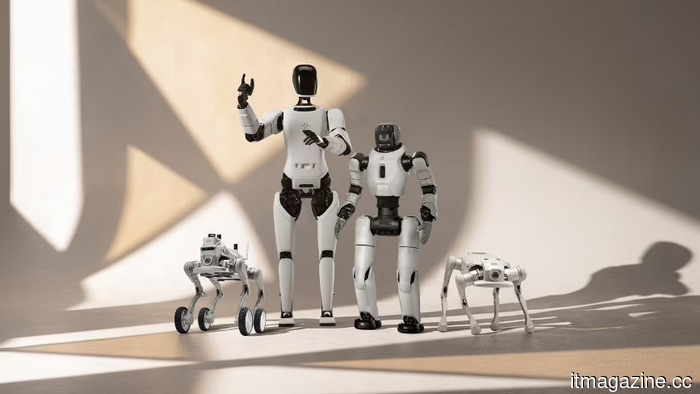
China warns of reprisals in response to the US ban on robots.
The US aimed to exclude Chinese robots, prompting Beijing's response: if this occurs, we will retaliate in significant ways. China has warned of "resolute" backlash after Washington's decision to prohibit imports of humanoid robots made in China. The country's commerce ministry criticized the move as discriminatory and claimed it "severely" harms trade relations, according to reports from the New York Times and CNBC.
The ministry has called for the US to reverse its decision, threatening countermeasures if it fails to comply. It accused the US of "overextending the notion of national security" and contended that the action disrupts global supply chains.
What the US actually prohibited
The catalyst for this move was an FCC order issued this week that added foreign "advanced robotic devices" to its restricted Covered List. This order prohibits new humanoid robots and robotic dogs from receiving the import approval required for sale in the US, although previously approved models may remain.
The regulation is broader than it initially appeared, encompassing nearly all new wireless, software-governed robots weighing over 4.4 pounds that can perceive their environment, including robot lawnmowers, sidewalk delivery bots, and Chinese robot vacuums. Although the FCC did not specifically mention China, Chinese companies hold a dominant position in this sector.
Washington's argument hinges on two primary concerns. One is that connected robots might serve as Trojan horses for gathering data. The other is that robotics is crucial in an AI-driven economy. The Pentagon has already flagged Chinese company Unitree, a leader in the field, over alleged military connections.
China's leverage
The threat of retaliation is serious, as China possesses significant advantages. Analysts suggest that the two most apparent leverage points are rare earth minerals, where China controls supply, and market access for major US companies such as Tesla and Nvidia. Both would have serious repercussions.
The timing is particularly unfavorable for Chinese robot manufacturers. "This poses a significant issue for Chinese humanoid companies planning their IPOs in the coming months," remarked Counterpoint's Marc Einstein. Unitree and Agibot have submitted applications to go public, and Hong Kong-listed UBTech saw its stock briefly drop over 6 percent.
The uncomfortable reality
There’s a complication that complicates enforcement of the ban. It has become almost impossible to manufacture a competitive humanoid robot without using Chinese-made components like sensors and joints. In addition, China leads the world in robotics, operating more factory robots than the rest of the globe combined.
This confrontation comes at a sensitive time. Trump is set to host Xi Jinping in September, amidst already heightened tensions. Treasury Secretary Scott Bessent has suggested sanctions related to AI model "theft." Meanwhile, Trump hinted earlier this week at a more lenient approach to AI regulations to maintain US leadership.
Robots have now become a distinct aspect of the ongoing tech conflict. The US has established boundaries around its market, while China is indicating that it could impose heavy costs for crossing those boundaries.
Other articles
 Agon secures $30 million to develop Europe's synthetic battlefield for defense AI.
Agon, established by former employees of Anduril and Applied Intuition, has secured $30 million to create a synthetic training environment for defense AI in Europe.
Agon secures $30 million to develop Europe's synthetic battlefield for defense AI.
Agon, established by former employees of Anduril and Applied Intuition, has secured $30 million to create a synthetic training environment for defense AI in Europe.
 Agon secures $30 million to create Europe’s synthetic battlefield for defense AI.
Agon, established by former members of Anduril and Applied Intuition, has secured $30 million to develop a synthetic training environment for defense AI in Europe.
Agon secures $30 million to create Europe’s synthetic battlefield for defense AI.
Agon, established by former members of Anduril and Applied Intuition, has secured $30 million to develop a synthetic training environment for defense AI in Europe.
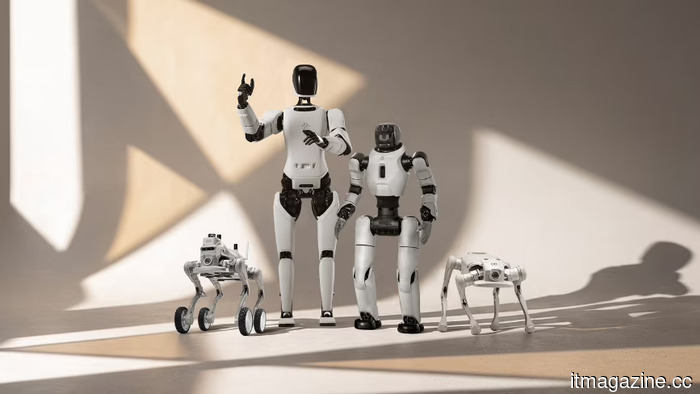 China warns of countermeasures in response to the US ban on robots.
China has warned of potential retaliation in response to the US prohibition on Chinese robot imports, using rare earths and access to Tesla and Nvidia markets as bargaining chips, according to the NYT.
China warns of countermeasures in response to the US ban on robots.
China has warned of potential retaliation in response to the US prohibition on Chinese robot imports, using rare earths and access to Tesla and Nvidia markets as bargaining chips, according to the NYT.
 Microsoft is combining its Copilots into a single AI super application.
This year, Microsoft is combining Copilot’s chat, coding, Cowork, and autonomous agents into one AI “super app” that will cover both consumer and enterprise use.
Microsoft is combining its Copilots into a single AI super application.
This year, Microsoft is combining Copilot’s chat, coding, Cowork, and autonomous agents into one AI “super app” that will cover both consumer and enterprise use.
 NHS England has acknowledged that it concealed Palantir’s access to patient information.
NHS England has acknowledged that its documentation did not reveal that Palantir personnel can access identifiable patient information within the Federated Data Platform.
NHS England has acknowledged that it concealed Palantir’s access to patient information.
NHS England has acknowledged that its documentation did not reveal that Palantir personnel can access identifiable patient information within the Federated Data Platform.
 EXCLUSIVE: Jennifer Hale, the star of X-Men ’97, discusses season 2 and her return as Jean Grey.
Jennifer Hale discusses her role as Jean Grey in season 2 of X-Men '97, her return to Marvel's legendary mutant story, and what fans might look forward to next.
EXCLUSIVE: Jennifer Hale, the star of X-Men ’97, discusses season 2 and her return as Jean Grey.
Jennifer Hale discusses her role as Jean Grey in season 2 of X-Men '97, her return to Marvel's legendary mutant story, and what fans might look forward to next.
China warns of reprisals in response to the US ban on robots.
China has issued a warning of retaliation in response to the US prohibition on Chinese robot imports, using rare earths and access to the Tesla and Nvidia markets as potential leverage, according to the New York Times.