

Individuals are documenting every interaction using AI tools, and no one has given their consent.
TL;DRAI tools now capture conversations without announcing themselves, and users are taking them to dates and personal discussions. An increasing number of professionals are employing AI tools to record every dialogue they engage in, often without the knowledge of those being recorded. The Wall Street Journal reported this week that applications like Granola, which transcribes meetings without a visible bot or prior notification, have made ambient recording so seamless that users are starting to incorporate the technology into personal interactions. This shift raises legal and ethical concerns that neither the tools nor their users seem prepared to address.
Granola, which secured 125 million dollars in funding earlier this year at a valuation of one and a half billion dollars, captures audio directly through the user’s device microphone rather than joining a call as a distinct participant. This means no bot icon is present during the meeting, and no automated notification informs attendees that a recording is taking place. Michelle Lim, CEO of the meeting software company Flint, mentioned to the Journal that she wishes Granola were operating in every room she enters, highlighting both its allure and the associated issues.
Some users have extended this concept beyond the workplace; for instance, Emmie Chang, founder of Yuzu Labs, shared with the Journal that she records first dates and sends the transcripts to Claude for insights on the conversation. Others have reported recording therapy sessions, medical appointments, and casual dinners with friends, all without informing the other party. In the eleven US states that mandate all-party consent for recordings, including California, Florida, Illinois, and Pennsylvania, recording without disclosure may constitute a felony under state wiretapping laws.
The implications for the workplace are already emerging. Amy Dufrane, CEO of the Human Resource Certification Institute, told the Associated Press that AI note-takers present significant organizational risks, asserting that companies should refrain from using them entirely. Reports indicate that AI note-takers have remained on video calls after employees have departed, quietly documenting informal conversations and gossip, while privacy law expert Alex Alben cautioned that automatic recording involving third parties introduces liabilities that most users have not contemplated.
Researchers have also raised a different concern that extends beyond privacy, with studies on cognitive offloading revealing a negative correlation between excessive AI use and critical thinking. The concern is not solely about recording without consent; it also extends to the potential loss of the ability to listen, remember, and process conversations independently. As these tools become more affordable and less noticeable, the question shifts from whether they will proliferate to whether anyone will take the time to ask for permission beforehand.

Other articles
 Following four generations of stagnation in camera technology, the Galaxy S27 may finally introduce a new main sensor.
According to reports, Samsung is testing a 50MP Sony main sensor for the Galaxy S27 and S27+, while the 12MP ultrawide camera might stay the same.
Following four generations of stagnation in camera technology, the Galaxy S27 may finally introduce a new main sensor.
According to reports, Samsung is testing a 50MP Sony main sensor for the Galaxy S27 and S27+, while the 12MP ultrawide camera might stay the same.
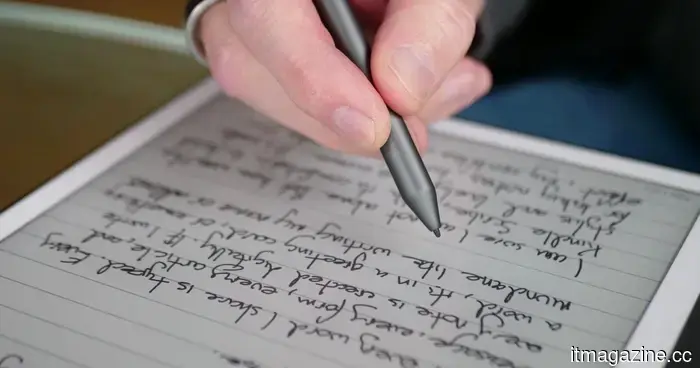
 Quit misplacing your notes and kick off the school year with one of these e-readers that also function as notebooks.
Your notes are dispersed throughout various notebooks, your PDFs are hidden in folders that you'll likely never locate again, and your backpack is unnecessarily heavy. E-readers with pen support address these issues by combining reading, writing, and organization into a single device.
Quit misplacing your notes and kick off the school year with one of these e-readers that also function as notebooks.
Your notes are dispersed throughout various notebooks, your PDFs are hidden in folders that you'll likely never locate again, and your backpack is unnecessarily heavy. E-readers with pen support address these issues by combining reading, writing, and organization into a single device.
 Individuals are capturing every dialogue using AI tools, and no one has given their consent.
AI meeting tools such as Granola are now capable of recording without making an announcement, prompting some users to start recording personal conversations and dates as well.
Individuals are capturing every dialogue using AI tools, and no one has given their consent.
AI meeting tools such as Granola are now capable of recording without making an announcement, prompting some users to start recording personal conversations and dates as well.
 Quit misplacing your notes and begin the school year with one of these e-readers that also function as notebooks.
Your notes are spread out among various notebooks, your PDFs are lost in folders that are impossible to locate, and your backpack is unnecessarily heavy. E-readers with pen support resolve these issues by combining reading, writing, and organization into a single device.
Quit misplacing your notes and begin the school year with one of these e-readers that also function as notebooks.
Your notes are spread out among various notebooks, your PDFs are lost in folders that are impossible to locate, and your backpack is unnecessarily heavy. E-readers with pen support resolve these issues by combining reading, writing, and organization into a single device.
 Google Flow Music Spaces is evolving into a comprehensive AI music studio.
Google has announced a significant update for Flow Music Spaces, introducing AI-driven song editing, stem separation, image generation, lyrics, and video production to its collaborative environments.
Google Flow Music Spaces is evolving into a comprehensive AI music studio.
Google has announced a significant update for Flow Music Spaces, introducing AI-driven song editing, stem separation, image generation, lyrics, and video production to its collaborative environments.
 Galaxy Watch 9 vs. Watch Series 11: Has Apple finally found a worthy competitor in the smartwatch arena?
Samsung's Galaxy Watch 9 offers a lower price than Apple's Watch Series 11, featuring a brighter display and a more advanced chip; however, Apple’s software capabilities continue to be challenging to surpass.
Galaxy Watch 9 vs. Watch Series 11: Has Apple finally found a worthy competitor in the smartwatch arena?
Samsung's Galaxy Watch 9 offers a lower price than Apple's Watch Series 11, featuring a brighter display and a more advanced chip; however, Apple’s software capabilities continue to be challenging to surpass.
Individuals are documenting every interaction using AI tools, and no one has given their consent.
AI meeting tools such as Granola now have the capability to record without making any announcements, and certain users have begun to record private conversations and dates as well.