

The Company Brain and the future of market entry strategy.
TL;DRB2B revenue teams utilize an average of 23 vendors, yet their pipelines remain stagnant. The issue isn't the AI models themselves but rather the fragmented storage systems that support them. Implementing a Company Brain, a centralized intelligence layer that provides shared memory and decision-making to a network of specialized agents, can transform isolated tools into an effective revenue engine. Founders who prioritize building this brain first will surpass those who continue to attach agents to outdated CRMs.
In the past year, founders have enthusiastically embraced the potential of autonomous agents, resulting in a surge in software usage across the industry as teams raced to integrate the latest tools. Despite these substantial investments, sales pipelines have not improved. This creates a paradox for modern revenue teams: the average business-to-business go-to-market team operates software from 23 distinct vendors.
Teams adopted artificial intelligence into their workflows with the expectation of significant improvements in efficiency and conversion rates. Instead, they faced an influx of irrelevant communications and generic outreach in their inboxes. The disparity between AI's potential and actual sales outcomes is rapidly widening. Although activity levels are at an all-time high, revenue is not increasing.
The problem does not stem from the artificial intelligence models but from the inadequate architectural framework in which they are required to function.
Establishing a Centralized Go-to-Market Engine
The go-to-market industry has long relied on data storage rather than actual intelligence. For decades, revenue teams have depended on systems of record to carry out their daily tasks, which primarily serve to store information until a human takes action. Each customer interaction essentially starts from scratch. Artificial intelligence didn’t rectify flawed sales playbooks; instead, it amplified those shortcomings. Addressing this issue necessitates an entirely new approach. Companies like Alta recognize that the solution lies not in augmenting intelligence onto legacy databases but in building a new framework from the ground up.
Teams require a system that allows every tool to communicate with a single source of truth. By moving away from fragmented storage solutions and adopting unified systems, they can better leverage AI agents. The technology sector made a substantial error by applying intelligent agents to legacy storage systems as stand-alone solutions. Each tool functions in isolation within this flawed architecture, lacking shared memory or collective strategic direction.
Customer relationship management platforms and sales engagement databases operate in this manner. That foundational structure sufficed when people performed all the work and made strategic choices, but it completely fails when companies seek software that can operate autonomously.
A System of Actions represents a new software category rather than just an add-on feature for existing databases. A true System of Actions determines the next steps and executes tasks autonomously without human intervention.
The Architecture of the Company Brain
The transformation starts with creating a Company Brain, which serves as a centralized intelligence layer that maps out how your revenue engine functions from top to bottom. A coordinated network of specialized agents leverages this central brain to conduct their daily operations. This hub retains all the institutional knowledge and operational expertise necessary to close deals and makes informed judgments on the next steps based on historical data. The connected agents carry out the work in the field, handling prospecting, outbound messaging, inbound lead qualification, calls, and ongoing campaign optimization all at once.
Intelligence grows exponentially when shared across a unified network rather than confined to silos. Every action taken by an agent feeds back into the central brain in real time, ensuring continuous learning. Agents designed for different tasks evolve collectively as a unified entity with each customer interaction. When one agent discovers that a specific messaging strategy is effective, the whole system quickly adapts to utilize that insight, while lessons learned by an isolated tool remain stuck within that particular software.
The movement towards an agentic web, linking together AI agents, underscores why interconnected intelligence will consistently outperform disjointed software. The Company Brain turns formerly isolated tasks into a highly synchronized and continually enhancing revenue operation.
Implementing Intelligence Across the Stack
Creating this architecture involves a deliberate sequence of actions to guarantee long-term effectiveness. The central brain must be developed prior to deploying any autonomous agents. To be genuinely effective, this central intelligence layer needs to draw from over fifty distinct data sources and hundreds of unique buying signals. Once the brain is in place, specialized agents can be crafted for specific roles, operating on that singular source of truth. These agents are then seamlessly integrated with the technology stack that your sales and marketing teams use daily.
This connected configuration enables the software to implement complex playbooks that adapt in real time. If a prospect indicates high interest on a pricing page, the brain interprets that signal and promptly directs the outbound agent to compose a highly contextual message. Each email response and closed deal enhances the overall system’s intelligence for the next engagement. For those looking to grasp the technical details behind this shift, a beginner's guide to building AI agents offers valuable insights into how these autonomous networks operate fundamentally.
The distinguishing factor for modern enterprise teams is that the central intelligence layer shapes the overall strategy while the specialized agents handle the execution on a day
Other articles
 Apple is finally eliminating AI applications that can digitally strip individuals of their clothing.
Apple has taken down multiple AI nudify applications following legal actions that alleged the company permitted deepfake pornography software to stay on the App Store.
Apple is finally eliminating AI applications that can digitally strip individuals of their clothing.
Apple has taken down multiple AI nudify applications following legal actions that alleged the company permitted deepfake pornography software to stay on the App Store.
 Apple is finally eliminating AI applications that are capable of digitally undressing individuals.
Apple has taken down multiple AI nudify applications following legal action that claimed the company permitted deepfake pornography tools to continue being available on the App Store.
Apple is finally eliminating AI applications that are capable of digitally undressing individuals.
Apple has taken down multiple AI nudify applications following legal action that claimed the company permitted deepfake pornography tools to continue being available on the App Store.
 The Call of Duty film takes place in the Modern Warfare universe, and it has the potential to launch an entire franchise.
Taylor Sheridan and Peter Berg are set to adapt the Modern Warfare storyline for the big screen, while Paramount is looking to expand the Call of Duty universe.
The Call of Duty film takes place in the Modern Warfare universe, and it has the potential to launch an entire franchise.
Taylor Sheridan and Peter Berg are set to adapt the Modern Warfare storyline for the big screen, while Paramount is looking to expand the Call of Duty universe.
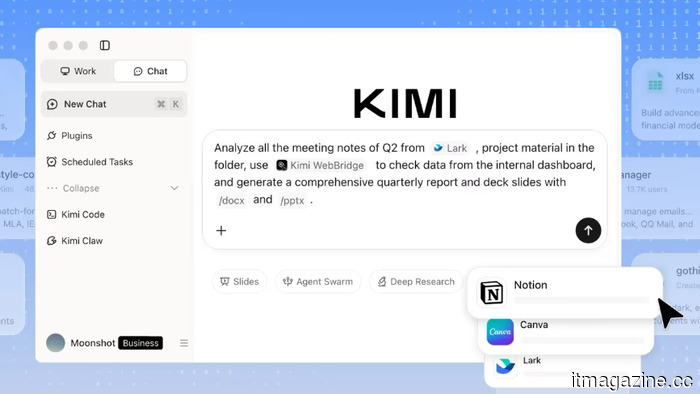 Moonshot intends to go public in Hong Kong within the next six months, aiming for a valuation of $30 billion.
Moonshot AI informed investors that it is getting ready for an IPO in Hong Kong within the next six months. As of June, its annual recurring revenue reached $300 million. The latest funding round has valued the company at more than $30 billion.
Moonshot intends to go public in Hong Kong within the next six months, aiming for a valuation of $30 billion.
Moonshot AI informed investors that it is getting ready for an IPO in Hong Kong within the next six months. As of June, its annual recurring revenue reached $300 million. The latest funding round has valued the company at more than $30 billion.
 The Call of Duty film takes place in the Modern Warfare universe and has the potential to spawn an entire franchise.
Taylor Sheridan and Peter Berg are adapting the Modern Warfare narrative for the big screen, as Paramount seeks to expand a wider Call of Duty universe.
The Call of Duty film takes place in the Modern Warfare universe and has the potential to spawn an entire franchise.
Taylor Sheridan and Peter Berg are adapting the Modern Warfare narrative for the big screen, as Paramount seeks to expand a wider Call of Duty universe.
The Company Brain and the future of market entry strategy.
AI agents integrated into legacy CRMs are amplifying flawed playbooks instead of rectifying them. What revenue teams truly require is a centralized Company Brain that disseminates memory and judgment among all agents, representing the necessary shift in architecture.