
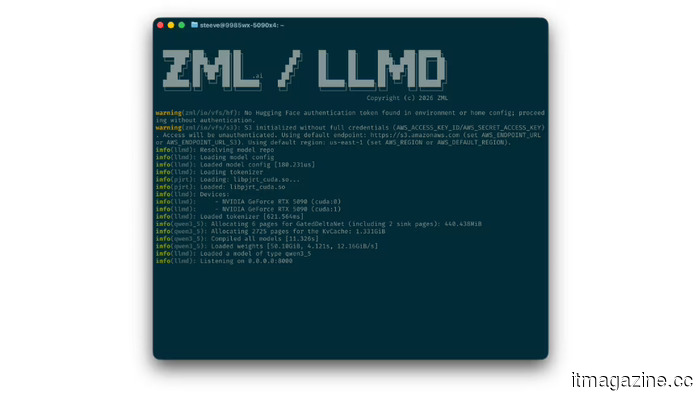
ZML's complimentary AI server operates on any leading chip.
A startup based in Paris aims to diminish Nvidia’s dominance in AI, not by developing a new chip, but through software. ZML has launched a free tool that operates open-source models rapidly across various platforms including Nvidia, AMD, Google, Apple, and Intel.
Though Nvidia currently leads in AI hardware, its control is becoming less secure. According to TechCrunch, ZML, a Parisian startup supported by AI pioneer Yann LeCun, has introduced free software that facilitates the operation of open-source language models on a diverse range of chipsets. This range includes five different targets: Nvidia, AMD, Google’s TPUs, Intel, and Apple.
The tool, named ZML/LLMD, serves as an inference server. Inference refers to the process of executing a trained model to respond to inputs, which currently consumes the majority of computing resources. Founder Steeve Morin stated that the objective is to dismantle the barriers that confine users to a specific vendor and to maximize the performance of each chip.
The importance of utilizing a variety of chips lies primarily in cost. As AI expenses increase, companies and cloud services seek the flexibility to choose less expensive or energy-efficient silicon for specific tasks. “The aim is to empower people to construct their own systems,” Morin explained. Achieving this effectively could serve as a significant advantage against Nvidia's stronghold.
This innovation might also benefit a surge of emerging chip manufacturers, many located in Europe. Morin mentioned companies such as Axelera, Fractile, Kalray, SiPearl, and VSORA, among others. Software that recognizes their chips as primary options rather than inferior ones provides customers with valid incentives to explore them.
The competition is fierce and expensive. Morin does not dismiss Nvidia's influence and notes that ZML maintains a positive rapport with the chip leader. However, the market is crowded. The “inference gold rush” has led to competitors like Baseten, recently valued at $13 billion, along with the teams behind open-source projects like vLLM and SGLang, all pursuing the same goal of reducing AI operating costs.
Morin believes ZML has a broader vision. “We have reached the stage where we are co-designing silicon,” he remarked. His nimble team of 20 has quickly delivered results, with more updates on the horizon.
The significance of LLMD lies in its current availability for free, aimed at building user engagement rather than being a paid product at this time. Its unique origin sends a broader message. A tool designed to weaken Nvidia’s hold and to bolster Europe’s AI infrastructure emerged from Paris, not Silicon Valley. Morin, who secured $20 million from investors including Xavier Niel’s Kima Ventures, stated clearly, “I couldn’t do ZML anywhere but in Paris.”
Other articles
 According to Gartner, customers favor ChatGPT over company chatbots.
According to Gartner, customers are three times more inclined to utilize third-party Generative AI tools like ChatGPT instead of company chatbots for support, as the returns on AI investments are delayed compared to the expenditures.
According to Gartner, customers favor ChatGPT over company chatbots.
According to Gartner, customers are three times more inclined to utilize third-party Generative AI tools like ChatGPT instead of company chatbots for support, as the returns on AI investments are delayed compared to the expenditures.
 Cloudflare and OpenAI are collaborating on a pilot project to enhance the freshness of AI search results.
Cloudflare is collaborating with OpenAI to integrate real-time network signals into ChatGPT's search, marking a shift for a company that was founded on preventing AI crawlers.
Cloudflare and OpenAI are collaborating on a pilot project to enhance the freshness of AI search results.
Cloudflare is collaborating with OpenAI to integrate real-time network signals into ChatGPT's search, marking a shift for a company that was founded on preventing AI crawlers.
 The GhostApproval bug disrupts six leading AI coding agents.
Wiz's 'GhostApproval' employs an outdated symlink technique to enable six AI coding agents, ranging from Amazon Q to Cursor, to operate beyond the sandbox and transfer ownership of the box.
The GhostApproval bug disrupts six leading AI coding agents.
Wiz's 'GhostApproval' employs an outdated symlink technique to enable six AI coding agents, ranging from Amazon Q to Cursor, to operate beyond the sandbox and transfer ownership of the box.
 Gartner has found that customers favor ChatGPT over company chatbots.
According to Gartner, customers are three times more likely to utilize third-party generative AI such as ChatGPT for support compared to company chatbots, as the returns on AI investments are slower than the expenditures.
Gartner has found that customers favor ChatGPT over company chatbots.
According to Gartner, customers are three times more likely to utilize third-party generative AI such as ChatGPT for support compared to company chatbots, as the returns on AI investments are slower than the expenditures.
 NATO engages Accenture and Leonardo for a secure cloud project valued at €200 million.
NATO has finalized a seven-year agreement worth approximately €200 million with Accenture and Leonardo to create a secure cloud infrastructure, known as the Protected Business Network, for the Alliance.
NATO engages Accenture and Leonardo for a secure cloud project valued at €200 million.
NATO has finalized a seven-year agreement worth approximately €200 million with Accenture and Leonardo to create a secure cloud infrastructure, known as the Protected Business Network, for the Alliance.
 Mark Cuban: Lovable and Replit have the potential to endure beyond the AI labs.
During the RAISE Summit, Mark Cuban contended that vibe-coding tools such as Lovable and Replit can endure against Anthropic and OpenAI by taking control of the workflow rather than merely the code.
Mark Cuban: Lovable and Replit have the potential to endure beyond the AI labs.
During the RAISE Summit, Mark Cuban contended that vibe-coding tools such as Lovable and Replit can endure against Anthropic and OpenAI by taking control of the workflow rather than merely the code.
ZML's complimentary AI server operates on any leading chip.
France's ZML has launched ZML/LLMD, a free inference server that operates open-source AI at high speed on Nvidia, AMD, Google, Intel, and Apple processors.