
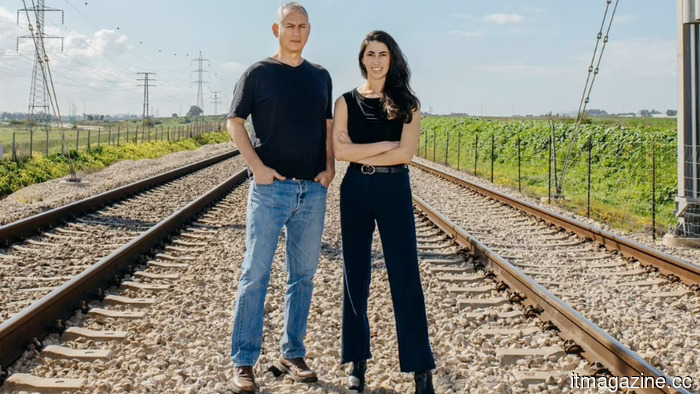
Beyond cables and batteries: Voltify's innovative approach to electrifying freight rail.
Freight rail is frequently seen as the most energy-efficient option for transporting goods across land, yet it relies on one of the least clean sources in modern infrastructure: diesel. With rail operators confronting rising fuel costs, stricter emissions regulations, and aging locomotive fleets, the discussion has shifted from whether rail should decarbonize to how it can achieve that goal.
One company believes the industry has been tackling the issue incorrectly. Co-founded by Daphna Langer, Voltify aims to bypass traditional electrification methods, focusing on electrifying freight rail without having to reconstruct the entire network or compromising operational range.
The Electrification Trap
The idea of electrifying rail seems straightforward in theory: replace diesel locomotives with electric ones and connect them to renewable energy sources. However, in practice, the freight rail system in the United States encompasses about 140,000 miles of privately owned tracks, making comprehensive overhead electrification via catenary wire financially unfeasible. This method works well for densely populated passenger routes but is impractical given the scale and fragmentation of freight networks.
Using battery-electric locomotives appears to be a simpler alternative, but it brings a new limitation: energy density. Batteries hold less energy per kilogram than diesel fuel—over ten times less—which means a locomotive reliant solely on batteries quickly faces range issues unless it can be recharged often. This creates an operational bottleneck: trains must either stop frequently or carry too much battery weight to be economically viable.
Thus, the industry finds itself caught between two unsatisfactory options: “electrify everything” or “charge at a depot for extended periods.”
Leapfrogging Conventional Electrification
Voltify proposes that freight rail doesn't need to decide between comprehensive electrification and battery-only locomotives. Instead, it reexamines the necessity of electrification, combining battery-electric locomotives with strategically placed charging infrastructure that powers trains while they operate.
The central concept is scale compression. Rather than electrifying the entire rail network, Voltify's model electrifies only a small portion of the track using high-power charging segments that provide energy as trains move. The un-electrified sections are supported by onboard battery storage. Static charging at depots enhances this dynamic charging system, allowing locomotives to recharge during natural breaks in operations.
This perspective redefines electrification not as a complete infrastructure overhaul, but as a selective enhancement of the most valuable segments of the rail network.
A Three-Pillar System
Voltify's framework consists of three closely integrated components: locomotives, charging infrastructure, and energy systems.
The first component is the locomotive. Instead of creating entirely new locomotives, Voltify retrofits existing diesel units into battery-electric versions. This strategy minimizes capital expenditure and makes use of the current asset base in the rail sector.
The second component is the charging infrastructure. Voltify employs an overhead conductor bar and pantograph system that provides both static and dynamic charging, supported by an unmanned setup ideal for rail environments. A manual charger acts as a supplement for energy replenishment at depots. The aim is not continuous electrification but rather targeted, high-capacity energy transfer where trains typically pass or stop.
The third component is power and optimization. Voltify integrates solar power, grid electricity, and battery storage into localized microgrids. These microgrids are controlled by proprietary software that dynamically determines the best times to purchase, store, or distribute electricity based on cost and demand.
Together, these components create a system designed not only for electrification but also for energy management.
Where the Business Case Actually Works
While the narrative of decarbonization is appealing, Voltify's primary advantage lies in its economic feasibility.
Diesel constitutes one of the largest and most unpredictable operating costs for rail operators. Voltify asserts that its system can decrease energy expenses by up to 30%, reframing electrification as a means to improve operating margins rather than solely serving sustainability goals. For Class I railroads, where fuel represents a significant operating cost, the chance to lower energy expenditures without overhauling the network presents a compelling financial opportunity.
Regulatory pressure related to local air quality is another motivator. Though freight rail accounts for a relatively small portion of global CO2 emissions, locomotives release nitrogen oxides and diesel particulate matter that significantly impact air quality in rail yards and nearby communities. These facilities are often located next to densely populated, low-income neighborhoods, making emissions a local health crisis rather than a global concern.
The Concentration Problem
The critical detail in rail emissions is not their overall quantity but their geographical impact.
Rail yards operate continuously, with switcher locomotives idling and maneuvering in fixed locations often adjacent to residential areas. This results in concentrated exposure to pollutants, such as NOx and soot. Studies on rail-related pollution have linked it to major public health costs across the country, including thousands of premature deaths each year and tens of billions of dollars in health damages.
In California, investigations
Other articles
 Judge affirms verdict in investor fraud case involving Musk and Twitter.
A federal judge dismissed Elon Musk's attempt to overturn the verdict that he deceived Twitter investors in 2022, keeping the potential damages of up to $2.6 billion at stake.
Judge affirms verdict in investor fraud case involving Musk and Twitter.
A federal judge dismissed Elon Musk's attempt to overturn the verdict that he deceived Twitter investors in 2022, keeping the potential damages of up to $2.6 billion at stake.
 Utah's AI prescription program raises concerns among its medical board.
Utah has become the first state in the US to allow an AI chatbot to renew prescriptions without the involvement of a doctor. However, the state's medical board is requesting that the Doctronic pilot program be paused.
Utah's AI prescription program raises concerns among its medical board.
Utah has become the first state in the US to allow an AI chatbot to renew prescriptions without the involvement of a doctor. However, the state's medical board is requesting that the Doctronic pilot program be paused.
 The Expense of Tool Overload: The Reason Companies Are Moving Away from Numerous Applications
Relying on different applications for each task in the workplace can subtly increase expenses and complications. Bitrix24 is convinced that there's a more efficient approach to creating a modern workspace with a comprehensive business suite.
The Expense of Tool Overload: The Reason Companies Are Moving Away from Numerous Applications
Relying on different applications for each task in the workplace can subtly increase expenses and complications. Bitrix24 is convinced that there's a more efficient approach to creating a modern workspace with a comprehensive business suite.
 Before Apple, Caviar is showcasing the luxurious foldable iPhone Ultra.
Caviar is not holding out for Apple’s initial foldable iPhone, unveiling a luxury collection of 19 units inspired by the speculated iPhone Ultra.
Before Apple, Caviar is showcasing the luxurious foldable iPhone Ultra.
Caviar is not holding out for Apple’s initial foldable iPhone, unveiling a luxury collection of 19 units inspired by the speculated iPhone Ultra.
 Before Apple, Caviar is unveiling the foldable iPhone Ultra with a touch of luxury.
Caviar is not holding off for Apple's initial foldable iPhone, as it unveils a luxurious collection of 19 units inspired by the speculated iPhone Ultra.
Before Apple, Caviar is unveiling the foldable iPhone Ultra with a touch of luxury.
Caviar is not holding off for Apple's initial foldable iPhone, as it unveils a luxurious collection of 19 units inspired by the speculated iPhone Ultra.
 Forget about streaks; this free iOS app connects your workouts to the survival of a city.
A new fitness application named LightsOn offers users a virtual city that remains illuminated only as long as they keep active.
Forget about streaks; this free iOS app connects your workouts to the survival of a city.
A new fitness application named LightsOn offers users a virtual city that remains illuminated only as long as they keep active.
Beyond cables and batteries: Voltify's innovative approach to electrifying freight rail.
Voltify, co-founded by Daphna Langer, is developing a three-pronged approach consisting of battery-electric locomotive retrofits, dynamic in-motion charging sections, and microgrid energy management to electrify freight rail without the need to reconstruct the entire infrastructure.