
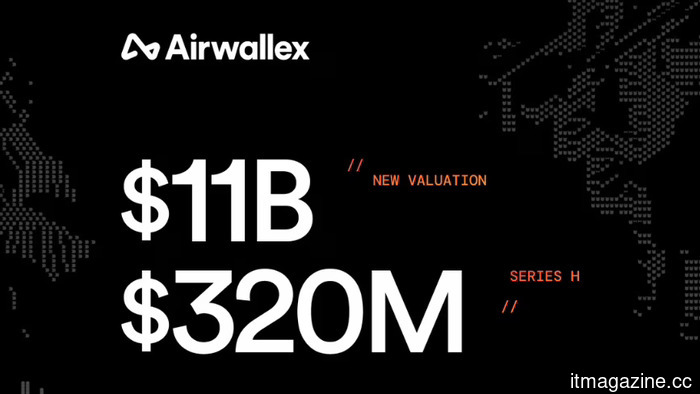
Airwallex secures $320 million with an $11 billion valuation.
Airwallex has secured $320 million in a Series H funding round, bringing its valuation to $11 billion, a significant increase from the $8 billion recorded in December 2025. The payments company is now shifting its focus towards “autonomous finance” and AI agents that can perform transactions on users' behalf.
The Series H funding, led by returning investor Addition, marks a rapid rise in valuation for Airwallex, which has increased by $3 billion in approximately six months. The funds are intended to facilitate a transition from simply facilitating money movement to managing finances directly, with AI taking on operational tasks.
The roster of investors participating in this round is impressive, including Baillie Gifford, Hummingbird, QED Investors, T. Rowe Price, Hedosophia, Haun Ventures, Washington University in St. Louis, and Amex Ventures. This group comprises a combination of crossover funds, fintech experts, and a crypto investor focused on agent payments.
According to Airwallex, the new funding will expedite its venture into autonomous finance, allow for expansion into new regulatory markets, and enhance the teams developing its AI-driven financial software.
As for business performance, Airwallex is experiencing rapid growth. By March 2026, it achieved an annualized revenue of $1.3 billion, marking a 74% increase year-on-year, with annualized transaction volume hitting $287 billion, a rise of over 120%.
The platform is becoming more integrated, with over 90% of its revenue now generated from clients utilizing multiple Airwallex services. This cross-selling strategy is highly valued by investors, as it enhances the lifetime value of customer accounts.
Currently, Airwallex provides services to over 676,000 businesses worldwide, either directly or through platform partnerships. Its offerings include payment acceptance, billing, global accounts, corporate cards, and spend management. Founded in Melbourne in 2015, the company now holds over 85 licenses across various regions including North America, Europe, the Middle East, and Asia-Pacific, operating from San Francisco and Singapore with a workforce exceeding 2,300 across 27 offices.
The company’s latest pitch extends beyond just payments. Airwallex believes that the licenses and settlement infrastructures it developed over the past decade are essential for an AI-driven economy, and it now aims to establish the intelligent layer that will operate above them.
Co-founder and CEO Jack Zhang remarked, “We believe this is the most consequential moment in the history of global finance, and we are building accordingly. A decade ago, we did not know exactly what the agentic economy would look like, but we built a foundation for it.”
To illustrate their vision, Airwallex has introduced two new products. The first, T:0, is an AI-native finance platform designed to manage a company's entire financial operations. It automates tasks such as bookkeeping, forecasting, tax management, compliance, and reporting right from the start and is currently in private beta testing.
Zhang's message regarding T:0 is straightforward. He aims for company founders to achieve “CFO-grade books” without needing to employ a finance team or overhaul existing systems. This approach directly addresses the fragmented tools that smaller businesses typically use.
Additionally, Airwallex has been enhancing its capabilities through acquisitions. Earlier in June, it acquired Leapfin, a revenue-recognition and reconciliation platform to convert raw transaction data into GAAP-compliant financials. This acquisition aligns perfectly with T:0's objectives.
The rationale behind Airwallex's strategy comes from a principle that Zhang frequently emphasizes: the AI era has no geographic boundaries. Small teams can now operate globally from the outset, often managed by only a few individuals and a suite of automated agents. Airwallex aims to serve as their financial department.
The second product introduced is Airi, an agentic consumer wallet. At its launch, it integrates Airwallex’s one-click checkout feature, which has reportedly improved successful checkout conversions by up to 14% in initial tests.
Looking ahead, Airwallex envisions Airi evolving into a wallet infrastructure for software agents that make purchases on behalf of consumers. This will involve delegated payments, spending limits, permission controls, and multi-currency balances, all facilitated through regulated networks.
The underlying reasoning is straightforward: AI agents require a secure, global channel to access real currency, whether fiat or stablecoins, and Airwallex aims to fulfill that need.
In this competitive landscape, Airwallex is not the only contender. The race to dominate the payment infrastructure for AI agents has become one of the most heated battles in the fintech sector. Major players are already making moves; Stripe has modified its Link wallet for agents and demonstrated stablecoin transactions for agent-to-agent payments. OpenAI has partnered with Visa, enabling its agents to shop and make payments across numerous merchants, while Mastercard, PayPal, and Google are also developing competing protocols.
Smaller companies are
Other articles
 Cannes insights: What a two-time major champion understands about marketing that CMOs might overlook.
During Cannes Lions, Bryson DeChambeau advocated for athletes as creators. The true narrative lies in the strategy behind the slogans.
Cannes insights: What a two-time major champion understands about marketing that CMOs might overlook.
During Cannes Lions, Bryson DeChambeau advocated for athletes as creators. The true narrative lies in the strategy behind the slogans.
 Brussels engaged in discussions with Washington concerning Anthropic's access following the Fable 5 prohibition.
Brussels engaged in discussions with Washington regarding Anthropic after a US export-control directive restricted Europe's access to Fable 5 and Mythos 5, which also affected ENISA.
Brussels engaged in discussions with Washington concerning Anthropic's access following the Fable 5 prohibition.
Brussels engaged in discussions with Washington regarding Anthropic after a US export-control directive restricted Europe's access to Fable 5 and Mythos 5, which also affected ENISA.
.jpg) Top 10 contract management software solutions for 2026 (comparison)
A ranked evaluation of the top 10 contract management software solutions for 2026, assessed based on AI-driven review, repository search capabilities, renewal management, and workflow automation. This includes pricing details, advantages, disadvantages, and key features for each platform.
Top 10 contract management software solutions for 2026 (comparison)
A ranked evaluation of the top 10 contract management software solutions for 2026, assessed based on AI-driven review, repository search capabilities, renewal management, and workflow automation. This includes pricing details, advantages, disadvantages, and key features for each platform.
 Airwallex secures $320 million, reaching an $11 billion valuation.
Airwallex has secured $320 million at an $11 billion valuation, increasing from $8 billion, and is shifting its focus towards autonomous finance and AI agents that conduct transactions on your behalf.
Airwallex secures $320 million, reaching an $11 billion valuation.
Airwallex has secured $320 million at an $11 billion valuation, increasing from $8 billion, and is shifting its focus towards autonomous finance and AI agents that conduct transactions on your behalf.
 Alan secures €480 million in funding, with Prosus leading the round at a valuation of €5.5 billion.
Alan has secured €480 million, with Prosus leading the investment at a valuation of €5.5 billion, just a few months after its previous funding round, as the French insurtech focuses on AI-driven prevention.
Alan secures €480 million in funding, with Prosus leading the round at a valuation of €5.5 billion.
Alan has secured €480 million, with Prosus leading the investment at a valuation of €5.5 billion, just a few months after its previous funding round, as the French insurtech focuses on AI-driven prevention.
 Apple increases prices for Mac and iPad as the AI memory shortage impacts retail.
Tim Cook states that Apple's price hikes are 'inevitable' due to the rising costs of memory chips driven by AI demand. The starting price of the Mac mini has already increased.
Apple increases prices for Mac and iPad as the AI memory shortage impacts retail.
Tim Cook states that Apple's price hikes are 'inevitable' due to the rising costs of memory chips driven by AI demand. The starting price of the Mac mini has already increased.
Airwallex secures $320 million with an $11 billion valuation.
Airwallex has successfully secured $320 million at an $11 billion valuation, an increase from its previous $8 billion valuation, and is shifting its focus towards autonomous finance and AI agents that handle transactions on your behalf.