
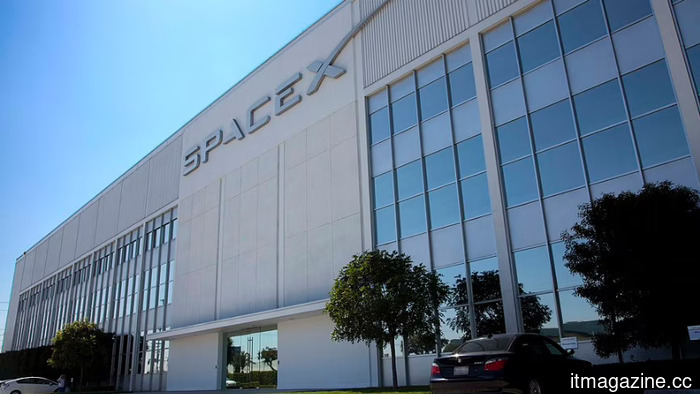
SpaceX shares decline once more as the surge following the IPO continues to diminish.
Shares of SpaceX appeared set to decline again as US markets reopened following the extended weekend, continuing a downward trend that has diminished much of the excitement surrounding the largest stock-market debut in history. The stock closed last week at approximately $185, down about 18 percent from the $225.64 peak it reached on June 16, just four days after its Nasdaq listing under the ticker SPCX.
The rapid fluctuations have been notable even for a high-profile IPO. SpaceX priced its shares at $135 on June 12, raising around $75 billion, and experienced a remarkable 67 percent surge in its first three trading sessions before any quarterly report was released. However, it dropped 5 percent the following Wednesday and 3.6 percent on Thursday, marking its first two-day decline as a public entity, before trading was halted due to the Juneteenth holiday.
The reasons behind this trend are more mechanical than fundamental. A very small portion of SpaceX shares are actively trading; roughly 4 percent is available for exchange, while the remainder is restricted under a staggered schedule that won’t start to ease until around the company’s first earnings report this summer and won’t fully unlock until well into next year. This limited float amplifies price movements: it contributed to the stock’s 67 percent rise on modest trading volume, and it can equally reverse course when sentiment shifts.
Two main factors contributed to this change. On June 17, the first put options for SPCX began to trade, giving skeptics a practical avenue to bet against a stock that had previously been nearly impossible to short due to the scarcity of available shares. Additionally, the day before, SpaceX announced plans to acquire Anysphere, the creator of the AI coding tool Cursor, for $60 billion in an all-stock transaction, which immediately diluted the shares for those who had purchased in the open market just days before.
The Cursor acquisition also raised questions about the company’s valuation. SpaceX's pricing suggested a revenue multiple of around 100 times, a figure that appears reasonable only as a speculative bet on Starlink, Starship, and the xAI artificial-intelligence division that merged into the company earlier this year, rather than based on current earnings. Spending $60 billion of newly public stock shortly after the IPO to acquire an AI business indicated to investors management’s belief about where growth must come from and their willingness to dilute shareholders to achieve it.
The underlying financials tell a significant story. Starlink, SpaceX's satellite internet division, which is its closest source of steady revenue, generated $11.4 billion last year, but its average revenue per user has been diminishing, dropping to about $66 per month in the first quarter from $86 a year prior. The company remains unprofitable on a GAAP basis, with the xAI division recording a $4.9 billion net loss—this disparity between price and fundamentals is what bears are emphasizing.
Moreover, a dual-class structure gives Elon Musk approximately 79 percent of the voting power with about 42 percent of the equity, leaving open-market shareholders, who are currently experiencing volatility, with little influence over the decisions impacting the stock.
Not everyone is convinced that the debut accurately reflected the company's true value. Gary Black of The Future Fund characterized the initial trading of SPCX as more akin to a meme stock than a security based on fundamentals, a perspective made easier by the lack of short positions and options during the initial trading days. Morningstar had already assessed the fair value at a much lower level than the IPO price. Our coverage showed the same trajectory, from a highly oversubscribed book to the record Nasdaq debut, followed by an initial 6 percent decline as the fervor waned.
The more significant challenge lies ahead. The same lock-up arrangement that has kept supply limited will begin releasing shares in the coming months, and a stock that rose from $135 to $225 on a 4 percent float will face a different market once the remaining 96 percent can be sold. For now, the decline represents the rally reversing.
Whether SpaceX will be valued based on its Starlink revenue or the narrative it presented at $135 is the question that will be resolved in the next few months.
Other articles
 Baden Bower monitors 12,040 AI citations across six different engines to rank the leading publications for AI visibility.
A recent index scoring 12,040 citations from ChatGPT, Perplexity, Claude, Gemini, Google AI Overviews, and Copilot reveals that editorial sources lead in AI responses, with Forbes at the top and press release services ranked lower.
Baden Bower monitors 12,040 AI citations across six different engines to rank the leading publications for AI visibility.
A recent index scoring 12,040 citations from ChatGPT, Perplexity, Claude, Gemini, Google AI Overviews, and Copilot reveals that editorial sources lead in AI responses, with Forbes at the top and press release services ranked lower.
 The Bank of England relaxes its strict regulations on stablecoins.
In response to feedback from the industry, the Bank of England has abandoned its initial plan for individual holding limits on stablecoins and has opted for limits on issuance based on the issuer instead.
The Bank of England relaxes its strict regulations on stablecoins.
In response to feedback from the industry, the Bank of England has abandoned its initial plan for individual holding limits on stablecoins and has opted for limits on issuance based on the issuer instead.
 Spiro secures $55 million from China's NewTrails as it approaches a valuation of $1 billion.
Spiro has secured $55 million from the Chinese investor NewTrails Capital, bringing its total disclosed funding to over $550 million as it approaches a $1 billion valuation.
Spiro secures $55 million from China's NewTrails as it approaches a valuation of $1 billion.
Spiro has secured $55 million from the Chinese investor NewTrails Capital, bringing its total disclosed funding to over $550 million as it approaches a $1 billion valuation.
 Is it possible for an ice machine to cool an Nvidia RTX GPU during gaming? A bold modification demonstrates that it can.
A YouTuber transformed a countertop ice machine into a personalized cooler for an Nvidia RTX 3060, reducing the temperatures of Cyberpunk 2077 from approximately 60 degrees to between 22 and 23 degrees Celsius.
Is it possible for an ice machine to cool an Nvidia RTX GPU during gaming? A bold modification demonstrates that it can.
A YouTuber transformed a countertop ice machine into a personalized cooler for an Nvidia RTX 3060, reducing the temperatures of Cyberpunk 2077 from approximately 60 degrees to between 22 and 23 degrees Celsius.
 Baden Bower monitors 12,040 AI citations across six platforms to rank leading publications for AI prominence.
A recent index, which tallied 12,040 citations from ChatGPT, Perplexity, Claude, Gemini, Google AI Overviews, and Copilot, reveals that editorial sources lead in AI responses, with Forbes taking the top spot and press release wires ranking towards the bottom.
Baden Bower monitors 12,040 AI citations across six platforms to rank leading publications for AI prominence.
A recent index, which tallied 12,040 citations from ChatGPT, Perplexity, Claude, Gemini, Google AI Overviews, and Copilot, reveals that editorial sources lead in AI responses, with Forbes taking the top spot and press release wires ranking towards the bottom.
 Epic is enhancing its game launcher with a much-needed speed increase and a variety of new features.
Epic is revamping its Games Store launcher entirely, aiming for quicker startup times, enhancements in download speeds in the future, player reviews, profiles, and additional features for the store.
Epic is enhancing its game launcher with a much-needed speed increase and a variety of new features.
Epic is revamping its Games Store launcher entirely, aiming for quicker startup times, enhancements in download speeds in the future, player reviews, profiles, and additional features for the store.
SpaceX shares decline once more as the surge following the IPO continues to diminish.
SpaceX shares have declined to around $185 after reaching a high of $225, as a limited float, new short-selling mechanisms, and a $60 billion Cursor deal dampen investor enthusiasm.