
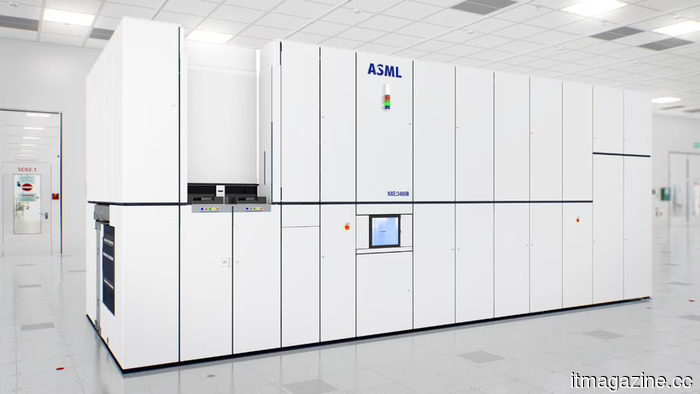
The United States claims that a chip tool from ASML is located in China, but ASML refutes this.
The United States has accused the only company in the world that manufactures the advanced machines used for cutting-edge chips of allowing one to enter China. However, the US has not provided evidence, and the company maintains that such an event never occurred.
In recent discussions, Commerce Secretary Howard Lutnick informed ASML’s top executives that Washington suspects one of its state-of-the-art lithography machines may have been transferred to China, potentially breaching US-led export regulations. The Dutch company, which has a nearly total monopoly on the technology, has refuted the claim.
What the US alleges is reflected in reports from Bloomberg, indicating that Lutnick's team believes they possess proof that ASML sent EUV-related components and equipment to China, yet they have consistently refused to disclose this evidence.
Extreme ultraviolet (EUV) machines are crucial for manufacturing the most advanced semiconductors, and ASML is the sole producer of these machines. Since approximately 2019, these machines have been prohibited from being exported to China, and this conflict marks another development in the ongoing chip rivalry that has frequently involved the Dutch firm.
ASML has responded to the allegations with a pointed denial. The company has distributed a document in Washington asserting, “No indication of any ASML EUV system in China,” and emphasizes that it has “never shipped an EUV machine to China,” nor any “component, module, or equipment specifically designed for use in an EUV machine.”
The accusation appears contradictory when considering commercial realities. ASML's export license is vital for its survival; despite decreasing revenue from China, which now constitutes about one-fifth of its income, it remains the firm’s largest market. Sacrificing that license to benefit a single Chinese client would be akin to corporate suicide. This raises a significant question: a serious allegation lacks public evidence, and the accused has strong incentives not to engage in the alleged misconduct.
This dispute arises as Washington intensifies pressure on its allies. A proposed US law would compel the Netherlands and Japan to align their export regulations with those of the US or face unilateral action, with President Trump reportedly urging the Dutch government firmly.
The situation is further complicated for ASML, as its future increasingly aligns with American interests. The company has recently agreed to assist in constructing Elon Musk’s $55 billion “Terafab” chip facility in Texas, even as the US ramps up enforcement efforts.
For ASML, the implication is that mere compliance may not suffice anymore. The company must now demonstrate a negative on Washington’s timeline, with a valuation around $700 billion and its business in China at stake.
Unless the US corroborates its claims, there remains a standoff regarding the uncertain status of one machine that may or may not be where it should not be, with the entire Western initiative to prevent advanced chip manufacturing from reaching China hinging on this outcome.
Другие статьи
 Google is adopting Nvidia's strategy to challenge its dominance in the AI chip market.
Google is adopting Nvidia's strategy by employing financial incentives and circular financing to attract customers for its TPUs and to reduce its dominance in the AI chip market.
A startup claims it has solved the obstacle that was hindering AI progress.
Miami-based startup Subquadratic asserts that its SubQ model overcomes the limitations of 'quadratic attention.' Independent evaluations support many of its claims, though skepticism persists.
Google is adopting Nvidia's strategy to challenge its dominance in the AI chip market.
Google is adopting Nvidia's strategy by employing financial incentives and circular financing to attract customers for its TPUs and to reduce its dominance in the AI chip market.
A startup claims it has solved the obstacle that was hindering AI progress.
Miami-based startup Subquadratic asserts that its SubQ model overcomes the limitations of 'quadratic attention.' Independent evaluations support many of its claims, though skepticism persists.
 Jio submits application for India's largest IPO and a competitor to Starlink.
Reliance Jio has submitted an application for what may become India's largest IPO in history, and at the same Annual General Meeting, it also introduced a $15 billion satellite network aiming to compete with Starlink.
Jio submits application for India's largest IPO and a competitor to Starlink.
Reliance Jio has submitted an application for what may become India's largest IPO in history, and at the same Annual General Meeting, it also introduced a $15 billion satellite network aiming to compete with Starlink.
 Jio submits application for India's largest IPO and a competitor to Starlink.
Reliance Jio has submitted documents for what might be the largest IPO in India’s history and took the opportunity at the same AGM to announce a $15 billion satellite network aimed at competing with Starlink.
Jio submits application for India's largest IPO and a competitor to Starlink.
Reliance Jio has submitted documents for what might be the largest IPO in India’s history and took the opportunity at the same AGM to announce a $15 billion satellite network aimed at competing with Starlink.
The United States claims that a chip tool from ASML is located in China, but ASML refutes this.
Commerce chief Howard Lutnick states that one of ASML's leading chip manufacturing machines might have arrived in China. However, ASML maintains that it has never delivered an EUV tool to the country.